Summary
Micron's Clay megafab will generate real demand for housing, lodging, retail and supplier space across Central New York, but that demand arrives on the schedule of the build, not the announcement, so every Micron-area project should be underwritten to operational hiring rather than to the headline. First-fab operations are now expected around 2030, the full campus not until roughly 2041, and the permanent workforce of about 9,000 fab employees not until approximately 2045, with only the first two fabs, on the order of $50 billion of the up to $100 billion program, contractually committed.
The metro reads soft, with apartment vacancy of roughly 7 percent and industrial vacancy near 6.7 percent, but the submarkets in Micron's commute shed are tight: North Syracuse and Liverpool rents grew about 3.5 percent against vacancy near 4 percent, only about 20 hotel rooms are under construction in the entire market, and the northern Onondaga retail submarket sits around 3 percent vacancy. With cap rates near 8.5 percent for apartments, 8.8 percent for retail and 10 percent for industrial, new construction must beat buying existing stock, which makes SBA 7(a) and 504 loans, USDA Business and Industry loans and the $150 million Housing Central New York Fund central to what can be financed.
Written for Lenders and CDCs underwriting Micron-area projects, Developers of workforce housing, hotels and retail in Onondaga and Oswego counties, Micron suppliers planning build-to-suit facilities, Investors weighing a position in Central New York real estate. 22 minute read.
Key figures
- Average jobs per year across New York at full operation
- about 45,000 jobs per year
- REMI economic-impact study commissioned by Empire State Development, references 4 and 5At full operation of the campus
- Permanent Micron fab workforce at full ramp
- about 9,000 fab employees
- Final Environmental Impact Statement and Empire State Development / Micron projections, references 3 and 4First-fab operations around 2030; full workforce by approximately 2045
- North Syracuse and Liverpool apartment rent growth and vacancy
- rents up about 3.5 percent, vacancy near 4 percent
- MMCG market databasePast year, as of 2026 Q2
- Hotel rooms under construction in the Syracuse market
- only about 20 rooms
- MMCG market databaseMid-2026
- Syracuse cap rates by asset class
- apartments near 8.5 percent, retail near 8.8 percent, industrial near 10 percent, hotels above 10 percent
- MMCG market databaseMid-2026
- Housing Central New York Fund
- $150 million, targeting at least 2,500 workforce units
- Housing Central New York Fund launch by the Office of Governor Hochul, Empire State Development and the Community Preservation Corporation, reference 14Launched February 2026; no awards made as of the article
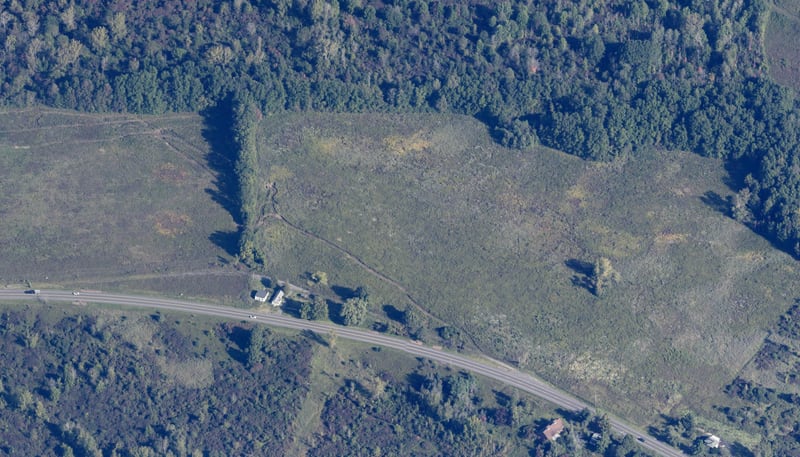
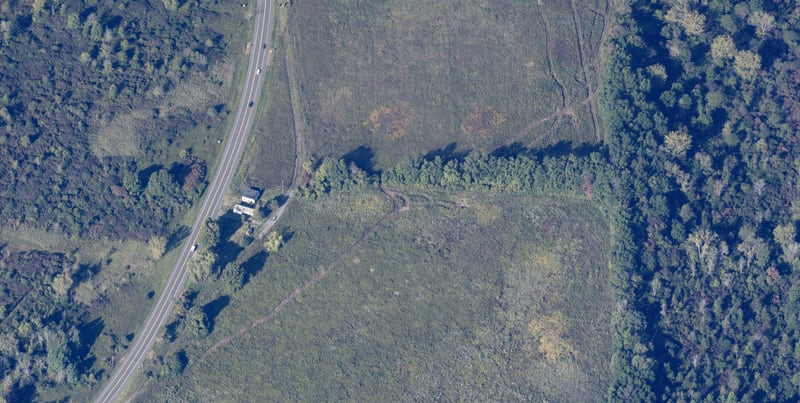
The proposed site at 5171 New York State Route 31, in the Town of Clay, Onondaga County, within close proximity to the proposed Micron semiconductor manufacturing campus (the "megafab") at White Pine Commerce Park, the largest economic-development project in Central New York's history. The parcel holds direct frontage on Route 31, the primary east-west arterial linking the established commercial corridor to the proposed factory, and sits squarely within the primary commute shed examined throughout this report. The land is predominantly open and level to gently rolling, characteristic of former agricultural land now carrying scattered brush, and is bordered by mature woodland along its northern and eastern edges. A small existing structure occupies the road frontage; the remainder of the parcel is undeveloped. Overhead utility lines run along the Route 31 frontage.
On a cold morning this past January, Micron Technology broke ground on a tract of former farmland at the White Pine Commerce Park in the Town of Clay, just north of Syracuse, formally starting what the company and New York State have framed as a commitment of up to $100 billion across four semiconductor fabrication plants.(1)(2) For the commercial real estate market across Central New York, that groundbreaking has been treated as a starting gun. Land that traded in five figures an acre a few years ago now changes hands in six. Brokers field calls about hotel pads and apartment sites tied to a workforce that, for the most part, has not been hired yet.
The enthusiasm is not misplaced. A project of this scale genuinely reshapes a regional economy, and the people who position early can do very well. But the record of comparable megaprojects, and the condition of the Syracuse market as it actually sits today, both argue for a particular kind of discipline. The headline numbers are real. They are also back-loaded, conditional, and routinely missed on their announced timelines. The developers who got hurt at projects like this one were almost always the ones who built to a future number in a thin market before the jobs arrived. Central New York is a thin, slow-growing market. So the opportunity has to be underwritten to operational hiring, not to press releases, and when the market is read at the submarket level rather than the metro headline, the picture turns out to be both more encouraging and more specific than the boomtown framing suggests.
What is actually committed
It is worth being precise about what Micron has and has not promised, because the difference governs everything downstream.
The "up to $100 billion" figure covers a four-fab program expected to build out over roughly two decades.(1) What is contractually committed today is the first phase, the first two fabs, representing on the order of $50 billion in investment. The remaining two fabs are real intentions, not signed obligations, and on the evidence of every peer project they will be built only when the memory market and Micron's customers justify them.
Timing matters more than headline dollars. The Final Environmental Impact Statement for the site, completed in late 2025, reflects a schedule that has already slipped by two to three years against the original announcement.(3) First-fab operations are now expected around 2030 rather than mid-decade; the full campus is not anticipated until roughly 2041; and the full permanent workforce of about 9,000 fab employees is not projected to be in place until approximately 2045.(3)(4) The supporting infrastructure tells the same story of a long build. A new 345-kilovolt transmission line cleared state regulatory approval in October 2025; a water-supply program drawing from Lake Ontario and a major wastewater upgrade, together approaching a billion dollars, sit on the project's critical path.(8)(9) Bechtel was named as the engineering and construction partner only this June.(10) Federal CHIPS Act funding, part of an award shared with Micron's Idaho site, and New York's own Green CHIPS package of incentives underwrite the economics, but they do not accelerate the physics of building four of the most complex factories on earth.(6)(7)
None of this diminishes the project. It simply means the demand it creates arrives on a 2030-and-beyond schedule, in stages, and conditionally, and any feasibility analysis that treats 2026 as the year the boom lands is mispricing the risk.
The jobs behind the number
The figure that travels fastest is "50,000 jobs." It is defensible, but it has to be unpacked, because it bundles together three very different kinds of demand that arrive at different times and support different real estate.
The roughly 50,000 figure comes from an economic-impact study commissioned by Empire State Development and modeled in REMI, which projected an average of about 45,000 jobs per year across New York at full operation, the large majority of them in Central New York, supporting on the order of $16.7 billion in annual output.(4)(5) That total is not 50,000 paychecks appearing at the fab gate. It layers a transient construction workforce, which can peak in the thousands per day during the most intense building periods, on top of the roughly 9,000 permanent Micron employees, on top of a wider band of indirect and induced jobs at suppliers, contractors, and the local businesses their spending supports.(4)(11) Micron and the state have set a local-hiring target near 80 percent and define the labor shed as a radius of roughly 90 miles, which usefully bounds where workers will actually live and spend.(11)
Two cautions follow. First, the construction cohort is real demand but finite demand: it wants extended-stay rooms, workforce lodging, fuel, and quick meals, and much of it sunsets as the campus is completed. Second, the often-cited national figure of around 90,000 jobs belongs to Micron's separate $200 billion U.S. vision and should never be conflated with the Clay site's regional impact.(12) For underwriting purposes, the number that matters is not the announced headline but the pace of operational hiring, and that pace is gated by the 2030 ramp.
+2 to 5 yrsTypical megafab slippage to stress-test
What the last megafabs taught
Central New York does not have to guess how this plays out. There is a usable record, and it is humbling.
The most directly relevant comparison sits about two hours east. GlobalFoundries opened its Fab 8 in Saratoga County in 2012, eventually employing on the order of 3,000 people, and in 2024 announced a further multibillion-dollar expansion.(16) Saratoga is, in many respects, the optimistic case, same state, same incentive regime, a county that was already growing. And yet local officials there describe a transformation that was real but far slower and smaller than promised. The town supervisor in Malta, where the fab sits, has put it plainly: the technology park that was supposed to fill with suppliers largely did not, and the explosive, sudden development everyone expected simply did not materialize on the timeline they imagined.(17) Home prices in Saratoga County did roughly double over a decade and a half, but the steepest gains came years after the fab opened and were heavily entangled with the pandemic-era migration that lifted the whole Northeast.(18)
The cautionary cases are sharper. Intel's "Silicon Heartland" outside Columbus was announced in 2022 at $20 billion and 3,000 direct jobs, with talk of a far larger buildout.(19) First-fab operations have since been pushed to roughly 2030 to 2031, and as of early 2026 the site employed a small fraction of the promised headcount.(19) The damage in that case fell on the local market: outside developers bought land to build housing and commercial space against a timeline that then slipped by years, and many of those projects were reconsidered or shelved.(19) Samsung's fab in Taylor, Texas was built to better than ninety percent completion and then sat largely idle, waiting on customers and tooling.(20) And the genre's worst outcome remains Foxconn in Wisconsin, where a community assembled land and borrowed heavily against a promised 13,000 jobs and ultimately saw closer to 1,200.(21)
- Announced at launch
- Realized to date
The numbers behind this chart
| Category | Announced at launch | Realized to date |
|---|---|---|
| Foxconn (Wisconsin) | 13000 | 1242 |
| Intel (Ohio) | 3000 | 162 |
| TSMC (Arizona) | 6000 | 3000 |
| GlobalFoundries (New York) | 3000 | 3000 |
The pattern across all of them is consistent and transferable. Induced real estate absorption tracks operational hiring, not announcements and not even construction. Where employers actually hired fast, in deep-capacity Sun Belt metros, the housing and retail response came within a year or two. Where the fab ramped slowly, the demand lagged its opening by five to ten years, and where developers committed ahead of operations in a thin market, capital got stranded. Syracuse and Onondaga County belong unambiguously in the slow-growth category alongside Saratoga and the Columbus exurbs, not Phoenix or Austin. That single classification should discipline every demand curve in a Micron-area feasibility study: apply meaningful haircuts to the announced jobs, push the timeline out, treat the third and fourth fabs as options rather than commitments, and underwrite essentially no induced absorption until the ramp and hiring are visibly underway.
The market as it sits
Here is where careful work separates from the boomtown narrative. Read at the metro level, the Syracuse market in mid-2026 looks soft, and a casual analyst could talk themselves out of the whole thesis. Read at the submarket level, the towns where Micron's workforce will actually live and the corridors their spending will actually reach, it looks tight in exactly the places that matter. The figures that follow are drawn from MMCG's market database.
Apartments
On paper the apartment market is the weakest it has been in years: vacancy of roughly 7 percent, well above its five-year average near 5.5 percent, with slightly negative net absorption over the past year. That headline is almost entirely a story about new luxury product in the City of Syracuse. Vacancy in the top tier of properties runs above 12 percent, and essentially all of the roughly 1,100 units now under construction sit inside the city, concentrated in the higher-rent tiers, more supply landing precisely where occupancy is already strained, in a downtown that is carrying vacancy above 11 percent.
The suburbs are a different market. In the North Syracuse and Liverpool submarket, directly in Micron's commute shed, rents have grown about 3.5 percent over the past year, the fastest in the metro, against vacancy near 4 percent and positive net absorption. Baldwinsville runs tighter still, with vacancy around 2.4 percent. The workforce-grade product that a technician's salary actually rents is the tightest segment in the entire market. In other words, nothing is being built into the very submarkets where Micron demand will concentrate, while everything under construction is chasing the one pocket that is already oversupplied. That is a far more useful finding than "Syracuse apartments are soft," and it points new development toward suburban, workforce and attainable product rather than another downtown luxury tower.
+3.5%Fastest rent growth (N. Syracuse / Liverpool)
The investment math reinforces the point. Apartments in this market trade at cap rates near 8.5 percent, at roughly $110,000 per unit, less than half the national figure, and sales volume over the past year ran at a quarter of its recent norm. At those values, with construction costs and debt where they are, it is simply cheaper to buy an existing building than to build a new one . New market-rate construction barely pencils. That reality is exactly why the subsidy architecture around this project matters so much, and why it is not a footnote.
The subsidy stack is substantial. A $150 million Housing Central New York Fund, launched in February 2026 and administered by the Community Preservation Corporation alongside the state, is targeting at least 2,500 workforce units across the six-county region, though it had not yet made awards as of this writing.(14) That sits on top of a $500 million community investment commitment tied to the Green CHIPS package and projects such as the redevelopment of the former Syracuse Developmental Center.(7)(15) Independent demand studies have put the regional need at somewhere between 20,000 and 30,000 housing units over the life of the project.(13) The gap between what the market will build unsubsidized and what the region will need is the whole game for residential developers here, and it is bridged with low-cost gap financing and tax-credit equity, not with market-rate construction loans alone. The one genuine demand-side caution: Oxford Economics projects the metro to lose roughly 8,000 residents between 2025 and 2029, and Micron is explicitly the bet that reverses that trajectory rather than a demographic tailwind already in hand.
Hotels
Lodging is the asset class most exposed to the construction cohort, and the current data is encouraging for a well-timed entrant for a reason that is easy to miss. The market runs at about 61 percent occupancy, an average daily rate near $138, and revenue per available room of roughly $85, up about 2.5 percent over the past year . More important than any of those levels is the pipeline: only about 20 rooms are under construction across the entire market. The several hundred rooms that have been floated around the county and at sites like the Great Northern Mall are announced or planned, not under construction, which means the much-discussed oversupply risk is a forward problem, not a present one. Today's market is tight and improving, which is precisely the condition under which a disciplined, demand-tied extended-stay project can work.
Segment and geography both matter. The upscale and upper-midscale tier, the natural home of the extended-stay and select-service product that suits both relocating engineers and construction crews, runs a healthy occupancy near 66 percent, while the midscale and economy tier is soft at around 53 percent, a caution for anyone tempted by a bare-bones flag. And the submarket surrounding the city, which includes the Micron side, has been growing revenue per room about 6 percent, far outpacing the airport cluster. The opportunity is real; the discipline is to size it to the construction timeline and let it sunset, and to recognize that hotels here trade above a 10 percent cap, which is a demanding hurdle for new hotel construction .
The numbers
| Category | Occupancy | RevPAR |
|---|---|---|
| Luxury & Upper Upscale | 70.1 | 151 |
| Upscale & Upper Midscale | 66.5 | 98 |
| Midscale & Economy | 52.9 | 50 |
Retail
Retail behaves exactly as the comparables predict: it follows rooftops, and rooftops follow the ramp. Metro rent growth has been under 1 percent, against nearly 2 percent nationally, and the mall segment is genuinely distressed at roughly 14.5 percent vacancy, the Great Northern Mall's reinvention is part of that story. But the neighborhood, strip, and pad formats that serve daily needs are tight, in the 2 to 3 percent range, and the single brightest spot in the entire retail market is the northern Onondaga submarket nearest the fab. It posted the strongest absorption in the metro over the past year, sits around 3 percent vacancy, and is the only northern submarket with retail actually under construction, fully preleased, along the Route 31 corridor. The read for retail is patience with timing but conviction on location: the quick-service, convenience, fuel, and grocery-anchored pad demand will arrive with the rooftops, and the northern corridor is already moving ahead of the metro. Retail here trades near an 8.8 percent cap.
Industrial
Industrial is the asset class most directly leveraged to Micron's supply chain, and it is also where the "wait for it" discipline is most important. On the surface the market is soft: vacancy near 6.7 percent, above its long-run level around 5 percent, with slightly negative net absorption over the past year as a few large blocks of space came back. Two things cut the other way, hard. First, almost nothing speculative is being built, on the order of 17,000 square feet under construction across a 74-million-square-foot market, against a ten-year average above 400,000. Second, rents are climbing far faster here than nationally: more than 4 percent over the past year against barely 1 percent for the country, and fastest of all, above 5 percent, in the northern submarket closest to the campus. The flex segment, the most likely fit for smaller suppliers and vendors, is the tightest of all at under 4 percent vacancy.
An empty construction pipeline paired with real pricing power is exactly the setup one wants ahead of a demand wave. But the wave itself is a function of when Micron's tooling, ramp, and supplier commitments actually land, and the relevant supplier space will largely be purpose-built rather than absorbed from older existing stock. Industrial here trades near a 10 percent cap at roughly $69 per square foot, a quarter of the national price, which again means the financeable opportunity is in owner-occupied, build-to-suit supplier facilities, not in buying aging flex product at a double-digit yield and hoping.
The numbers behind this chart
| Category | Rent growth (YoY) |
|---|---|
| U.S. average | 1.2 |
| Syracuse metro | 4.3 |
| Micron corridor (NE Outer Onondaga) | 5.4 |
The unifying thread across all four asset classes is that Syracuse trades wide, apartments near 8.5 percent, retail near 8.8 percent, industrial near 10 percent, hotels above 10 percent. Wide cap rates and low per-unit values mean new construction must clear a high bar simply to beat buying what already exists. That is the single most important fact for any investor, and it is why government-guaranteed financing and the public subsidy stack are not peripheral to the Micron opportunity. They are central to it.
- Syracuse
- U.S. average
The numbers behind this chart
| Category | Syracuse | U.S. average |
|---|---|---|
| Apartments | 8.6 | 5.8 |
| Retail | 8.8 | 7.4 |
| Industrial | 9.9 | 7.3 |
| Hospitality | 10.5 | 9.4 |
| Office | 12.1 | 9 |
How these deals get financed
The capital environment in mid-2026 is the backdrop against which all of this has to pencil, and it is not generous. The Federal Reserve has held its policy rate at 3.50 to 3.75 percent through the first half of the year, with the prime rate at 6.75 percent and little expectation of near-term cuts.(22) Money is expensive, lenders are selective, and untested submarkets get a harder look than stabilized ones. In that climate, the right financing structure is often what makes a Micron-area deal viable at all, and the structure is usually decided by three switches.
| Induced asset class | SBA 7(a) | SBA 504 | USDA B&I | Conventional | Agency | HUD / FHA |
|---|---|---|---|---|---|---|
| Extended-stay / select-service hotel | ||||||
| Gas / c-store / QSR | ||||||
| Self-storage | ||||||
| Industrial / supplier facility (NAICS 31 to 33) | ||||||
| Medical / veterinary / childcare | ||||||
| Market-rate multifamily (investor) | ||||||
| Workforce / affordable housing | ||||||
| Retail / net-lease (pad, investor) |
The first switch is owner-occupancy. For an owner-operator, a hotelier running their own flag, a convenience and fuel operator, a self-storage or veterinary or childcare business that occupies its own building, the Small Business Administration's programs are the workhorses. Under the SBA's current operating rules, in effect since June 2025, the 7(a) program lends up to $5 million and can wrap real estate, equipment, and working capital into a single note at high leverage for owner-occupied property, while the 504 program pairs a bank loan with a long-term, fixed-rate debenture for real estate and major equipment.(23) Passive, investor-owned real estate, a market-rate apartment building, a leased retail center, falls outside those programs and routes instead to conventional bank debt or, for stabilized multifamily, to agency and federal housing finance.
The second switch is rural siting, and it is where Central New York hides a genuine and underused edge. The U.S. Department of Agriculture's Business and Industry program lends in rural areas, outside cities of 50,000 and their built-up peripheries, with no small-business size standard, loans up to $25 million, and, as of the 2026 fiscal year, a guarantee raised to 85 percent on loans under $5 million.(24) Most of Oswego County outside the cities of Fulton and Oswego qualifies, as do rural towns on the fringe of Onondaga County, which means a project sited a few miles in one direction rather than another can unlock larger, more favorable financing that simply is not available inside the Syracuse urbanized core.(24) For the secondary band of the commute shed, the Central Square and Phoenix corridor and beyond, that is a structuring advantage worth designing around.
The third switch is manufacturer status. A Micron supplier in the right manufacturing classification can access an enhanced SBA 504 debenture with fee waivers in the current fiscal year, which is among the most favorable terms available anywhere in the small-business financing world.(23) For workforce and affordable housing, the structure is different again: low-income housing tax-credit equity and the low-cost subordinate debt from the Housing Central New York fund layer beneath conventional or federal senior debt to close the gaps that high rates and construction costs would otherwise leave open.(14) The point is that there is no single right answer. The financeable deal is the one matched correctly to the owner's profile, the site's geography, and the asset's use, which is the difference between a feasibility study that gets a loan committee to yes and one that does not.
What could go wrong
A credible analysis names its own failure modes. The principal risk is timing: Micron has already slipped its schedule once, every comparable project slipped further, and a deal underwritten to a 2030 ramp that becomes a 2032 ramp can run out of runway. The second risk is the conditional nature of the later fabs; a meaningful share of the long-run demand depends on the third and fourth plants, which are demand-gated and should carry little weight until they are confirmed with operational intent. The third is overbuilding, the specific trap that caught developers at Intel's Ohio site, and the one most likely to catch the optimists here, particularly in downtown luxury apartments and economy hotels, where the market is already showing strain. The fourth is the macro climate: a move higher in rates, or further cap-rate widening in an already wide market, compresses values and shrinks what can be financed. And the fifth is simply the regional base, a metro projected to lose population over the next several years is one in which Micron has to perform as advertised for the demand to materialize at all.
The watch-items that would recalibrate the thesis are concrete and worth tracking quarterly: visible progress on first-fab construction and the start of operational hiring; the pace at which the peer projects in Arizona, Texas, and Ohio hit their own milestones; Micron's capital-spending signals on the later fabs; and, locally, the one early-warning indicator that matters most, whether apartment vacancy and absorption in the northern submarkets hold up against whatever supply gets delivered.
The bottom line
Micron's Clay campus will, over time, do for Central New York roughly what GlobalFoundries did for Saratoga County: drive real, durable demand for housing, lodging, retail, and supplier space. The mistake would be to assume it does so on the schedule of the announcement rather than the schedule of the build, or to treat a soft metro headline as a verdict on submarkets that are quietly tightening. The disciplined read is that the opportunity is real, it is staged, and it is specific, concentrated in workforce and attainable housing in the northern suburbs, in demand-tied extended-stay lodging sized to the construction wave, in the daily-needs retail that will follow the rooftops up the Route 31 corridor, and in owner-occupied, build-to-suit supplier facilities financed through the right program. Capital that respects the timing and the geography will be rewarded. Capital that builds to the headline will not.
That is the kind of question MMCG exists to answer. The firm produces third-party, lender-grade feasibility studies relied upon across SBA, USDA, and conventional financing for projects exactly like these, the analysis that tells a lender what is financeable in this market, on what terms, on what timeline. For developers, operators, and lenders weighing a position around the Micron campus, the firm is available to discuss a specific site or transaction.
June 14, 2026, by Michal Mohelsky, J.D. Principal of MMCG Invest, LLC, feasibility study company.
To discuss a feasibility study for a project in the Micron trade area, Book a meeting with MMCG .
Reach out to discuss how our methodology supports your lending or development decision.

Michal Mohelsky, J.D. | Principal | mmcginvest.com
Contact: michal@mmcginvest.com
Phone: (628) 225-1110
About MMCG
MMCG Invest, LLC is a national commercial real estate feasibility consulting firm specializing in SBA and USDA feasibility studies across asset classes including hotels and hospitality , multifamily, RV parks , gas stations , and assisted living. Our analyses serve lenders, CDCs, investors, and developers seeking institutional-quality market intelligence for underwriting and investment decisions. Studies prepared under USPAP discipline.
Disclaimer: This report is provided for informational purposes only and does not constitute investment advice. Data presented herein is derived from proprietary MMCG databases and third-party sources believed to be reliable; however, MMCG Invest makes no representation as to the accuracy or completeness of such information. Figures from third-party industry databases have been independently verified and, where appropriate, adjusted to reflect MMCG's proprietary analytical methodology. Past performance is not indicative of future results.
Sources
Micron Technology and Office of Governor Kathy Hochul, announcements on the White Pine Commerce Park investment and four-fab program, Town of Clay, NY.
Reporting on the January 16, 2026 groundbreaking, Syracuse Media Group ( syracuse.com ).
Final Environmental Impact Statement, Micron / White Pine Commerce Park, Town of Clay (released November 7, 2025); project phasing and operational schedule.
Empire State Development and Micron, permanent-employment and total-jobs projections for the Central New York campus.
REMI economic-impact study commissioned by Empire State Development (HR&A Advisors), New York State and Central New York job and output estimates.
U.S. Department of Commerce, CHIPS and Science Act direct funding award (New York and Idaho facilities).
Empire State Development / New York State, Green CHIPS incentive package and Community Investment Fund.
New York State Public Service Commission, approval of the 345-kV transmission line (October 16, 2025).
Regional reporting on the Lake Ontario water-supply program and Oak Orchard wastewater upgrade.
Micron and Bechtel, engineering-procurement-construction partnership announcement (June 10, 2026).
Micron / Empire State Development, construction-workforce projections, local-hiring target, and labor-shed definition.
Micron Technology, U.S. manufacturing and R&D investment vision (June 2025) and associated national employment figure.
HR&A Advisors (for Empire State Development) and czb housing-needs analyses for the Central New York region.
Office of Governor Kathy Hochul, Empire State Development, and the Community Preservation Corporation, Housing Central New York Fund launch (February 19, 2026).
Local reporting on the redevelopment of the former Syracuse Developmental Center.
GlobalFoundries and Saratoga Economic Development Corporation, Fab 8 history and 2024 expansion announcement.
Town of Malta officials and the Capital Region Chamber, remarks on the realized pace of development around Fab 8 (Spectrum News; CBS6 Albany).
Greater Capital Association of Realtors and Saratoga Business Journal, Saratoga County home-price data, 2012 to 2025.
Intel, Licking County officials, and local reporting on the Ohio "Silicon Heartland" project schedule and employment (10TV and others).
Samsung and trade reporting on the Taylor, Texas fab completion and delay (Nikkei Asia; Taylor Press).
Wisconsin Economic Development Corporation, Foxconn contract renegotiation and realized employment.
Federal Reserve / Federal Open Market Committee, policy-rate decisions and the prime rate, first half of 2026.
U.S. Small Business Administration, Standard Operating Procedure 50 10 8 (effective June 1, 2025); 7(a) and 504 program parameters and fiscal-year 2026 fee provisions.
U.S. Department of Agriculture, Rural Development, Business and Industry Guaranteed Loan Program (fiscal-year 2026 guarantee increase) and rural-area eligibility.

Michal Mohelsky, J.D., FMVA, Practicing Affiliate of the Appraisal Institute
Principal, MMCG Invest, LLC
Published June 15, 2026. How this analysis was prepared.
Cite this
Michal Mohelsky, J.D., FMVA (2026). Building Around Micron: A Disciplined Read on the Clay Megafab and Central New York Real Estate. MMCG Invest, LLC. https://www.mmcginvest.com/post/building-around-micron-a-disciplined-read-on-the-clay-megafab-and-central-new-york-real-estate
Where this goes next
- The service page for the program this analysis is aboutMMCG's feasibility study page for this subject.