Summary
The feasibility requirements of 7 CFR Part 5001 are program-specific, and the Agency now applies them with private credit rigor. A study by an independent qualified consultant is mandatory for any B&I guaranteed loan greater than $1,000,000 to a new business, Community Facilities loans fall into a lighter or heavier form around a $25 million safe harbor, and REAP documentation tiers at $80,000 and $200,000 of Total Project Cost.
The rigor is what changed: the B&I approval rate fell from 89 percent in FY2021 to 53 percent in FY2023, and the February 2026 open letter disclosed over $1 billion delinquent against a portfolio exceeding $12 billion. Balance sheets must be dated within 90 days of complete submission, and the January 2026 pause on biodigester and Controlled Environment Agriculture applications followed 27 percent and 43 percent delinquency in those two portfolios.
Written for Lenders originating OneRD guaranteed loans, Borrowers scoping a USDA application, Developers and sponsors of rural projects, Consultants preparing USDA feasibility studies. 54 minute read.
Key figures
- B&I application approval rate
- 89 percent in FY2021 falling to 53 percent in FY2023
- Public Agency data, FY2023 being the most recent year with public data per the guideFY2021 to FY2023
- B&I mandatory feasibility study trigger
- $1 million new-business trigger
- 7 CFR 5001.306(a)(3)(i)current as of May 2026
- OneRD active guaranteed portfolio and delinquency
- over $12 billion active across 775-plus lenders, over $1 billion delinquent, approximately $300 million in losses and repurchases
- Open Letter to Lenders from RBCS Administrator J.R. Claeys, February 20, 2026the year prior to February 2026
- Biodigester and CEA portfolio delinquency behind the application pause
- $386.4 million at 27 percent delinquent, $311.9 million at 43 percent delinquent
- USDA Rural Development Unnumbered Letter, January 14, 2026as disclosed January 2026
- B&I guarantee percentage on loans under $5 million
- 85 percent, up from 80 percent
- 91 FR 11272, FY2026 OneRD Fee Notice, March 9, 2026effective October 1, 2025
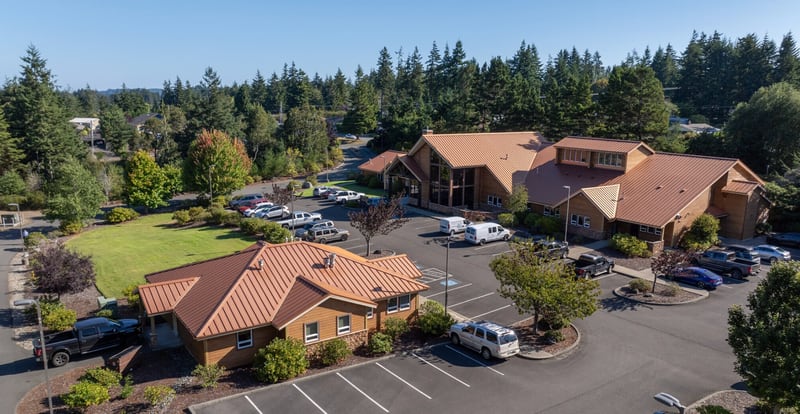
A representative rural medical asset of the type financed under USDA Community Facilities Business.
A reference guide for lenders, borrowers, and developers navigating the OneRD Guaranteed Loan framework under 7 CFR Part 5001.
Why this guide exists
If you have spent any time on the USDA Rural Development guaranteed loan programs, you already know the problem. There is no single document that tells you, plainly, what a USDA feasibility study has to contain, when one is required, who is allowed to prepare it, and what gets it rejected. The regulation is one document. The triggering thresholds are scattered across four program-specific sections. The actual content requirements live in two appendices that the Federal Register publishes as scanned images. The most consequential operational rules of the last eighteen months are not in the regulation at all but in a series of Administrator-issued letters that practitioners have to track separately.
The Small Business Administration's parallel document, SOP 50 10 8, is over a thousand pages but it is at least one document. The USDA equivalent is a constellation. This guide is our attempt to pull it together.
We built this reference because we spend our days writing feasibility studies for the lenders and borrowers who use these programs, and we have watched the rejection rate climb. In FY2021, the Agency approved 89 percent of B&I applications. By FY2023, the most recent year with public data, that figure had fallen to 53 percent. In February 2026, the RBCS Administrator disclosed in an open letter to lenders that the portfolio carries more than a billion dollars in delinquent loans and about three hundred million in losses over the prior year against a twelve-billion-dollar active book. The Agency is not just tightening; it is in the middle of the most consequential portfolio-quality reset since the 2002 Moses Lake liquidation audit.
Everything that follows assumes you are reading this because you have a real project, a real lender, and a real timeline. We have organized the guide so you can read it straight through or jump to the section that matches the program you are working on.
CHART 1: USDA Feasibility Study Decision Tree, a step-by-step wizard that resolves which program rules apply (B&I, CF, REAP, or WWD), whether a feasibility study is mandatory or discretionary, and which document track applies (vendor certification, Appendix C / D / E, or CF lighter versus heavier form). Source: 7 CFR Part 5001 §§5001.304, 5001.305, 5001.306, 5001.307.
Part One: The Regulatory Architecture You Actually Need to Know
One regulation, four programs, two universes
7 CFR Part 5001 is the codified home of the OneRD Guaranteed Loan Initiative. It took effect on October 1, 2020, and it consolidated six legacy regulatory regimes into a single framework: general guaranteed loan provisions (formerly 7 CFR Part 4279 Subpart A), B&I origination (formerly Part 4279 Subpart B), B&I and REAP guarantee servicing (formerly Part 4287 Subpart B), Community Facilities guaranteed loans (formerly Part 3575 Subpart A), Water and Waste Disposal guaranteed loans (formerly Part 1779), and the guaranteed portion of REAP (formerly Part 4280 Subpart B). That consolidation is the single most important thing to understand about the current framework, because most of what you find online about "B&I feasibility study requirements" was written before October 2020 and references regulations that no longer exist in their original form. Subparts B of Parts 4279 and 4287 were not fully retired; they were preserved by the December 10, 2021 amendment as residual homes for B&I CARES Act loans and pre-October-2020 legacy origination and servicing.
What Part 5001 did not touch is just as important. Community Facilities direct loans remain governed by 7 CFR Part 1942 Subpart A. CF grants remain under 7 CFR Part 3570 Subpart B. WWD direct loans remain under 7 CFR Part 1780. REAP grants (as distinct from REAP guaranteed loans) remain under 7 CFR Part 4280 Subpart B's grant provisions. Mixing these up is the single most common conceptual error we see in pre-application packages. A community asking about "a USDA loan for our fire station" almost always means a CF direct loan under Part 1942, not a CF guaranteed loan under Part 5001. The feasibility study requirements are different. The application process is different. The dollar caps are different. Everything is different.
CHART 2: USDA Guaranteed Loan Regulatory Architecture Map, showing 7 CFR Part 5001 as the primary framework with its four OneRD guaranteed programs, the three sibling regimes outside it (Part 4279 Subpart B preserved for legacy origination, Part 4280 Subpart B for REAP grants, Part 1b for NEPA), and the six legacy regulatory regimes Part 5001 consolidated in 2020. Source: 7 CFR Part 5001; 85 FR 42494; 86 FR 70349.
How Part 5001 is structured
The regulation is organized into six subparts. Subpart A covers general provisions, including the master definitions at §5001.3 that anchor the entire framework. Subpart B handles eligibility (who can borrow, who can lend, what projects qualify). Subpart C governs origination, including the lender's credit evaluation at §5001.202 that is the analytical spine of every application. Subpart D is where the feasibility study lives, with program-specific sections at §5001.304 (CF), §5001.305 (WWD), §5001.306 (B&I), and §5001.307 (REAP), plus five appendices that prescribe content. Subpart E covers the loan and guarantee provisions including pricing and the loan note guarantee. Subpart F covers servicing.
The five appendices to Subpart D are where the actual substance of a feasibility study lives:
Appendix A sets out the five components every USDA feasibility study must contain.
Appendix B governs the financial feasibility reports specific to Community Facilities.
Appendix C prescribes the technical report for REAP Energy Efficiency Improvement (EEI) projects over $80,000.
Appendix D prescribes the technical report for REAP Renewable Energy System (RES) projects between $80,000 and $200,000.
Appendix E prescribes the technical report for REAP RES projects at or above $200,000, with nine technology-specific subsections.
The regulation has been amended multiple times since promulgation. The most consequential amendments were December 10, 2021 (which preserved 7 CFR Part 4279 as a residual home for B&I CARES Act loans and pre-October-2020 legacy servicing), September 30, 2024 (a substantial substantive update effective November 29, 2024), and December 11, 2025 (technical corrections including the affiliate definition).
CHART 3: 7 CFR Part 5001 Rulemaking Timeline, twelve Federal Register actions spanning July 14, 2020 through December 12, 2025, including the original final rule, every substantive amendment, every technical correction, and the most consequential post-effective-date corrections. Source: Federal Register publications 2020 through 2025; eCFR.
Part Two: When a Feasibility Study Is Required
This is where most readers come in. The triggering rules are program-specific. We will walk through each program in turn.
Business and Industry: the $1 million / new business rule
The B&I trigger is the most mechanical of any USDA guaranteed program. Per 7 CFR 5001.306(a)(3)(i), a feasibility study prepared by an independent qualified consultant acceptable to the Agency is mandatory for any guaranteed loan greater than $1,000,000 to a new business.
"New business" is a regulatory term of art. The §5001.3 definition is: "a business that has been in operation for less than one full year and a business that has been in operation for at least one full year and has not achieved full operational capacity or stable operations as determined by the Administrator." A new affiliate of an existing business that is moving or expanding into a new market or labor area also counts. We have seen practitioners and lenders argue endlessly about the "stable operations" question; in practice, the Agency's State Office makes that determination on a case-by-case basis, and it is one of the few areas where pre-application consultation with the State Office is genuinely valuable.
For B&I loans of $1,000,000 or less, or for loans of any size to existing businesses, the Agency may still require a feasibility study under the discretionary authority of 7 CFR 5001.306(a)(3)(ii). The most common reasons the Agency invokes this discretion are when the lender's analysis is thin, when the project will significantly affect the existing operations of the borrower, or when the technical or market feasibility cannot be determined from the documentation provided. The §5001.303(c)(4) residual authority is the catch-all: if the Agency cannot determine a basis for successful repayment from the lender's analysis and the borrower's business plan, an independent feasibility study can be required regardless of loan size.
| Program | Scenario | Document Required | Preparer | Citation |
|---|---|---|---|---|
| B&I | New business, loan > $1M | MandatoryFive-component feasibility study | Independent qualified consultant acceptable to the Agency | 7 CFR 5001.306(a)(3)(i) |
| B&I | New business, loan ≤ $1M | DiscretionaryAgency may require if repayment basis unclear | Independent qualified consultant if required | 7 CFR 5001.306(a)(3)(ii); 5001.303(c)(4) |
| B&I | Existing business, loan > $1M | DiscretionaryFrequent for significant change of operations | Independent qualified consultant if required | 7 CFR 5001.306(a)(3)(ii) |
| B&I | Existing business, loan ≤ $1M | DiscretionaryRarely required in practice | Independent qualified consultant if required | 7 CFR 5001.306(a)(3)(ii) |
| CF | New entity or new activity, loan > $1M | MandatoryFive-component feasibility study | Independent qualified consultant | 7 CFR 5001.304 |
| CF | New entity or new activity, loan ≤ $1M | DiscretionaryFinancial feasibility report (lighter form may apply) | Qualified firm or individual; may be lender | 7 CFR 5001.304 |
| CF | Existing CF, loan ≤ $25M (safe harbor) | Lighter FormFinancial Feasibility Analysis (Appendix B) | Qualified firm or individual; may be lender | 7 CFR 5001.304(a)(1) |
| CF | GO bond or tax-supported income covers debt service | Lighter FormFinancial Feasibility Analysis | Qualified firm or individual; may be lender | 7 CFR 5001.304(a)(2) |
| CF | Three years audited financials showing capacity | Lighter FormFinancial Feasibility Analysis | Qualified firm or individual; may be lender | 7 CFR 5001.304(a)(3) |
| CF | None of three safe harbors met | Heavier FormFinancial Feasibility Study with Examination Opinion | CPA or CPA firm, AICPA SSAE 23 / AT-C 305 | 7 CFR 5001.304(b) |
| REAP RES | Total Project Cost ≤ $80,000 | Light TrackSix-element vendor or installer certification | Vendor or installer | 7 CFR 5001.307(e)(1) |
| REAP RES | TPC > $80,000 and < $200,000 | MandatoryAppendix D technical report (Sections A through E) | Qualified consultant | Appendix D to Subpart D |
| REAP RES | TPC ≥ $200,000 | MandatoryAppendix E technical report (Sections A through G plus 9 technology subsections) | Qualified consultant with technology-specific credentials | Appendix E to Subpart D |
| REAP RES | Feasibility study (any TPC) | DiscretionaryRequired only when lender or Agency deems necessary | Independent qualified consultant | 7 CFR 5001.307(d) |
| REAP EEI | Total Project Cost ≤ $80,000 | Light TrackSix-element vendor or installer certification | Vendor or installer | 7 CFR 5001.307(e)(1) |
| REAP EEI | TPC > $80,000 and < $200,000 | MandatoryAppendix C with energy audit OR energy assessment | Energy auditor or energy assessor | Appendix C to Subpart D |
| REAP EEI | TPC ≥ $200,000 | MandatoryAppendix C with full energy audit (ASHRAE Level II, ANSI, or ASABE S162) | Energy auditor only (4 credential pathways) | Appendix C to Subpart D |
| WWD | Standard system, residential or community user base | Not RequiredNo feasibility study; engineering documentation only | Not applicable | 7 CFR 5001.305(a)(1) |
| WWD | Business-dependent system, single business is primary user | RequiredBusiness economic viability assessment | Independent qualified consultant | 7 CFR 5001.305 |
CHART 4: Five Cs of Credit to Five Components Crosswalk, two-column map showing how the lender's §5001.202(b)(1) through (b)(5) credit evaluation draws from the §5001.3 plus Appendix A feasibility components, with primary and secondary relationships and what the lender's credit memo must extract from each section of the study. Source: 7 CFR Part 5001 §5001.3, §5001.202(b), Appendix A to Subpart D.
Community Facilities: the $25 million safe harbor and the AICPA examination opinion
CF feasibility requirements work differently from B&I. Every CF guaranteed loan requires some form of financial feasibility report. The only question is which of two tiers applies.
The lighter form, under 7 CFR 5001.304(a), is called a "financial feasibility analysis." It can be prepared by a qualified firm or individual, and critically, it can be prepared by the lender itself if the credit evaluation contains all the items required by Appendix B. The lighter form applies if any one of three safe harbors is met: (1) the guaranteed loan is $25 million or less and is to an existing community facility; (2) the loan is secured by a general obligation bond or other tax-supported income sufficient to cover debt service over the life of the loan; or (3) the borrower has audited financial statements showing three years of capacity to pay existing and new debt service.
The heavier form, under 7 CFR 5001.304(b), is the "financial feasibility study with examination opinion." It applies to every CF guaranteed loan that does not qualify for the lighter form. The regulation requires preparation in accordance with AICPA attestation standards; the current AICPA examination engagement standard is SSAE 23, codified at AT-C section 305. The preparer must carry professional liability insurance. In practice this means a CPA or CPA firm issuing an examination report on prospective financial information. The cost differential between the two forms is significant: a financial feasibility analysis typically runs in the high four to low five figures; a financial feasibility study with examination opinion typically runs five times that.
Note the override at §5001.304(a)(4): even if the project qualifies for the lighter form, the Agency may require a full feasibility study if the lender's analysis is insufficient. And for loans greater than $1,000,000 to a "new entity or an entity conducting a new activity," a feasibility study by an independent qualified consultant is mandatory. This last provision imports a B&I-style trigger into the CF framework that many practitioners miss.
CF also has three special analytical rules that no other program shares. Financial projections for assisted living , skilled nursing, or similar residential facilities must be based on no more than 90 percent occupancy. Utility projects dependent on user fees must base income and expense forecasts on either a State statute or local ordinance requiring mandatory hookup, or on signed and enforceable user agreements. And if the success of the community facility depends on a single business that is its primary user, the economic viability of that business must also be assessed (which means an embedded B&I-style analysis inside the CF feasibility study).
REAP: three documents, three tiers, nine technology-specific subsections
REAP is the most complex program in the framework because it requires up to three distinct technical documents that practitioners routinely conflate. We will untangle them in detail in Part Four. For now, the triggering rules:
A feasibility study is required for RES projects only, and only "when deemed necessary by the lender or Agency" per 7 CFR 5001.307(d). This is the most discretionary trigger in the entire regulation.
A technical report is required for every REAP project, and its content is tiered by Total Project Cost. For TPC of $80,000 or less, a six-element vendor or installer certification suffices. For RES projects between $80,000 and $200,000, Appendix D applies (Sections A through E). For RES projects at or above $200,000, Appendix E applies (Sections A through G plus nine technology-specific resource assessments). For EEI projects above $80,000, Appendix C applies.
An energy audit or energy assessment is required for EEI projects. For projects at or above $200,000 TPC, a full energy audit meeting ASHRAE Level II, ANSI, or ASABE S162 standards is mandatory. For projects between $80,000 and $200,000, the preparer can choose between a full audit and a lighter energy assessment.
Water and Waste Disposal: the no-feasibility-study program
This will be brief because there is nothing to say. WWD guaranteed loans do not require a feasibility study. Per 7 CFR 5001.305(a)(1), the Agency "does not provide technical oversight or recommendations as to the technical feasibility of the project." Engineering documentation is required, including project description, cost estimate, residential and non-residential connection count, and population served. One exception worth noting under 7 CFR 5001.305: if the majority user of the system is a business and the financial success of the system depends on that business, the economic viability of that business must be assessed. We have seen this trigger in cases involving meatpackers anchoring a rural utility, or large industrial users in single-employer markets.
Part Three: The Five Components Every Feasibility Study Must Contain
Every USDA feasibility study, regardless of program, must address five substantive components . They are named verbatim in the §5001.3 master definition: economic, market, technical, financial, and management feasibility. Appendix A elaborates each one. We have written these reports across the asset classes USDA finances, and we can tell you which components get scrutinized hardest and which get applicants in trouble most often.
CHART 5: Preparer Independence and Qualification Verifier, screening tool against the seven §5001.208 conflict-of-interest tests and the five §5001.3 qualification tests, returning a live verdict on whether the proposed preparer meets the Agency's "independent qualified consultant" standard. Source: 7 CFR Part 5001 §5001.3 and §5001.208.
Economic feasibility
This is the macro-environment chapter. The Agency wants to see that the project sponsor has correctly diagnosed the industry, the broader economic environment, and the implications of entry. Generic industry overview content lifted from secondary sources is the most common failure mode. Specifically: an "economic feasibility" section that cites national GDP growth and unemployment trends is not addressing economic feasibility. The Agency wants project-specific, geography-specific, and industry-specific analysis. Trade press, government data sources (BLS, Census, ERS), and industry trade association data are the right anchors.
Market feasibility
This is the most consequential component, and the most commonly under-developed. 7 CFR 5001.202(b) is organized around the Five Cs of credit at paragraphs (b)(1) through (b)(5): Character, Capacity, Capital, Collateral, and Conditions. The Conditions factor at (b)(5) is where market feasibility sits, and within that factor the regulation enumerates nine illustrative considerations at (b)(5)(i) through (b)(5)(ix): resource and feedstock market depth, current and future market potential and off-take agreements, energy and transportation infrastructure and environmental considerations, technical feasibility including demonstrated performance of the technology, complexity of construction and completion terms, contracts and permits, counterparty creditworthiness, public policy issues, and other criteria the lender or Agency considers relevant.
For a market feasibility analysis to survive Agency review, it has to define a defensible trade area (drive-time isochrones, AADT capture for retail and hospitality, demographic capture polygons for healthcare and senior care), quantify demand using the right cohort (not total population for a senior living project, for example, but age 75-plus with relevant income and asset profiles), inventory existing and planned supply (not just current competitors but permit filings and CON applications), and triangulate pricing against three or more comparables. Generic ten-mile-radius trade areas with no methodology, demand inflated by total-population proxies, and supply analysis that omits pipeline are the failure patterns we see in roughly half of the studies we get asked to peer-review.
Technical feasibility
For most non-REAP projects, technical feasibility is the production process, capacity, site analysis, technology selection, equipment, regulatory and code compliance, and operating risk. For REAP, technical feasibility is the technical report (Appendix C, D, or E depending on TPC and project type), which is a separate apparatus we cover in Part Four. The Agency's expectation is "sufficient detail to enable the Agency to determine the technical merit of the project," per the language of 7 CFR 5001.307(e)(1). Design drawings and process flowcharts are encouraged.
Financial feasibility
This is the only component with a verbatim regulatory definition: 7 CFR 5001.3 defines financial feasibility as "the ability of a project to achieve sufficient income, credit, and cash flow to financially sustain the project over the long term and meet all debt obligations." Note the distinction from economic feasibility: economic is macro, financial is micro. Both are required, in different chapters, addressing different questions.
The Agency's specific financial feasibility expectations come from §5001.303(c)(4) and the credit evaluation Content provisions at §5001.202(b)(6). The borrower's balance sheet and YTD income statement must be dated within 90 days of the complete application submission (this is the only bright-line data recency rule in the regulation). Historical statements must cover the lesser of three years or all years of operation. Projections must extend at least two years through full operational capacity, and DSCR must be modeled with explicit sensitivity testing. Projections that deviate from historical performance must be substantiated. Industry-benchmark ratios from Dun & Bradstreet or the Risk Management Association are expected per §5001.202(b)(6)(iii).
Management feasibility
The component most often treated as an afterthought. The Agency expects detailed documentation of ownership and governance structure, experience and qualifications of key personnel, organizational design, and operational plan. For owner-operator businesses, succession risk is a live issue. For first-time operators in a regulated industry, the absence of a written third-party management agreement is typically fatal. The §5001.3 definition of "business plan" places the documentation burden squarely on the borrower: "if a business or industry is in decline or financial distress, the business plan must describe in detail how the project differs from the current industry trends or improves the borrower's financial position."
CHART 6: USDA Agency Review Process Flow, five-stage path from lender submission through intake review, substantive review with conditional National Office escalation, conditional commitment, and closing, including the top five RFI triggers most commonly raised at the substantive review stage. Source: 7 CFR Part 5001 §5001.202; USDA RBCS application and review procedures.
Part Four: REAP, In Depth
REAP deserves its own section because it operates differently from B&I and CF. The three-document distinction is the source of more confused application packages than any other single issue in the program.
| Technology | Requirements | 2026 Status |
|---|---|---|
| WindAppendix E §C.1 | Resource Assessment Wind data source identified; on-site monitoring conditions documented, or assumptions explained when applying nearby station data to the site. Performance (Section G) Warranty covering both breakdown and performance degradation; SCADA-class monitoring. | Restricted Ineligible under B&I; REAP subject to Strong Stewardship UL filters. |
| SolarAppendix E §C.2 | Resource Assessment Solar resource data source identified; assumptions and modeling inputs documented. Performance (Section G) Warranty covering breakdown and degradation; production monitoring. | Restricted Ground-mount > 50 kW ineligible; cropland and foreign-adversary components excluded. |
| Bioenergy / BiomassAppendix E §C.3 | Resource Assessment Type, quantity, quality, seasonality of biomass; harvest, storage, shipping infrastructure; established-resource summary; woody-biomass certification that the material cannot be used as higher-value wood product. Performance (Section G) Warranty plus degradation; biomass-throughput monitoring. | Eligible |
| Geothermal ElectricAppendix E §C.4 | Resource Assessment Temperature, flow, and sustainability of the geothermal resource; conversion system; cooled-water handling; measurement setup. Performance (Section G) Warranty plus degradation; resource-sustainability monitoring. | Eligible |
| Geothermal DirectAppendix E §C.5 | Resource Assessment Same resource-assessment rigor as Geothermal Electric, applied to direct-use systems rather than electricity conversion. Performance (Section G) Warranty plus degradation; resource-sustainability monitoring. | Eligible |
| Anaerobic Digester / BiogasAppendix E §C.6 | Resource Assessment Substrate type, quantity, seasonality, frequency; biodegradability lab studies; daily, monthly, seasonal gas-production estimates; digester type identified; system designer named. Performance (Section G) Warranty plus degradation; gas-production monitoring; effluent management plan. | Paused Jan 14, 2026 UL: applications paused pending portfolio review. |
| HydrogenAppendix E §C.7 | Resource Assessment Type, quantity, quality, seasonality of biomass feedstock; or, for solar, wind, or geothermal source energy, the underlying renewable resource. Local resource maps acceptable for preliminary scoping. Performance (Section G) Warranty plus degradation; production monitoring. | Eligible |
| Hydroelectric / OceanAppendix E §C.8 | Resource Assessment Temperature (if applicable), flow, sustainability, evaluation duration. If less than 1 year of data, qualified consultant must provide correlation analysis between site data and a nearby long-term measurement site. Hydroelectric capped at 30 MW rated power. Performance (Section G) Warranty plus degradation; flow and generation monitoring. | Eligible |
| RES with StorageAppendix E §C.9 | Resource Assessment Storage system specifications: application, size, lifetime, response time, capital and maintenance costs; integration with the host RES. Performance (Section G) Warranty plus degradation; round-trip efficiency monitoring. | Eligible BESS per AN 4900 (3/18/2025); subject to host-RES eligibility filters. |
CHART 7: REAP Appendix E Technology Requirements, nine technology categories (Wind, Solar, Bioenergy, Geothermal Electric, Geothermal Direct, Anaerobic Digester, Hydrogen, Hydroelectric, RES with Storage) with technology-specific Section C resource assessment requirements, Section G performance expectations, and current 2026 eligibility status. Source: 7 CFR Part 5001 Appendix E to Subpart D; USDA RBCS Unnumbered Letters 2025 through 2026.
Audit, assessment, technical report, feasibility study: what each one is
An energy audit is a comprehensive report meeting ASHRAE Level II, ANSI, or ASABE S162 standards. It documents current energy usage, recommended improvements with costs, projected energy savings, dollars saved per year, and simple payback. It must be prepared or supervised by an "energy auditor," which under §5001.3 means a person holding one of four credentials: AEE Certified Energy Auditor; AEE Certified Energy Manager; State-licensed Professional Engineer with at least one year of experience and at least two similar audits; or a four-year engineering or architectural degree with at least three years of experience and at least five similar audits.
An energy assessment is the lighter alternative. Per §5001.3, it is "an Agency-approved report assessing energy use, cost, and efficiency by analyzing energy bills and surveying the target building and/or equipment." It can be prepared by an "energy assessor," who under §5001.3 has at least three years of experience and at least five prior energy assessments or audits on similar projects. Energy assessments are permitted in place of an audit only for EEI projects between $80,000 and $200,000 TPC. For EEI projects at or above $200,000, a full energy audit is mandatory.
A technical report is the project-specific document required for every REAP application, with content tiered by TPC. It can be prepared by the vendor or installer for projects at or below $80,000 TPC. For larger projects, it must be prepared by a qualified consultant whose credentials match the technology. The Agency reviews the technical report under 7 CFR 5001.106(e) and grades each substantive section as "pass," "pass with conditions," or "fail." A failure in any single section renders the project "without technical merit."
A feasibility study is the omnibus economic, market, technical, financial, and management analysis defined at §5001.3 and elaborated in Appendix A. For REAP, it is required only for RES projects and only when the lender or Agency deems it necessary. The technical report can be embedded inside the technical feasibility section of a feasibility study (per §5001.307(e)(1)), but a feasibility study cannot substitute for an energy audit or assessment.
CHART 8: Pending USDA Rulemaking and Information Collections, six initiatives in the regulatory pipeline including the Part 4280 Subpart B rewrite, REAP information collection revisions, and the FY2026 fee notice, each scored against a five-stage progress map (announced, NPRM, comment, final, effective). Source: Unified Agenda; Federal Register; Regulations gov; USDA RBCS stakeholder announcements.
RES technical reports by TPC band
The thresholds are $80,000 and $200,000. Below $80,000, the six-element vendor or installer certification suffices. Between $80,000 and $200,000, Appendix D applies with Sections A (Project Description), B (Resource Assessment), C (Project Economic Assessment), D (Project Construction and Equipment Information), and E (Qualifications of Key Service Providers).
At $200,000 and above, Appendix E applies, with Sections A through G plus nine technology-specific resource assessment subsections (Wind, Solar, Bioenergy/Biomass, Geothermal Electric, Geothermal Direct, Anaerobic Digester/Biogas, Hydrogen, Hydroelectric/Ocean Energy, and RES with Storage Components). Each subsection has its own specific data requirements.
Anaerobic digester projects deserve special attention because they have the most demanding resource assessment in the appendix, and because the Agency placed all biodigester and CEA applications under administrative pause in January 2026 after disclosing that 27 percent of the biodigester portfolio and 43 percent of the CEA portfolio were delinquent. If you are working on a biodigester project, do not commission feasibility study or technical report work until the pause is formally lifted and the rewrite of 7 CFR Part 4280 Subpart B (announced March 31, 2026) is final.
EEI technical reports and the ASHRAE Level II standard
For EEI projects, Appendix C governs. It requires Section A (Project Information), either Section B (full Energy Audit) or Section C (Energy Assessment), and Section D (Qualifications). The decision between B and C is driven by TPC: at or above $200,000, Section B mandatory; between $80,000 and $200,000, either is acceptable.
A full ASHRAE Level II energy survey is a substantive engineering exercise. The four required elements are: (1) a situation report describing existing building, energy systems, usage, and the most recent 12-month or 2 to 5 year average price per unit of energy; (2) a description of proposed improvements with preliminary specifications and drawings; (3) a technical analysis quantifying baseline and projected energy consumption, simple payback, and cost-effectiveness ranking; and (4) the auditor's resume and credentials.
What changed in 2025 and 2026
REAP is the program most affected by the regulatory and policy reset of the last eighteen months. The August 19, 2025 Strong Stewardship UL made wind and solar projects ineligible for B&I guarantees entirely, and made specified categories of solar ineligible for REAP guarantees (ground-mount solar PV larger than 50 kW, ground-mount solar that cannot document historical energy usage, ground-mount solar on certified cropland, and solar systems with components from foreign-adversary countries). The December 15, 2025 America First UL excluded borrowers, lenders, and guarantors with citizenship or headquarters in foreign-adversary countries as defined by 15 CFR 791.4. The January 14, 2026 UL paused biodigester and CEA applications. The March 31, 2026 stakeholder announcement signaled an imminent rewrite of the REAP grant regulation under Executive Order 14315.
REAP guaranteed loans continue to be accepted for FY2026 under Part 5001, but feasibility study and technical report scoping must explicitly address the ineligibility filters, supply chain provenance, and (for the management feasibility component) borrower and principal citizenship.
Part Five: Independence, Qualifications, and What Counts as Acceptable
CHART 9: Administrator Notices and Unnumbered Letters Timeline, nineteen RBCS issuances spanning August 21, 2024 through April 2, 2026, including the Strong Stewardship UL, the America First UL, the biodigester and CEA application pause, and the Open Letter to Lenders from Administrator Claeys, with impact rating and program scope. Source: USDA Rural Development Business and Cooperative Service.
The "independent qualified consultant" standard
The §5001.3 definition is short: "an independent third-party person possessing the knowledge, expertise, and experience to perform the specific task required." Independence and qualifications are separate tests. Independence is binary: either the preparer has no compensated-agent or affiliate relationship to the borrower or the lender, or the preparer does. Qualifications are graduated: the Agency expects credentials and experience that match the task.
Conflict of interest is defined at §5001.3 to include, but not be limited to, "a person acting as a compensated agent of the borrower and the lender on the same guaranteed loan." A feasibility study consultant who is also the borrower's loan packager on the same transaction is disqualified. A consultant who is on the lender's referral roster with a contingent-fee arrangement is disqualified. A consultant who is the borrower's regular accountant or business consultant is generally disqualified for the same transaction (the relationship is not arm's-length).
Acceptability is a State Office decision
For B&I, the regulation requires that the consultant be "acceptable to the Agency." The acceptability determination is made by the State Office on a case-by-case basis. The Agency does not maintain a pre-qualified preparer list. Acceptability turns on (a) documented credentials and prior experience in the specific industry and asset class, (b) absence of conflicts of interest, and (c) absence of any pattern of inadequate prior submissions to the Agency.
For CF, the lighter §5001.304(a) financial feasibility analysis can be prepared by "a qualified firm or individual who may be the lender." The heavier §5001.304(b) financial feasibility study with examination opinion must be prepared in accordance with AICPA attestation standards. The current AICPA examination engagement standard is SSAE 23, codified at AT-C section 305. The preparer must carry professional liability insurance. This effectively limits §5001.304(b) studies to CPAs and CPA firms.
For REAP, the qualification standards are codified at §5001.3 for energy auditors, energy assessors, and inspectors. The four energy auditor pathways and the three-year-plus-five-assessment energy assessor pathway are not interchangeable in the field.
How MMCG approaches independence
Since you are reading a guide we wrote, transparency is appropriate. We hold ourselves to a stricter independence standard than the regulation requires. We will not prepare a feasibility study for a project in which we have packaged the loan, brokered the property, or hold any ownership or contingent-fee relationship. We will not accept compensation tied to loan approval, project closing, or any other outcome. The feasibility study fee is paid 50 percent at engagement and 50 percent at delivery, regardless of the Agency's decision on the underlying loan, and if the Agency requires revisions for acceptance, we make them at no additional cost.
Part Six: How the Agency Actually Reviews Your Study
State Office, National Office, and the Executive Credit Committee
The Agency administers Part 5001 through a network of state offices. The State Director's loan approval authority runs to a base level of $5 million and a maximum level of $10 million per RD Instruction 1901-A. Transactions above the State Director's authority route to the National Office through the OneRD Guarantee Loan Initiative Project Manager, who serves as intake for the RD Executive Credit Committee. The Executive Credit Committee is the operative inter-agency body for cross-program review and exception authority.
State Directors can redelegate up to the full state authority to a Program Director who has completed the OneRD Training and Assessment. They can redelegate up to $1 million to an Area Director who is part of the registered OneRD Guarantee team. The State OneRD Credit Committee provides a peer-review function inside each state office. Delegated officials who act contrary to the State OneRD Credit Committee's recommendation must document their reasons.
A critical structural rule: State Directors may not approve actions on loans or loan applications previously disapproved by the National Office. There is no forum-shopping.
CHART 10: Failure Modes Typology, thirteen common feasibility study failure modes across six categories (Market, Financial, Management, Technical, Economic, Procedural) with severity classification (Critical, High, Medium), symptom description, regulatory citation, and remediation guidance for each. Source: 7 CFR Part 5001; MMCG peer review engagement experience.
What the lender's evaluation has to do
7 CFR 5001.202(b)(6)(ii) requires the lender's credit evaluation to include "a written evaluation of the feasibility study, business plan, technical report, and engineering and architectural reports, as applicable." This is a separately required deliverable. It is not the credit memo. It is the lender's substantive critique of the consultant's findings: does the lender accept the methodology, does the lender accept the conclusions, where does the lender disagree, what mitigants does the lender propose.
In our experience, the absence of a substantive lender evaluation is one of the leading reasons applications stall in completeness review. Lenders accustomed to SBA processing sometimes submit a thin credit memo that incorporates the feasibility study by reference, and the State Office returns the application asking for a separate written evaluation.
Common rejection grounds
After the Agency completes preliminary eligibility review and confirms application completeness, substantive review begins. The Agency evaluates each of the five feasibility study components, the lender's credit evaluation, the technical and engineering reports as applicable, and the environmental documentation. The most common rejection grounds, by frequency:
Generic or "checkbox" market analysis. The Agency increasingly expects analytical rigor that mirrors what a private credit committee would demand on a non-guaranteed loan. Recycled industry overview content, ten-mile-radius trade areas with no methodology, and demand quantification using total-population proxies are the failure patterns we see most often.
Financial projections unsupported by an explicit assumption sheet. The Agency expects scenario analysis at base, downside, and upside scenarios. Pro forma cash flows that ramp aggressively without documented justification trigger §5001.303(c)(4) discretion.
Independence or qualification failures. A preparer with a contingent-fee or referral relationship to the lender or borrower; a CV that does not document specific industry expertise; a preparer who is the borrower's accountant on other engagements.
Data recency failures. Balance sheets dated more than 90 days before complete application submission (a flat regulatory violation under §5001.303(c)(4)(i)). Demographic data from the prior decennial census when current ACS five-year data is available. Trade-area market data more than twelve months old.
Five-component coverage gaps. Studies that address market and financial thoroughly but treat economic, technical, or management as afterthoughts. Management is the single most under-developed component we see.
Process failures. The lender's written evaluation of the feasibility study absent or perfunctory. Engineering or architectural reports missing on construction projects. Intergovernmental consultation comments under 2 CFR Part 415 missing. Environmental information under §5001.207 incomplete.
The §5001.303(c)(4) safety valve
When the Agency cannot determine a basis for successful repayment from the lender's analysis and the borrower's business plan, it can require an independent feasibility study regardless of whether the underlying program triggers would otherwise have required one. This authority is exercised case-by-case and is not appealable as such, although the resulting adverse decision is appealable to the National Appeals Division under §5001.5.
The Agency has been invoking this authority more aggressively over the last three fiscal years. The B&I approval rate fell from 89 percent in FY2021 to 53 percent in FY2023, and the operational signals from the February 2026 open letter to lenders suggest FY2024 and FY2025 will not show recovery. For applicants involved in novel technology, new business situations, or significant changes in scale, the practical recommendation is to commission an independent feasibility study under §5001.303(c)(4) standards proactively rather than waiting for the Agency to require one. The marginal cost is meaningfully less than the cost of a six-month delay.
Resubmission and appeal
If the Agency finds the application incomplete, it issues a written deficiency notice under §5001.303(a). The cure period is not numerically specified; in practice it ranges from a few weeks to several months depending on the issue. There is no limit on the number of resubmissions, but material modification of a complete application restarts the submission date of record under §5001.303(d), which can affect priority scoring.
If the Agency denies a complete application after substantive review, the adverse decision is appealable to the National Appeals Division under 7 CFR Part 11 and §5001.5. The appeal must be filed within thirty days. NAD operates an independent hearing officer process with optional Director review. The Agency's discretionary determinations under §5001.303(c)(4) are not themselves directly appealable, but any adverse decision that follows from them is. Federal district court review under the Administrative Procedure Act is available after exhaustion of administrative remedies.
Part Seven: What Changed in 2025 and 2026
The codified regulation has been quiet since the December 11, 2025 technical corrections. The operational overlay has been anything but quiet.
CHART 11: Feasibility Study Thresholds by Program, nineteen program-by-loan-band scenarios across B&I, CF, REAP RES, REAP EEI, and WWD, with the document required and the preparer credentials for each. Source: 7 CFR Part 5001 §§5001.304, 5001.305, 5001.306, 5001.307.
The Strong Stewardship UL (August 19, 2025)
Implementing Executive Order 14315, this UL makes wind and solar projects ineligible for B&I guarantees entirely. For REAP, it makes the following ineligible: ground-mount solar PV systems larger than 50 kW; ground-mount solar that cannot document historical energy usage; ground-mount solar proposed on certified cropland as defined by FSA Handbook 10-CM rev. 2; and solar systems with components made in a foreign-adversary country under 15 CFR 791.4.
For feasibility study practice, this means REAP technical reports for ground-mount solar must document historical energy usage and verify non-foreign-adversary supply chain provenance. B&I feasibility studies relying on wind or solar revenue must be re-scoped.
The America First UL (December 15, 2025)
Implementing the National Farm Security Action Plan. For B&I, TPEP, and REAP guaranteed loans, individuals who are citizens of, and companies headquartered in, countries determined to be foreign adversaries under 15 CFR 791.4 are not eligible to participate as borrowers, lenders, or guarantors. The management feasibility component of OneRD feasibility studies must now affirmatively verify principal citizenship and corporate headquarters jurisdiction.
The Biodigester and CEA Pause (January 14, 2026)
This UL paused acceptance of applications for biodigester and Controlled Environment Agriculture projects (vertical farming, hydroponics, aeroponics, aquaponics) across RBCS programs. The portfolio rationale disclosed on the face of the UL: 21 anaerobic biodigester loans totaling $386.4 million with 27 percent delinquent, and CEA loans totaling $311.9 million with 43 percent delinquent. The pause was extended in April 2026 and remains in effect as of this writing.
The Open Letter to Lenders (February 20, 2026)
Not a formal UL, but functionally one of the most consequential documents of the cycle. Administrator J.R. Claeys disclosed that the OneRD portfolio exceeded $12 billion in active guaranteed loans across 775-plus lenders, with over $1 billion delinquent and approximately $300 million in losses and repurchases over the prior year. The letter cited 7 CFR 5001.132 as the authority to remove lenders for negligent underwriting or servicing and laid out ten underwriting best-practice expectations including: justifying interest-only or ramp-up periods with realistic monthly cash-flow projections; sizing loans against industry norms with explicit working capital analysis; aligning offtake contracts with the loan term where industry-feasible; funding reserves from borrower equity rather than the Agency loan; and treating C-PACE financing as a prior lien with a 10 percent collateral discount factor and at least two years of C-PACE assessment payments subtracted from collateral coverage.
These are not regulatory amendments. They are de facto underwriting standards backed by §5001.132 enforcement authority. We treat them as binding for every B&I, CF, and REAP feasibility study we deliver.
The FY2026 Fee Notice (March 9, 2026)
91 FR 11272 announced the FY2026 OneRD fee schedule, effective October 1, 2025. The single substantive change: the B&I guarantee percentage is now tiered by loan size. Loans under $5 million receive an 85 percent guarantee (up from 80 percent). Loans of $5 million to $25 million remain at 80 percent. CF, REAP, and WWD guarantee percentages and fees are unchanged from FY2025.
The 5-percentage-point uplift on sub-$5 million B&I loans is the first size-based tiering in OneRD history. The economic significance for feasibility study practice: the segment most directly affected is the $1 million to $5 million new-business B&I deal that carries a mandatory feasibility study under §5001.306(a)(3)(i). Lender economics on this segment improved materially, which we expect will modestly expand deal flow, and increase Agency scrutiny on study quality.
The Pending Rewrite of 7 CFR Part 4280 Subpart B
On March 31, 2026, RBCS announced its intent to rewrite the REAP grant regulation to comply with EO 14315. REAP grant awards are paused until the rewrite is final. REAP guaranteed loans continue under Part 5001 subject to the Strong Stewardship UL. No NPRM or target publication date has been published.
What This Means for Your Project
The practical implications fall into three groups depending on which side of the transaction you are on.
If you are a borrower
Identify which program applies before you commission anything. The most expensive mistake we see is borrowers commissioning a feasibility study before they have confirmed which program their project qualifies for. A study scoped for B&I will not satisfy CF requirements, and vice versa.
Engage the State Office early. The acceptability determination on the consultant, the scope decision on the feasibility study, and the determination of whether the §5001.304(a) safe harbors apply are all State Office decisions. Pre-application consultation is free and saves cycles.
Refresh your financials within 90 days of complete application submission. The §5001.303(c)(4)(i) 90-day rule is the only bright-line data recency requirement, and it is enforced. If your balance sheet is more than 90 days old at submission, the application is incomplete.
Build the application package with the Agency reviewer in mind, not the consultant's deliverable in mind. The Agency reviews the lender's credit evaluation, the feasibility study, the technical and engineering reports, and the environmental documentation as one integrated record. Inconsistencies between the consultant's projections and the lender's credit memo are the most common reason for re-submissions.
If you are a lender
Treat 7 CFR 5001.202(b)(6)(ii) as a hard requirement. The lender's written evaluation of the feasibility study is a separately required deliverable, not a sentence in the credit memo. The Agency reviews it. The absence of a substantive evaluation is a leading reason for State Office returns.
Track your portfolio against the February 20, 2026 best-practice expectations. The Administrator's letter is the operational standard the Agency is using to inform §5001.132 enforcement decisions, even though it is not a formal UL. The expectations on working capital sizing, offtake contract alignment, reserve funding, and C-PACE collateral treatment are the operative lender-conduct rules.
Use §5001.303(c)(4) preemptively. When the underlying file does not give you analytical comfort, commission an independent feasibility study before the Agency requires one. The marginal cost is less than the cost of a six-month delay.
If you are a developer or consultant
If you are a consultant, the independence test under §5001.3 and §5001.208 is the gating issue. The Agency reviews the consultant's relationship to the borrower and lender as part of its acceptability determination. A consultant who is the borrower's loan packager or who holds a contingent-fee arrangement with the lender is disqualified.
If you are a developer (sponsor) of a CF, B&I, or REAP project, structure your consultant engagements around the independence requirement from the start. We have seen sponsors commission "free" feasibility studies from packagers who plan to bill the cost into the loan; the Agency rejects these arrangements.
Final word
Feasibility study requirements under Part 5001 are not exotic. They are an analytical discipline that mirrors what a private credit committee would demand on a non-guaranteed loan, plus a specific overlay of program-specific requirements that come from the regulation, the Appendices, and the Administrator's letters.
What has changed in the last eighteen months is the rigor of Agency review. The 89 percent approval rate of FY2021 is gone. The current operating environment is closer to private credit underwriting than at any time in the program's history. Feasibility studies that get applications approved share three characteristics: they treat the five components with equal seriousness, they document independence and qualifications explicitly, and they triangulate every projection against historical performance and industry benchmarks. The studies that get applications denied tend to fail on the same axes: generic market analysis, unsupported financial projections, perfunctory management feasibility, and stale data.
If you are working on a USDA project and you would like a conversation about whether a feasibility study makes sense, what scope it should have, and which program rules apply, we are happy to help. We have prepared studies under every program covered in this guide, across asset classes ranging from senior care and rural healthcare to manufacturing, hospitality, and renewable energy.
May 12, 2026, by Michal Mohelsky, J.D. Principal of MMCG Invest, LLC, feasibility study consultant serving feasibility studies for assisted living facilities.
Reach out to discuss how our methodology supports your lending decision.
Michal Mohelsky, J.D. | Principal | mmcginvest.com
Contact: michal@mmcginvest.com
Phone: (628) 225-1110
Disclaimer: This report is provided for informational purposes only and does not constitute investment advice. Data presented herein is derived from proprietary MMCG databases and third-party sources believed to be reliable; however, MMCG Invest makes no representation as to the accuracy or completeness of such information. Figures from third-party industry databases have been independently verified and, where appropriate, adjusted to reflect MMCG's proprietary analytical methodology. Past performance is not indicative of future results.
References
(1) 7 CFR Part 5001, OneRD Guaranteed Loan Regulation, codified as Subparts A through D of Part 5001 and governing the four OneRD guaranteed loan programs (B&I, CF, REAP, WWD). Effective October 1, 2020; amended multiple times through December 11, 2025.
(2) 7 CFR 5001.3, definitions including "feasibility study," "financial feasibility," "independent qualified consultant," "qualified," "affiliate," and "commercially available." The verbatim definition of financial feasibility, "the ability of a project to achieve sufficient income, credit, and cash flow to financially sustain the project over the long term and meet all debt obligations," is anchored in this section.
(3) 7 CFR 5001.202(b), Lender Credit Evaluation requirements. The Five Cs of credit are codified at paragraphs (b)(1) through (b)(5): Character, Capacity, Capital, Collateral, and Conditions, with the nine illustrative considerations under the Conditions factor at (b)(5)(i) through (b)(5)(ix). The lender's separate written evaluation requirement is at (b)(6)(ii); the Dun & Bradstreet and RMA industry-benchmark ratios requirement is at (b)(6)(iii).
(4) 7 CFR 5001.208, Conflict of Interest standards governing lenders, borrowers, and consultants. The prohibition on serving as a compensated agent of both borrower and lender on the same guaranteed loan is anchored here.
(5) 7 CFR 5001.303(c)(4), Application requirements, including the bright-line 90-day financial documentation recency rule at (c)(4)(i): the balance sheet and YTD income statement must be dated within 90 days of complete submission to the Agency.
(6) 7 CFR 5001.304, Community Facilities Guaranteed program-specific feasibility study requirements. The "lighter form" safe harbors at §5001.304(a) (including the $25 million existing-CF safe harbor, the general-obligation-bond pathway, and the audited-financials pathway) and the "heavier form" examination-opinion standard at §5001.304(b) are codified in this section.
(7) 7 CFR 5001.305, Water and Waste Disposal Guaranteed program-specific requirements. The default no-feasibility-study posture and the business-anchored-system exception are codified at §5001.305(a)(1).
(8) 7 CFR 5001.306, Business and Industry Guaranteed program-specific feasibility study requirements. The mandatory $1 million new-business trigger is codified at §5001.306(a)(3)(i); the discretionary Agency authority is at §5001.306(a)(3)(ii).
(9) 7 CFR 5001.307, Rural Energy for America Program guaranteed loan requirements. The discretionary feasibility study trigger is at §5001.307(d); the technical report standard, including the $80,000 vendor-certification safe harbor, is at §5001.307(e)(1).
(10) 7 CFR 5001.132, Lender Removal Authority, cited by RBCS as the basis for de-enrolling lenders that fail to meet underwriting or servicing standards. Invoked explicitly in the February 20, 2026 Open Letter to Lenders.
(11) Appendices A through E to Subpart D of 7 CFR Part 5001: Appendix A (feasibility study content), Appendix B (CF financial feasibility analysis), Appendix C (REAP energy audits and energy assessments), Appendix D (REAP RES technical reports for Total Project Cost between $80,001 and $199,999), and Appendix E (REAP RES technical reports for Total Project Cost of $200,000 and above, including the nine technology-specific resource assessment subsections C.1 through C.9).
(12) 85 FR 42494 (July 14, 2020), Final Rule consolidating six legacy guaranteed-loan regulatory regimes into 7 CFR Part 5001, effective October 1, 2020. Initial technical corrections published at 85 FR 62196 (October 2, 2020).
(13) 86 FR 70349 (December 10, 2021), amendment preserving 7 CFR Part 4279 Subpart B as the residual home for B&I CARES Act loans and pre-October-2020 legacy origination, with conforming corrections at 87 FR 7361 (February 9, 2022).
(14) 89 FR 79698 (September 30, 2024), the most consequential substantive amendment to Part 5001 since promulgation, effective November 29, 2024. Updated feasibility study triggers, lender credit evaluation content at §5001.202, and program-specific application requirements. Post-effective-date corrections at 89 FR 97477 (December 9, 2024).
(15) FR Doc 2025-22567 (December 11, 2025) and FR Doc 2025-22660 (December 12, 2025), technical corrections to Part 5001, including the "affiliate" definition and restoration of the "commercially available" definition.
(16) 91 FR 11272 (March 9, 2026), FY2026 OneRD Fee Notice, retroactively effective October 1, 2025. Introduces the first size-based guarantee tiering in OneRD history: 85 percent guarantee on B&I loans under $5 million, 80 percent on loans of $5 million to $25 million. CF, REAP, and WWD guarantee percentages unchanged from FY2025.
(17) USDA Rural Development Strong Stewardship Unnumbered Letter (August 19, 2025), implementing Executive Order 14315. Makes wind projects ineligible under B&I; restricts ground-mount solar PV greater than 50 kW, ground-mount solar without documented historical energy usage, and ground-mount solar on certified cropland under REAP; applies foreign-adversary component screening under 15 CFR 791.4.
(18) USDA Rural Development America First Unnumbered Letter (December 15, 2025), implementing the National Farm Security Action Plan. Excludes individuals who are citizens of, and companies headquartered in, countries designated as foreign adversaries under 15 CFR 791.4 from participating as borrowers, lenders, or guarantors.
(19) USDA Rural Development Unnumbered Letter (January 14, 2026), pausing acceptance of applications for anaerobic biodigester and Controlled Environment Agriculture projects (vertical farming, hydroponics, aeroponics, aquaponics) across RBCS programs pending portfolio review. Pause extended by the April 2, 2026 stakeholder announcement.
(20) Open Letter to Lenders from RBCS Administrator J.R. Claeys (February 20, 2026). Disclosed an active OneRD portfolio of over $12 billion across 775-plus lenders, with over $1 billion delinquent and approximately $300 million in losses and repurchases over the prior year. Articulates ten underwriting best-practice expectations, citing §5001.132 as the enforcement authority.
(21) USDA Rural Development Stakeholder Announcement (March 31, 2026), notifying intent to rewrite 7 CFR Part 4280 Subpart B (REAP grant regulation) under Executive Order 14315. REAP grant awards paused until rewrite is final; REAP guaranteed loans continue under Part 5001 subject to the Strong Stewardship UL filters.
(22) USDA Administrator Notice 4900 (March 18, 2025), establishing processing guidance for Battery Energy Storage Systems under REAP as RES with Storage Components projects under Appendix E §C.9.
(23) 7 CFR Part 1b, USDA NEPA implementing framework, effective July 3, 2025. Replaced 7 CFR Part 1970. Governs environmental review across all USDA programs and is the regulatory basis on which USDA does not adopt ASTM E1527-21 Phase I Environmental Site Assessments as a uniform requirement.
(24) Small Business Administration Standard Operating Procedure 50 10 8, effective June 1, 2025. Referenced for comparative analysis of SBA 7(a) and 504 feasibility study and environmental site assessment requirements relative to USDA OneRD requirements.
(25) Cross-referenced external standards. AICPA Statement on Standards for Attestation Engagements No. 23, codified at AT-C section 305 (Examination Engagements), governing the CF Financial Feasibility Study with Examination Opinion under §5001.304(b). 15 CFR 791.4, Department of Commerce designation of foreign-adversary countries, incorporated by reference in the Strong Stewardship and America First Unnumbered Letters. ASHRAE Level II, ANSI, and ASABE S162 audit standards referenced under Appendix C for REAP energy audits. Executive Order 14315 (2025), the executive instrument behind the August 19, 2025 and December 15, 2025 ULs and the March 31, 2026 Part 4280 Subpart B rewrite announcement.
USDA

Michal Mohelsky, J.D., FMVA, Practicing Affiliate of the Appraisal Institute
Principal, MMCG Invest, LLC
Published May 12, 2026. How this analysis was prepared.
Cite this
Michal Mohelsky, J.D., FMVA (2026). USDA Feasibility Study Requirements: The Definitive Reference for B&I, REAP, and Community Facilities. MMCG Invest, LLC. https://www.mmcginvest.com/post/usda-feasibility-study-requirements-the-definitive-reference-for-b-i-reap-and-community-facilitie
Where this goes next
- USDA Business & Industry Loans Program: Feasibility Study ServicesMMCG's feasibility study page for this subject.