Summary
Assisted living and memory care fail for financial reasons rather than demographic ones, so the binding test is whether the lease-up clears debt service under the chosen capital structure. National occupancy has risen for nineteen consecutive quarters to 89.5 percent and construction sits at its lowest level since 2012, yet thirteen senior-care operators filed for Chapter 11 protection in 2025.
Revenue is durable because it is private pay, 93.9 percent of resident-fee revenue at the largest public operator in 2025, against Medicaid as primary payer for roughly sixty-three percent of skilled-nursing residents. The exposure sits in the fill: a new community takes eighteen to thirty months to stabilize while debt service is fixed from the first payment, and HUD Section 232 sets the lowest bar at a 1.45 times minimum coverage ratio. Penetration then decides the verdict, and the same national inventory reads as roughly 11 percent against seventy-five-plus households and 30 percent against eighty-five-plus.
Written for Lenders underwriting seniors housing, Assisted living and memory care developers, HUD 232 and agency borrowers. 25 minute read.
Key figures
- National senior housing occupancy
- 89.5 percent after nineteen consecutive quarterly gains
- NIC and NIC MAPfirst quarter of 2026
- Senior-care Chapter 11 filings
- thirteen operators
- Gibbins Advisors healthcare restructuring report2025
- HUD Section 232 minimum coverage and leverage
- 1.45 times coverage, to seventy-five percent of value
- HUD Office of Residential Care Facilities, FHA Section 232 program parameterscurrent program terms
- HUD Section 232 volume
- 337 transactions and roughly $5.96 billion insured
- HUD Office of Residential Care Facilitiesfiscal year 2025
- Penetration of the national inventory by age band
- 11 percent of seventy-five-plus, 18 percent of eighty-plus, 30 percent of eighty-five-plus
- NIC Investment Guide, 7th Editioncurrent national inventory
Updated: Jun 6
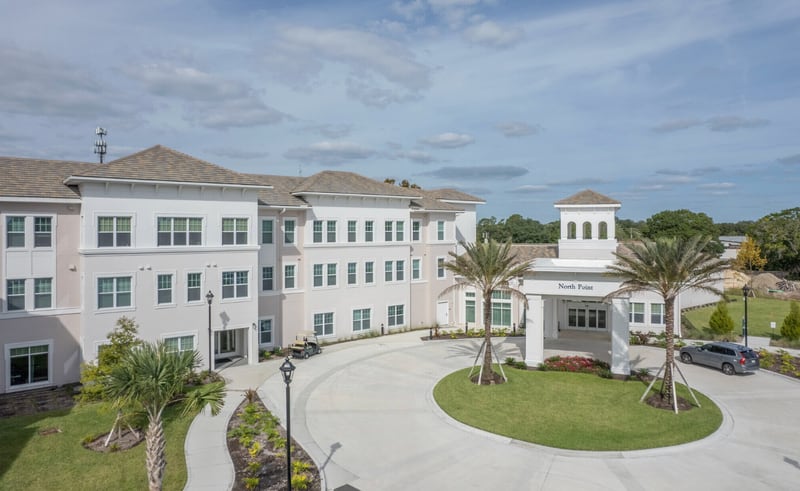
A modern, purpose-built assisted living and memory care community.
How Occupancy, Payor Mix, the Lease-Up Curve, and Capital Structure Determine Bankability under HUD/FHA Section 232, SBA, USDA, and Conventional Loan Programs
Executive Summary
Few real estate asset classes carry as clean a demand thesis as seniors housing, and few are as easy to misjudge. The arithmetic of aging is not in dispute: the population aged eighty and older is projected to grow by roughly 37 percent over the decade to 2035, while seniors housing construction has fallen to its lowest level since 2012 (1)(2). National occupancy has risen for nineteen consecutive quarters to 89.5 percent, the highest reading since the series began in 2006 (3). And yet thirteen senior-care operators filed for Chapter 11 protection in 2025 (4). The lesson for lenders and investors is that assisted living and memory care fail for financial reasons, not demographic ones.
This report frames assisted living and memory care revenue not as a function of demand but as a coverage test. The central thesis is direct: feasibility is the lease-up curve meeting the debt-service demands of the chosen capital structure, and durable private-pay revenue, not headline occupancy, is the true backbone of coverage . A community can show a healthy stabilized profile, occupancy near ninety percent and net operating income margins above twenty-five percent, and still fail in the eighteen-to-thirty-month fill, because debt service is fixed from the first payment while census is a flow that must be continuously re-sold.
Three structural features define the credit. First, the revenue line is built from units, occupancy, monthly rate, and a rising layer of acuity-based care charges, with memory care commanding a twenty-to-thirty percent premium over assisted living (5)(6 ). Second, the revenue is overwhelmingly private pay, roughly ninety-four percent at the larger branded operators, which insulates it from the reimbursement risk that defines skilled nursing and is the primary reason the asset class earns lower capitalization rates (7)(8) . Third, the financing structure sets the revenue threshold, and among the available programs the HUD/FHA Section 232 mortgage insurance program, with its long fully-amortizing term, non-recourse structure, and low fixed rate, produces the lowest coverage hurdle for a stabilized community (9).
The verdict that follows is that an assisted living or memory care project is bankable when it pairs conservative absorption and rate assumptions with a defensible private-pay demand base, an experienced operator, adequate equity, and a financing structure matched to the project's stage, and that it is unbankable when it leans on an aggressive lease-up, an income-unqualified market, a thin reserve through the fill, or a payor mix that drifts toward Medicaid. The sections that follow build the revenue case from the unit up and translate it into a coverage verdict under each program.
1. Why Revenue Durability Is the Feasibility Crux
The seniors housing demand story is genuinely exceptional, and that is precisely why it is dangerous. The investment-grade market spans roughly 24,900 properties and 3.2 million units with an implied value near $478 billion (1), and the assisted living segment alone generates on the order of $45 billion in annual service revenue (10). The demand engine is the eighty-plus cohort, which adds roughly four million people a year through the mid-2040s, against a development pace that NIC MAP estimates is meeting only about a quarter of what the demographics require (2). An analyst who stops at those figures will conclude that almost any community will fill. The distress record says otherwise.
The reconciliation is that demand is necessary but not sufficient. A new assisted living community does not stabilize for eighteen to thirty months, and during that fill it cannot cover its debt service from operations (11). The 2025 bankruptcies were overwhelmingly the product of balance-sheet and operating failures, agency-labor cost shocks, floating-rate debt that repriced as benchmark rates rose, and lease-ups that stalled, rather than any shortfall in underlying demand (4)(12). Feasibility, in other words, is decided in the financial model, not the demographic table , and the model lives or dies on two questions: how durable the revenue is, and whether it can clear debt service through the ramp.
That is the logic of the analysis that follows. Revenue enters at the top; the labor-dominated operating cost stack and debt service are deducted in sequence; and the residual, measured against debt service, is the coverage ratio that determines bankability. Every subsequent section builds one stage of that waterfall, beginning with the revenue itself.
The waterfall above is the spine of the report. One point of interpretation should be set at the outset, because it runs through everything that follows. At stabilization, a well-located community shows comfortable coverage and a margin above twenty-five percent , which can make the asset look low-risk. That comfort is real, but it is the wrong place to look. The binding feasibility test is not the stabilized year; it is the lease-up, during which revenue climbs from zero toward a stabilized run-rate while debt service is fixed from the first payment. The figures throughout this report are stabilized unless stated otherwise, and the reader should mentally discount them to the fill to see where the genuine risk lies.
2. The Revenue Build: Units, Occupancy, Rate, and Acuity
Revenue in an assisted living or memory care community is constructed bottom-up from four inputs: the number of units, the occupancy rate, the average monthly rate, and a layer of acuity-based care charges that scales with resident need. The canonical build is units multiplied by occupancy multiplied by the average monthly rate, plus level-of-care revenue, plus one-time community and second-person fees. The institutional revenue-intensity metrics are RevPOR, revenue per occupied room per month, and RevPAR, revenue per available room per month, which equals RevPOR multiplied by occupancy and is the truer measure because it embeds vacancy (5).
Unit count and rate
The headline national figure of roughly thirty-seven licensed beds per community is misleading for feasibility, because it blends thousands of small residential-care homes (13). For lender-financed, purpose-built product, the relevant scale is roughly seventy to ninety units for assisted living, twenty-five to fifty units for standalone memory care, and eighty to one hundred twenty or more for a combined campus. On rate, the national private-pay benchmarks cluster but do not coincide: the assisted living median runs from roughly $5,400 a month at the move-in aggregators to about $6,200 in the Genworth and CareScout cost survey, while memory care runs from roughly $6,700 to $8,000 (6)(14). The memory care premium, consistently twenty to thirty percent, reflects richer staffing ratios, awake overnight coverage, secured environments, and specialized programming, not merely a different room (15).
Occupancy and the operating leverage it carries
Stabilized assisted living occupancy reached 87.9 percent in the first quarter of 2026 , with the blended senior housing figure at 89.5 percent (3). The distribution matters as much as the average: at the largest operator, roughly a third of communities run above ninety percent occupancy while about fifteen percent sit below seventy (16). Because the cost base is heavily fixed, the last points of occupancy are disproportionately valuable; operators and owners cite incremental margins above fifty percent on each occupied unit added near stabilization, and one public operator quantifies a hundred basis points of occupancy as roughly twenty-three million dollars of incremental operating income across its portfolio (16). This convexity is why a credible projection treats the path to stabilized occupancy, not merely the stabilized level, as the central revenue question.
Acuity: the organic revenue lever
The fastest-growing and most strategically important revenue layer is care charges. Communities increasingly price care through tiered, points-based level-of-care systems that re-assess residents periodically, so that when acuity rises, care revenue rises with it (17). Care charges commonly add anywhere from a modest first-tier fee to more than two thousand dollars a month at the top tier, and in high-need cases represent half to three-quarters of the total bill (6). Acuity is rising structurally, the share of high-need residents and the eighty-five-plus cohort within assisted living has climbed steadily, which lifts revenue per unit but also expense per unit (18). For the analyst, the implication is that once base-rate growth normalizes toward four to six percent, disciplined acuity pricing is the primary remaining organic lever on net operating income, and a projection that ignores it understates both revenue and the staffing cost that must support it.
3. Durable Revenue: The Private-Pay Backbone
The single most important fact about assisted living and memory care revenue is that it is overwhelmingly paid out of pocket. Industry data place roughly four in five residents on private pay, and at the larger branded operators the revenue figure is higher still, the largest public operator reported that 93.9 percent of its resident-fee revenue came from private-pay residents in 2025, with under five percent from government programs (7). This is the structural opposite of skilled nursing, where Medicaid is the primary payer for roughly sixty-three percent of residents (19). It is the reason lenders and investors assign assisted living a lower capitalization rate than nursing care: private-pay revenue is not exposed to the reimbursement-rate and budget risk that defines government-funded care (8).
The comparison above is the durability case in one picture, and it reframes the revenue projection. The question for a feasibility study is not simply how many units will fill, but how durable the revenue behind them is. Medicaid does not pay for room and board in assisted living; it covers only services, and then only through home-and-community-based waivers whose reimbursement rates run well below private pay and whose availability is capped by state budgets and waitlists (20). A community that must lean on Medicaid to fill is therefore a different, lower-margin, policy-exposed credit than one that fills with private pay, a distinction sharpened by the federal Medicaid funding reductions enacted in 2025 (20).
Length of stay, turnover, and the sales engine
Private-pay durability has a counterintuitive feature: the durable asset is not the individual resident but the sales engine that replaces them. Average length of stay runs roughly twenty-two months in assisted living and about eighteen to twenty-four months in memory care, and median annual resident turnover approaches forty-seven percent (21)(22). A stabilized ninety-unit community at ninety percent occupancy must therefore execute on the order of three move-ins a month simply to hold census, before any growth. The practical consequence for the analysis is that marketing and sales are a permanent operating cost, not a one-time lease-up expense, and a projection that treats census as a stock rather than a flow will overstate stability.
The affordability ceiling
The structural constraint on private-pay demand is affordability. Research on the so-called forgotten middle projects that by 2033 roughly 72 percent of middle-income seniors, some 11.5 million people, will hold less than the income and assets needed to afford private assisted living and related medical care (23). The addressable market for premium product is therefore far smaller than the age-qualified population, and it is concentrated in the upper-income tiers and among home-equity-rich households. This is not a reason to avoid the asset class; it is the reason a credible demand analysis screens the market for income, not just age, a point the feasibility section returns to.
4. From Revenue to NOI, and the Lease-Up Curve
Converting revenue to net operating income requires the operating cost stack, and converting a new community to a stabilized run-rate requires a realistic lease-up. Both are essential to the coverage test, and the lease-up is where the credit is most fragile.
The labor-dominated cost stack
Assisted living is, before anything else, a labor business. Labor runs on the order of forty to forty-one percent of revenue and roughly fifty-five percent of total operating expense, dwarfing every other line (24)(25) . The remaining stack, dining, utilities, insurance, repairs and maintenance, housekeeping, sales and marketing, a management fee typically near five percent of revenue, real estate taxes, and general administration, is meaningful but secondary. Memory care costs more to operate because it staffs richer, with lower resident-to-aide ratios and awake overnight coverage. After the 2021-to-2023 wage-and-agency shock, margins have recovered sharply: NIC MAP reports sector operating margins surpassed twenty-five percent in mid-2025, the highest since 2018, as occupancy and rate growth outpaced expense inflation (26), with the larger owner-operators now printing margins in the high twenties to low thirties (7)(27).
The lease-up curve and the coverage danger window
A new community fills along an S-shaped curve: occupancy starts low, accelerates in the second year, and stabilizes in the third and fourth years after opening (11). NIC's longitudinal data place median occupancy near 89 percent about two years after opening and near 95 percent at four years for assisted living, with the first year decisive in setting the trajectory (11). The danger is that debt service does not ramp. It is fixed from the first payment, while revenue and margin are at their thinnest precisely when the loan begins to amortize.
The chart above makes the danger window visible. The gap between the climbing occupancy curve and the flat breakeven line in the first eighteen to twenty-four months is the period in which a thinly capitalized community fails, and it is the single most common reason an otherwise sound concept becomes distressed (11)(12). The discipline that addresses it is reserve sizing: HUD requires a working-capital escrow and, where a project cannot yet achieve its projected income, an initial operating-deficit reserve, while conventional and agency construction loans carry interest reserves for the same reason (9). A study that assumes rapid stabilization understates this risk; a credible one models the fill explicitly and confirms that equity and reserves can carry debt service through the trough.
5. The Financing Overlay: HUD 232, SBA, USDA, Conventional, and Agency
The financing structure sets the revenue threshold. Annual debt service is a function of the loan amount, which is driven by the required equity, the interest rate, and the amortization term, and the minimum net operating income is that debt service multiplied by the required coverage ratio. For senior care, five channels compete, and they capitalize a community very differently.
HUD/FHA Section 232: the dominant low-threshold structure
The FHA Section 232 program, administered through HUD's Office of Residential Care Facilities under the LEAN process, is the dominant permanent debt for stabilized assisted living, memory care, and skilled nursing (9). It is the only structure offering the combination of a long fully-amortizing term, up to thirty-five years on existing assets and forty on new construction, a non-recourse structure, and the lowest fixed rates in the market because the loans are insured by FHA and securitized through GNMA (9). The program applies a minimum debt-service coverage ratio of 1.45 times for residential care, with leverage on assisted living generally to seventy-five percent of value for for-profit borrowers (9). Because it combines high leverage, the longest amortization, the lowest rate, and non-recourse terms, Section 232 requires the lowest net operating income per dollar of loan, that is, it produces the lowest revenue threshold to be bankable. Fiscal year 2025 was a record for the program, with 337 transactions and roughly $5.96 billion of insured healthcare loans, up 89 percent year over year (9). Its costs are a mortgage insurance premium and a slower process, which is why the bridge-to-HUD path, acquiring and stabilizing on short-term debt and then refinancing into permanent Section 232 financing, is the dominant lifecycle strategy (9).
SBA, USDA, conventional, and agency
The other channels fit specific profiles. SBA 7(a) and 504 loans finance smaller, owner-operator communities and residential care homes; assisted living is explicitly eligible when licensed, but as a special-purpose property it carries a higher equity requirement, fifteen percent under the 504 structure and twenty percent for a special-purpose startup, and SBA financing is recourse (28). USDA Business and Industry loans serve assisted living in rural markets, generally communities under fifty thousand population, which is the program's defining limit because most senior-housing demand sits in metropolitan and suburban areas (29). Conventional bank debt offers speed and flexibility at lower leverage, sixty to seventy-five percent, with coverage of 1.25 to 1.40 times and typically recourse and shorter terms. Agency debt from Fannie Mae and Freddie Mac finances stabilized, licensed, majority-private-pay communities at coverage tiered by acuity, from 1.30 times for independent living to 1.45 times for dementia care, competing with HUD on speed where HUD competes on term and rate (9).
The comparison above illustrates why the program is not a detail but a determinant of feasibility. The same community that clears comfortably under a thirty-five-year, non-recourse Section 232 loan at 1.45 times coverage can require materially more net operating income, or more equity, under a shorter conventional loan at higher coverage, and a project that pencils as a HUD takeout may not pencil on a bank's terms during construction. The financing decision and the feasibility verdict are therefore inseparable, and a credible study models the project under the structure it will actually use.
6. The Feasibility Verdict: Saturation, Penetration, and Sensitivity
A lender-grade feasibility study ends in a coverage verdict, and three analyses drive it: a primary-market-area demand build, a sensitivity test proving the project survives a downside, and a saturation analysis conducted on the right denominator. For HUD's Section 232 program the market study is not a separate document but is embedded in the appraisal, authored by the same Certified General Appraiser, with demand quantified in units and beds and an absorption estimate tied to that demand (30).
Penetration, the primary market area, and the denominator problem
The most consequential methodological choice in the entire study is the penetration-rate denominator. The same national inventory reads as roughly 11 percent penetration against seventy-five-plus households, 18 percent against eighty-plus, and 30 percent against eighty-five-plus (1). Institutional practice layers an income-qualified screen on top, counting only the age-qualified households that can also afford the rate, which shrinks the base further and pushes achievable project-penetration ceilings down to roughly five to ten percent (23). Averaging across denominators is not conservatism; it is a category error that can flip a verdict. The primary market area itself is drawn tighter than for most property types, on the order of five to seven miles for assisted living and seven to ten for memory care, because residents and their families stay local (30).
Saturation and the current supply environment
Saturation is best measured at the submarket level, as units per thousand age-and-income-qualified seniors and as the supply-and-demand ratio, with units under construction in the primary market area counted as committed competition (30). The current environment is unusually favorable on this axis: inventory growth has fallen to roughly 0.4 percent a year, units under construction sit at their lowest level since 2012, and more than half of the markets NIC MAP tracks have no project under construction at all (2)(3). That sharply reduces near-term saturation risk for a well-located community, but it does not eliminate submarket-level oversupply, which remains a real risk in luxury assisted living and in certain memory care submarkets where dementia prevalence has been overestimated relative to local demand (31).
Sensitivity, breakeven, and the failure modes
A credible study runs a base, an upside, and a stressed downside case, and computes the coverage ratio in each. The variables it stress-tests are the ones sponsors most often overstate: absorption pace, rate and rate growth, the operating-expense and labor ratio, payor mix, and the lease-up timeline. The decisive single number is breakeven occupancy, the level at which the community covers operating expenses and debt service; lenders generally want it at or below eighty-five percent, and the gap between breakeven and stabilized occupancy is the project's margin of safety (32). With stabilized assisted living occupancy near 88 percent, a community whose breakeven is also near 88 percent has effectively no cushion. The dominant failure mode is a lease-up slower than projected, NIC MAP data show the share of new communities that never reach eighty percent campus occupancy has risen sharply by vintage, followed by rate or occupancy overestimation, labor-cost overruns, oversupply, and operator underperformance (11)(12).
The visualization above is the closing discipline of the report. A project that requires capturing more than its market can credibly yield, measured on an income-qualified denominator and net of committed competing supply, carries a risk no amount of operating skill fully offsets. Pulling the threads together, an assisted living or memory care community is bankable when it combines a defensible income-qualified demand base, conservative absorption and rate assumptions, a durable private-pay payor mix, an experienced operator, adequate equity and reserves to carry debt service through the lease-up, and a submarket without a cluster of competing units under construction. It is unbankable, or financeable only on substantially tighter terms, when it relies on an aggressive fill, an income-unqualified market, a thin reserve, or a payor mix that drifts toward Medicaid. The revenue projection is the heart of the study, but it earns credibility only when it survives the coverage test under the chosen capital structure and the saturation test in its specific trade area.
7. Conclusion
Assisted living and memory care revenue and project feasibility are the same question seen from two sides. The revenue line is built from units, occupancy, rate, and acuity, and made durable by a private-pay payor base; the feasibility verdict is whether that line clears the debt service implied by the capital structure, through a lease-up that takes two to three years and in a submarket measured on the right denominator. In a market with a powerful demographic tailwind and the lowest construction pipeline in over a decade, the projects that remain bankable are those assessed conservatively, financed in the structure that produces the lowest revenue threshold the deal can support, and sited where income-qualified demand genuinely exceeds committed supply.
MMCG Invest prepares lender-calibrated feasibility studies for assisted living, memory care, and the broader seniors housing continuum across HUD/FHA Section 232, SBA 7(a) and 504, USDA, conventional, and agency loan programs, with income-qualified demand modeling, primary-market-area and penetration analysis, stabilized projections, lease-up and coverage analysis, and third-party validation built for the way lenders read a file.
June 05, 2026, by Michal Mohelsky, J.D., Principal of MMCG Invest, LLC, feasibility study consultant for assisted living facilities.
Reach out to discuss how our methodology supports your lending decision.
Michal Mohelsky, J.D. | Principal | mmcginvest.com
Contact: michal@mmcginvest.com
Phone: (628) 225-1110
Disclaimer: This report is provided for informational purposes only and does not constitute investment advice. Data presented herein is derived from proprietary MMCG databases and third-party sources believed to be reliable; however, MMCG Invest makes no representation as to the accuracy or completeness of such information. Figures from third-party industry databases have been independently verified and, where appropriate, adjusted to reflect MMCG's proprietary analytical methodology. Past performance is not indicative of future results.
Sources:
(1) National Investment Center for Seniors Housing & Care (NIC). Investment Guide, 7th Edition (market size, inventory, penetration) https://www.nic.org 2024.
(2) NIC MAP / National Investment Center. Seniors housing demand projections and construction pipeline; units needed by 2030 https://www.nicmap.com 2025 to 2026.
(3) NIC / NIC MAP. Senior housing occupancy reaches 89.5% in Q1 2026 (19th consecutive quarterly gain; AL 87.9%) https://www.nic.org/news-press/ Apr. 23, 2026.
(4) Gibbins Advisors. Healthcare restructuring report: 13 senior-care Chapter 11 filings in 2025 https://www.gibbinsadvisors.com 2025 to 2026.
(5) Brookdale Senior Living, Inc. (NYSE: BKD). RevPOR / RevPAR definitions and quarterly operating supplements https://www.sec.gov 2025 to 2026.
(6) A Place for Mom. 2026 Cost of Long-Term Care report (AL and MC monthly rate medians; memory care premium; care charges) https://www.aplaceformom.com/caregiver-resources/articles/cost-of-assisted-living Feb. 2026.
(7) Brookdale Senior Living, Inc. Form 10-K, FY2025 (93.9% private-pay resident-fee revenue; segment operating margins) https://www.sec.gov Feb. 19, 2026.
(8) NIC. Capital market trends: private-pay vs. government-reimbursement revenue and cap-rate implications https://www.nic.org/industry-faqs/capital-market-trends-senior-housing-care-property-market/ 2025.
(9) U.S. Dept. of Housing and Urban Development (HUD), Office of Residential Care Facilities. FHA Section 232 LEAN program; Handbook 4232.1; FY2025 volume (337 transactions, ~$5.96B) https://www.hud.gov 2014 to 2026.
(10) IBISWorld. Assisted Living Facilities in the US, industry revenue and cost structure https://www.ibisworld.com 2024 to 2025.
(11) NIC / NIC MAP. Lease-up trends and the S-curve; first-year significance; occupancy by quarters since opening https://www.nic.org/blog/lease-up-trends-show-first-year-critical-nic-shark-second-segment-report/ 2024.
(12) Gibbins Advisors / U.S. Bankruptcy Court filings. Senior-care distress drivers (agency labor, floating-rate debt, stalled lease-up); LaVie Care Centers Chapter 11 https://www.gibbinsadvisors.com 2024 to 2025.
(13) American Health Care Association / National Center for Assisted Living (AHCA/NCAL). Assisted Living Facts & Figures (community count, beds, payor mix, length of stay) https://www.ahcancal.org/Assisted-Living/Facts-and-Figures/ 2024.
(14) Genworth / CareScout. Cost of Care Survey 2025 (assisted living national median ~$6,200/month) https://investor.genworth.com/news-events/press-releases/detail/1054/carescout-releases-2025-cost-of-care-survey-results Mar. 2, 2026.
(15) SeniorLiving.org. 2026 memory care cost and assisted living cost benchmarks; memory care premium drivers https://www.seniorliving.org/memory-care/costs/ 2026.
(16) Brookdale Senior Living, Inc. Q3 2025 supplemental: occupancy distribution and incremental-occupancy operating leverage https://www.sec.gov Nov. 2025.
(17) Senior Housing News. Levels-of-care / points-based pricing and acuity-matched care revenue https://seniorhousingnews.com/2025/08/18/inside-the-new-reality-of-matching-senior-living-care-to-resident-rates/ Aug. 18, 2025.
(18) Senior Housing News / Seniors Housing Business. Acuity creep: rising high-need and 85+ share within assisted living https://seniorshousingbusiness.com/the-acuity-creep-challenge/ 2025 to 2026.
(19) Kaiser Family Foundation (KFF). A Look at Nursing Facility Characteristics (Medicaid primary payer ~63% of SNF residents) https://www.kff.org 2025.
(20) KFF / MACPAC / Congressional Research Service. Medicaid HCBS waivers and room-and-board exclusion in AL; 2025 reconciliation Medicaid funding reductions https://www.kff.org 2025 to 2026.
(21) AHCA/NCAL. Average length of stay (~22 months AL) and transitions to higher acuity https://www.ahcancal.org/Assisted-Living/Facts-and-Figures/ 2024.
(22) Senior Housing News / Direct Supply. Resident turnover (~47% median annual) and length-of-stay dynamics by care level https://seniorhousingnews.com/2025/03/21/inside-the-dynamics-driving-senior-living-unit-turnover-length-of-stay/ Mar. 21, 2025.
(23) NORC at the University of Chicago / The SCAN Foundation. The Forgotten Middle: middle-income seniors and assisted living affordability, 2033 projection https://www.norc.org 2019; updated Aug. 31, 2022.
(24) IBISWorld (via MMCG database). Assisted living cost structure: labor ~40 to 41% of revenue https://www.ibisworld.com Oct. 2025.
(25) American Seniors Housing Association (ASHA) / NIC. State of Seniors Housing (labor ~55% of operating expense; operating margins by segment) https://www.ashaliving.org/ 2024.
(26) NIC MAP. Sector operating margins surpassed 25% in mid-2025 (highest since 2018) https://www.nicmap.com/blog/senior-housing-five-key-trends-to-watch-in-2026/ 2025 to 2026.
(27) Welltower (NYSE: WELL) and Ventas (NYSE: VTR). Seniors Housing Operating (SHOP) NOI margins and same-store growth https://www.sec.gov 2025 to 2026.
(28) U.S. Small Business Administration. SOP 50 10 8 (eff. June 1, 2025): assisted living eligibility; special-purpose equity (15%/20%) https://www.sba.gov Eff. June 1, 2025.
(29) U.S. Dept. of Agriculture, Rural Development. Business & Industry (B & I) Guaranteed Loan Program (7 CFR 5001); rural eligibility ( <50,000 population) https://www.rd.usda.gov/programs-services/business-programs/business-and-industry-guaranteed-loan 2025 to 2026.
(30) HUD ORCF, Section 232 Handbook 4232.1, Ch. 5. Appraisal and market study requirements; PMA definition; demand quantified in units/beds https://www.hud.gov 2014 (Rev-2 drafting table).
(31) Alzheimer's Association. 2025 Alzheimer's Disease Facts and Figures (dementia prevalence; uneven state-level growth) https://www.alz.org/alzheimers-dementia/facts-figures 2025.
(32) CBRE / Commercial Real Estate Loans. Breakeven occupancy methodology and lender thresholds for senior housing https://www.cbre.com/insights/reports/us-senior-housing-and-care-investor-survey-h2-2025 2025 to 2026.
USDA

Michal Mohelsky, J.D., FMVA, Practicing Affiliate of the Appraisal Institute
Principal, MMCG Invest, LLC
Published June 5, 2026. Last updated June 6, 2026. How this analysis was prepared.
Cite this
Michal Mohelsky, J.D., FMVA (2026). Assisted Living and Memory Care: Revenue Durability and Project Feasibility. MMCG Invest, LLC. https://www.mmcginvest.com/post/assisted-living-and-memory-care-revenue-durability-and-project-feasibility
Where this goes next
- Assisted Living Feasibility StudyMMCG's feasibility study page for this subject.