Summary
A well-selected Class B apartment acquisition clears conventional credit over a 10-year hold, because the supply wave has already crested rather than because it never happened. U.S. deliveries peaked at roughly 589,000 units in 2024 and fell about 30% in 2025, while net absorption rose to approximately 770,000 units and stabilized occupancy held near 94.8%.
The representative 248-unit, 1996-vintage community sits in a Midwest secondary market with new supply below 2.5% of inventory and rent growth of 3% to 4%, acquired at about $185,000 per unit, roughly 20% below replacement cost. At 65% loan-to-cost the deal underwrites to a stabilized DSCR near 1.28×, a stressed DSCR near 1.18× and a debt yield around 8%. The binding risk is expense discipline and market selection, not supply: property insurance roughly doubled since 2021 and total operating costs grew mid-single-digits while rents went flat.
Written for Regional bank lenders underwriting a conventional multifamily acquisition loan, Agency lenders evaluating a bridge-to-agency takeout at stabilization, Value-add sponsors acquiring Class B workforce housing, Credit committees reviewing a 10-year multifamily hold. 15 minute read.
Key figures
- Net absorption
- roughly 667,000 units
- RealPage Market Analytics; CBRE Research (sources 1 and 4)2024
- Multifamily construction starts
- fell about 40%
- U.S. Census Bureau, New Residential Construction (source 3)between 2023 and 2025
- Completions
- fell roughly 30%
- RealPage Market Analytics (source 1)2025
- All-in monthly cost of owning versus renting
- roughly 108% above the cost of renting
- CBRE Research, cost-to-own vs. cost-to-rent analysis (source 7)mid-2025
- First-time homebuyer share
- record-low 21%
- National Association of REALTORS, Profile of Home Buyers and Sellers, November 2025 (source 8)2025
- Institutional apartment values, peak-to-trough
- fell roughly 19% to 25%
- MSCI Real Capital Analytics (source 9)from the 2022 top
A conventional-loan feasibility case study · Class B value-add · June 2026
Conventional wisdom prices apartments at the moment of peak fear, record deliveries, negative rents, falling values, distress in the headlines. A disciplined fundamentals and unit-economics analysis of a representative acquisition reaches the opposite conclusion, and shows precisely what makes the asset financeable over a 10-year conventional hold.
1. An asset class the market is pricing at peak fear
A regional lender brings a financing request to committee: the acquisition and light repositioning of a 1990s-vintage, garden-style apartment community in a supply-constrained secondary market, capitalized with a conventional bank loan and an agency takeout at stabilization. The credit question is straightforward to state and difficult to answer well, does an apartment acquisition amortize safely over a 10-year horizon when the sector just absorbed the largest construction wave in half a century, headline rents have gone negative, values have fallen by a fifth, and the financial press is full of failed syndications?
This feasibility case study works that question the way an independent feasibility consultant works it for a lender: by separating the headline narrative from the evidence, anchoring the analysis to a specific market and asset, and pressure-testing the unit economics against the risks that actually move the outcome. The conclusion, stated up front, is that a well-selected apartment asset clears credit, not in spite of the supply wave, but because a closer reading of supply, demand, and basis inverts three assumptions the market currently treats as settled.
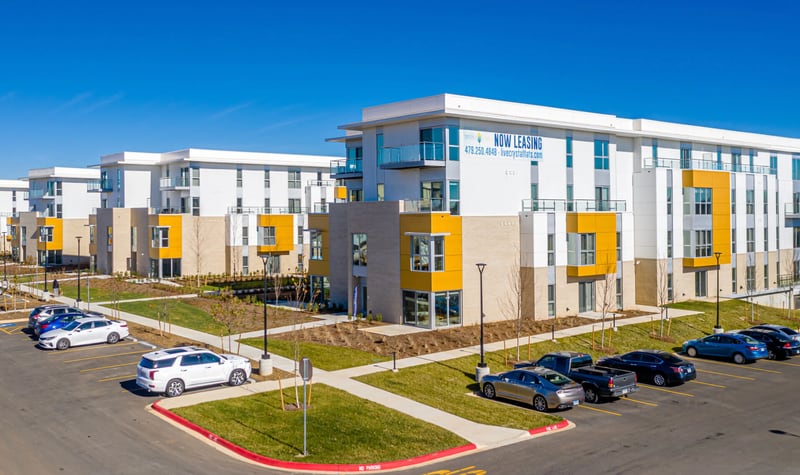
The representative asset. A proposed acquisition of a 248-unit, 1996-vintage, garden-style Class B community in a supply-constrained Midwest secondary market, at a going-in basis of ~$185,000 per unit, roughly 20% below estimated replacement cost. Total capitalization: ~$52.3 million, including a light interior value-add program. The market, asset, capital stack, and figures are illustrative composites built from public and industry data to demonstrate methodology; they do not depict a specific client or transaction.
2. The conventional reading: why the headline metrics say “avoid”
A surface read of the sector's top-line indicators supports the bear case, and a disciplined study has to state that case fairly before dismantling it. Three pillars carry it.
First, the supply wave. The United States delivered roughly 589,000 apartments in calendar 2024, the highest annual total in fifty years, and demand was widely expected to drown under it (1). A market absorbing a record glut of new product reads as the worst possible moment to add apartment exposure.
Second, negative rent growth. National effective rents turned slightly negative on a calendar-year basis in 2025, the first annual decline since early 2021, while concessions climbed to roughly 17% of stabilized units offering close to six weeks free, the highest since mid-2014 (2)(5). Falling face rents and deepening give-backs read as a market with no pricing power.
Third, falling values and visible distress. Institutional apartment values fell roughly 19% to 25% peak-to-trough from the 2022 top, cap rates expanded about 110 to 125 basis points , and multifamily CMBS delinquency climbed past 7% as 2021-vintage floating-rate syndications failed their debt-service tests (9)(14). An asset class repricing downward amid a wave of defaults looks structurally unsafe to finance.
Each pillar is factually accurate. Each is also incomplete in a way that reverses its conclusion once the evidence is examined at the level a lender actually underwrites, the forward supply pipeline rather than today's deliveries, net absorption rather than face rents, and acquisition basis rather than the prior owner's cost.
3. The first reversal: the supply wave is the buy signal, not the warning
The bear case treats the supply wave as a present danger. For a 10-year hold underwritten in 2026, the more relevant fact is that the wave has already crested, and what comes behind it is a cliff. A lender finances the years ahead, not the year behind.
Deliveries peaked in calendar 2024 and the falloff is steep. Completions fell roughly 30% in 2025, and the first quarter of 2026 produced the smallest quarterly delivery volume in four years (1). The mechanical cause is upstream and unambiguous: multifamily construction starts fell about 40% between 2023 and 2025, and units under construction dropped from a peak above one million to roughly 690,000 (3). Because an apartment community takes about two years to build, the depressed starts of 2025 dictate depressed deliveries in 2027, the supply shortage is already locked in by arithmetic, not forecast by hope.
The numbers
| Category | Apartment deliveries (000s units) | Starts (000s units) | Units under construction (000s) |
|---|---|---|---|
| 2022 | 440 | 545 | 930 |
| 2023 | 440 | 510 | 1010 |
| 2024 | 589 | 305 | 880 |
| 2025 | 409 | 300 | 690 |
| 2026 | 410 | 360 | 560 |
| 2027 | 370 | 380 | 540 |
| 2028 | 410 | 400 | 560 |
Annual deliveries (2022 to 2028) with the 2024 peak and forecast decline, against starts and units-under-construction lines, showing the ~40% starts collapse that locks in the 2027 supply trough.
Demand, meanwhile, did not drown, it set records. Net absorption reached roughly 667,000 units in 2024, the strongest in years, and accelerated to approximately 770,000 in 2025, outpacing even record deliveries (1)(4). Demand exceeded supply for four-plus consecutive quarters, which is why national occupancy held in the mid-90s on a stabilized basis even at the peak of the wave (4). The result is a textbook setup: a thinning pipeline colliding with durable demand.
The supply wave is not a reason to wait. It is the reason to move, the deliveries are behind the asset, the starts cliff is ahead of the competition, and underwriting in 2026 buys into a tightening market, not a flooding one.
Exhibit A, The supply cliff (U.S. apartment deliveries, starts & absorption)
| Metric | 2024 (peak) | 2025 | 2026 to 27 (f) |
|---|---|---|---|
| Deliveries (units) | ~589,000 | ~409,000 | ~333 to 478K |
| Change vs. prior year | +record | ~ −30% | declining |
| Net absorption (units) | ~667,000 | ~770,000 | ~300K+ |
| Stabilized occupancy | ~94.8% | ~94.8% | tightening |
Provider definitions differ (stabilized vs. broad inventory); figures are RealPage-basis where available and current as of June 2026. (f) = forecast. Sources: RealPage Market Analytics; CBRE Research; U.S. Census Bureau.
4. The second reversal: the “oversupply” is a face-rent illusion
The most consequential misreading in the bear case is mistaking negative face rents for weak demand. They are not the same thing. Face rents reflect a temporary, local collision between new lease-up product and a thin slice of the renter pool; demand reflects who needs housing, and on that measure, the floor under apartments is structural and reinforcing.
Start with what the negative rent number actually contains. The decline is concentrated in new-lease asking rents in heavily-developed submarkets, where lease-up communities discount to fill units. Renewals, which now represent the majority of leasing activity, held growth near 4% throughout 2025, with retention at record highs (2)(6). A stabilized community leans on renewals, not new leases, so its realized revenue trend runs well above the headline. The bankable deal underwrites the blend, and weights renewals, where the operator has pricing power, over new-lease asking rents, where lease-up competitors temporarily do not.
Beneath that sits the demand engine: the renter-by-necessity lock-out. The all-in monthly cost of owning a home ran roughly 108% above the cost of renting in mid-2025, about a 38% premium on a comparable basis, as 6-to-7% mortgage rates met elevated home prices (7). The first-time homebuyer share fell to a record-low 21%, the median first-time buyer aged to an all-time-high 40, and the homeownership rate held at 65.3%, not for lack of desire but for lack of access (8). Would-be buyers stay renters, lengthening tenancy and lifting retention precisely as the supply pipeline empties.
The numbers
| Category | Cost to own (mortgage, taxes, insurance) - $/mo | Apartment rent - $/mo | First-time buyer share (%) |
|---|---|---|---|
| 2019 | 2050 | 1520 | 33 |
| 2021 | 2350 | 1760 | 34 |
| 2023 | 4050 | 2120 | 26 |
| mid-2025 | 4643 | 2228 | 21 |
Average monthly cost to own vs. average apartment rent, alongside the first-time-buyer-share and homeownership-rate trend, making the ~108% ownership premium and record-low buyer entry visually immediate.
Exhibit B, Where the demand floor comes from (U.S. renter economics, mid-2025)
| Indicator | Reading | Direction for apartments |
|---|---|---|
| Premium to own vs. rent | ~108% | Locks would-be buyers into renting |
| First-time buyer share | 21% (record low) | Lengthens tenancy, lifts retention |
| Homeownership rate | 65.3% | Held down by affordability |
| Renewal rent growth (2025) | ~4% | Anchors realized revenue |
| Cost-burdened renter households | ~22.7 million | Deep, durable demand base |
Own-vs-rent premium is gross all-in; comparable-basis premium is lower. Figures current as of mid-2026. Sources: CBRE Research; National Association of REALTORS; U.S. Census Bureau; Harvard Joint Center for Housing Studies.
5. The third reversal: market selection sorts the outcome
The “falling rents” framing relies on a national average, but no lender finances a national average. They finance a community in a submarket, and location is precisely where the supply wave sorts winners from losers. The market has bifurcated into two very different Americas.
On one side sit the oversupplied Sun Belt and Mountain metros, Austin, Denver, Phoenix, San Antonio, Nashville, Charlotte, where deliveries ran 5% or more of standing inventory, vacancy pushed into double digits, and face rents fell 4% to 7% with the nation's deepest concessions (11). On the other sit the supply-constrained markets, the coastal gateways and, critically for this asset, the Midwest and Northeast secondary metros, where limited new construction met steady demand and rents grew 3% to 4% (11). The single best predictor of 2025 rent performance was not region or class; it was deliveries as a share of inventory.
The representative asset sits squarely in the insulated cohort. Its Midwest secondary market is running new supply below 2.5% of inventory, against rent growth of roughly 3% to 4% and stabilized occupancy near 95% (11). Just as important, it is a Class B community, workforce housing, where essentially nothing new is being built because construction economics only pencil at Class A rents. The new supply that pressured the market is concentrated at the top of the quality ladder; it does not compete with a renovated 1996-vintage asset priced well below it. The “oversupplied market” framing inverts at the trade-area level: this corridor is under-supplied in exactly the product the asset offers.
Exhibit C, Two Americas of multifamily supply (submarket positioning, 2025 to 26)
| Indicator | Representative market | Oversupplied Sun Belt |
|---|---|---|
| New supply (% of inventory) | below ~2.5% | 5%+ |
| Rent growth (YoY) | ~ +3% to +4% | −4% to −7% |
| Stabilized occupancy | ~95% | ~88 to 90% |
| Concession prevalence | limited | deep (~6+ wks free) |
| Competing new Class A | minimal | heavy lease-up |
Illustrative modeled values constructed from public market data to demonstrate market-selection methodology. Sources: RealPage Market Analytics; Yardi Matrix; CoStar; MMCG database.
6. Unit economics and capital markets
The forward thesis only matters if the asset services its debt from day one and refinances cleanly at the end of the hold. This is where the third reversal, basis, does its work. Because the asset is acquired after a 19%-to-25% value correction, the going-in basis of roughly $185,000 per unit sits about 20% below estimated replacement cost (10). The lender is not financing the prior owner's peak; it is financing a repriced basis, which is the single most reliable margin of safety in the structure.
That basis advantage flows straight into the credit metrics. At a conventional acquisition loan sized to roughly 65% loan-to-cost, the asset underwrites to a stabilized debt-service-coverage ratio near 1.28× and a debt yield comfortably inside the 7%-to-10% conventional band, with a path to an agency takeout at stabilization, where rates price tighter (12)(13). Critically, the deal is underwritten to survive at the capped rate as if fixed: it does not rely on rate cuts to clear, and it does not depend on near-term rent acceleration to refinance.
The light value-add program, interior renovations rolled out at turnover, provides the NOI growth, funded from a modest renovation reserve rather than aggressive trended rents. The exit is underwritten conservatively, at a cap rate flat to 25 basis points above the going-in rate, so the refinance math does not depend on the cap-rate compression that the forward curve may or may not deliver.
- Senior loan (~65% LTC)
- Sponsor equity
- Value-add reserve
- Closing & financing
The numbers behind this chart
| Category | Senior loan (~65% LTC) | Sponsor equity | Value-add reserve | Closing & financing |
|---|---|---|---|---|
| Capitalization | 34 | 14.1 | 3 | 1.2 |
Sources-and-uses capital stack with a base-case and stressed DSCR line overlay across the hold, showing coverage holding above 1.20× through stabilization and the agency-takeout refinance point.
Exhibit D, Capital stack & stabilized economics (representative acquisition)
| Metric | Value | Note |
|---|---|---|
| Units | 248 | 1996 garden-style, Class B |
| Going-in basis / unit | ~$185,000 | ~20% below replacement cost |
| Total capitalization | ~$52.3M | Acquisition + value-add + closing |
| Conventional loan (LTC) | ~65% | Bank acquisition / bridge |
| Stabilized DSCR (base) | ~1.28× | Agency takeout at stabilization |
| Stressed DSCR | ~1.18× | Higher-for-longer rate path |
| Debt yield (stabilized) | ~8% | Inside conventional 7 to 10% band |
Illustrative modeled values constructed to demonstrate underwriting methodology; not a specific transaction. Stress applies a higher-for-longer rate path and slower rent recovery. Source: MMCG database; agency and conventional lender term benchmarks.
7. The risk framework: what can go wrong, and why none of it is disqualifying here
A credible feasibility analysis does not wave away risk; it prices each exposure and shows why a well-structured deal absorbs it.
Operating-expense inflation. Expenses have outrun rent for three straight years: property insurance roughly doubled since 2021, property taxes remain the largest single line item, and total operating costs grew mid-single-digits while rents went flat (15). This is the genuine threat to apartment NOI, and the pro forma carries it explicitly, insurance, taxes, payroll, and a reassessment-on-sale haircut are all underwritten to current market, not the seller's trailing twelve months. The supply-constrained, lower-tax-volatility Midwest location limits the exposure relative to a coastal or Gulf-state asset.
Interest-rate and refinancing risk. The bridge-to-agency structure is underwritten at the capped rate as if fixed, with a funded rate-cap reserve, so a higher-for-longer path is a coverage-compression risk an adequately capitalized sponsor absorbs, not a solvency risk. The stressed DSCR already reflects it.
Regulatory and rent-regulation risk. Rent regulation expanded materially across California, Oregon, Washington, and New York, and any deal in a regulated jurisdiction must be stressed to its specific cap regime. The representative asset sits in a state with statewide preemption of local rent control, which removes a meaningful tail risk that would otherwise constrain the value-add thesis.
Demand and environmental exposures. Decelerating job growth and slower immigration warrant a conservative absorption assumption, which the pro forma carries. Older communities also carry real physical and environmental diligence obligations, matters for qualified environmental professionals conducting the appropriate site assessments, a diligence input the lender should require at the front of the calendar, distinct from and complementary to the market and financial feasibility analysis.
8. What the lender saw: the real risk is expense discipline and market selection
Assembled, the analysis relocates the risk. The threat to this asset is not that the supply wave drowns it within the loan term, the wave has crested, the starts cliff is locked in, and demand is structurally supported by the renter lock-out. The threat is ordinary operating risk: whether the sponsor holds expense growth below revenue growth, executes the interior program on schedule, and refinances into a stabilized agency loan at a conservative basis. That is a risk lenders know how to underwrite.
The sector sorts cleanly into winners and losers over the hold, and the representative asset falls on the right side of every line.
Exhibit E, Winners and losers over the conventional hold
| Best positioned | Most at risk |
|---|---|
| Supply-constrained Midwest / Northeast / gateway | Oversupplied Sun Belt lease-up markets |
| Workforce / Class B, bought below replacement cost | New Class A competing with heavy supply |
| Conservative leverage, capped or fixed debt | 2021 to 22 floating-rate, aggressive trended rents |
| Disciplined expense underwriting | Insurance- & tax-volatile coastal / Gulf states |
Framework synthesized from the cluster analysis of national fundamentals, capital markets, and submarket performance. Sources: CBRE Research; RealPage Market Analytics; Yardi Matrix; MMCG database.
The deal is financeable over a 10-year conventional hold on five conditions, each satisfied in the structure analyzed: a supply-constrained submarket where new deliveries run below the absorption rate; a going-in basis demonstrably below replacement cost; conventional leverage sized to a stabilized DSCR with a viable agency takeout; expense growth underwritten to current market with a reassessment haircut; and a sponsor with the capital and operating capability to execute the value-add and absorb a higher-for-longer rate path. Remove any one and the recommendation tightens.
It would also be intellectually honest to name what reverses the conclusion. Were construction starts to re-accelerate sharply, job losses to broaden beyond the current low-hire equilibrium, immigration to contract further and undercut household formation, and expense inflation to keep outrunning a stalled rent recovery, the cash-flow thesis would weaken and a long-horizon acquisition loan would warrant re-underwriting. None of those conditions holds decisively as of June 2026; all are worth monitoring across the life of the credit.
9. Methodology: how this analysis was built
The feasibility framework integrates national sector performance, conventional and agency financing terms, capital-markets and valuation data, demand and demographic analysis, submarket supply dynamics, and operating-cost and regulatory risk into a single lender-grade view. Macro and demand evidence is drawn from primary authorities, the U.S. Census Bureau, the Federal Reserve, the Harvard Joint Center for Housing Studies, and Fannie Mae and Freddie Mac multifamily research, alongside market data from RealPage Market Analytics, Yardi Matrix, CoStar, and CBRE Research, and capital-markets data from the Mortgage Bankers Association and MSCI Real Capital Analytics. Submarket, supply, and unit-economics figures for the representative asset are illustrative composites constructed from public and industry data to demonstrate the methodology a lender receives in a full engagement. The analysis supports the underwriting decisions of lenders and investors; it does not constitute and is independent of the credit decision itself.
Financing or evaluating a multifamily asset?
MMCG Invest produces independent, lender-grade feasibility studies for conventional, agency, SBA 7(a), SBA 504, and USDA B&I programs across 30+ asset classes, the analysis a credit committee relies on to underwrite with confidence.
July 1, 2026, by Michal Mohelsky, J.D. Principal of MMCG Invest, LLC, feasibility study company serving feasibility studies for multifamily and workforce projects .
Reach out to discuss how our methodology supports your lending decision.
Michal Mohelsky, J.D. | Principal | mmcginvest.com
Contact: michal@mmcginvest.com
Phone: (628) 225-1110
Request a Feasibility Study: mmcginvest.com/feasibility-study
Book a Meeting: calendar.app.google
Representative feasibility engagement . This case study presents a representative engagement. The market, asset, capital stack, and financial figures are illustrative composites constructed from public and industry data to demonstrate MMCG's analytical methodology; they do not depict a specific client, property, or transaction. Statistical data are current as of June 2026 and, where providers diverge, are flagged as such. Nothing herein is investment, legal, or tax advice.
Sources
- RealPage Market Analytics, U.S. apartment supply and absorption updates, 2025–Q1 2026.
- RealPage Market Analytics, U.S. effective rent, renewal, and trade-out data, Q4 2025–Q1 2026.
- U.S. Census Bureau, New Residential Construction, multifamily starts, completions & units under construction, 2023 to 2026.
- CBRE Research, U.S. Multifamily Figures, Q4 2025 & Q1 2026.
- RealPage Analytics, U.S. Apartment Concessions, January–May 2026.
- National Multifamily Housing Council / REIT disclosures, renewal retention and lease trade-out, 2025–Q1 2026.
- CBRE Research, cost-to-own vs. cost-to-rent analysis, mid-2025.
- National Association of REALTORS, Profile of Home Buyers and Sellers, November 2025; U.S. Census Bureau homeownership rate, Q1 2026.
- MSCI Real Capital Analytics, apartment cap rates, price index & transaction volume, 2024–Q1 2026.
- Capright; CBRE; Marcus & Millichap, replacement-cost and below-replacement-cost analysis, 2025 to 2026.
- RealPage Market Analytics; Yardi Matrix; CoStar, metro and submarket rent, vacancy & supply data, 2025 to 2026.
- Mortgage Bankers Association, Commercial/Multifamily Mortgage origination forecast, February 2026.
- Fannie Mae & Freddie Mac, multifamily loan terms; FHFA 2026 multifamily loan purchase caps, November 2025.
- Trepp; MBA, multifamily CMBS & CRE CLO delinquency, 2025–Q1 2026.
- National Apartment Association; Yardi Matrix; Federal Reserve, multifamily operating-expense and insurance-cost analysis, 2024 to 2026.
- Harvard Joint Center for Housing Studies, America's Rental Housing 2026; State of the Nation's Housing 2025.
- PwC / Urban Land Institute, Emerging Trends in Real Estate 2026, November 2025.
- U.S. Bureau of Labor Statistics, employment and wage data, 2025 to 2026.
- U.S. Census Bureau, population and net domestic migration, Vintage 2025.
- MMCG database, multifamily submarket, supply, and market-sizing estimates.
- MMCG database, conventional and agency multifamily underwriting and term benchmarks.

Michal Mohelsky, J.D., FMVA, Practicing Affiliate of the Appraisal Institute
Principal, MMCG Invest, LLC
Published July 1, 2026. How this analysis was prepared.
Cite this
Michal Mohelsky, J.D., FMVA (2026). Feasibility Case Study: Underwriting Multifamily Into The Supply Wave. MMCG Invest, LLC. https://www.mmcginvest.com/post/feasibility-case-study-underwriting-multifamily-into-the-supply-wave
Where this goes next
- Multifamily Feasibility StudyMMCG's feasibility study page for this subject.