Summary
A new-construction exurban fuel-and-convenience center clears credit over a 25-year SBA horizon, because the demand cliff has been deferred, the store rather than the fuel island is the business, and an exurban interchange site is the insulated profile. U.S. gasoline consumption averaged 8.9 million barrels per day in 2025, only about 1% below 2024, EV share of new-vehicle sales fell to 5.8% in the first quarter of 2026, and BloombergNEF cut its 2030 U.S. EV penetration forecast to 27% of sales.
Fuel is roughly 65% of industry sales but only 38.8% of gross profit dollars, while foodservice turns 28.5% of in-store sales into 38.9% of in-store gross profit. On the representative ~$5.95 million project, fuel volume ramps from roughly 92,000 to ~135,000 gallons per month and inside sales stabilize near $205,000 per month, giving a stabilized debt service coverage of 1.41× and 1.28× under the stressed downside, above the 1.25× line a prudent committee requires.
Written for SBA 7(a) and 504 lenders with a fuel-and-convenience request in committee, Developers of exurban gas station and c-store sites, Credit analysts modeling EV risk over a 25-year loan. 15 minute read.
Key figures
- U.S. convenience store count
- 151,975 stores, down 0.2% for a second consecutive year
- NACS / NIQ TDLinx, Convenience Industry Store Count (source 2)as of year-end 2025
- EV share of new-vehicle sales
- 5.8%, down from a 7.5% peak the prior summer
- Cox Automotive / Kelley Blue Book, Electric-Vehicle Sales Report Q1 2026 (source 10)first quarter of 2026
- Projected U.S. EV penetration by 2030
- 27% of sales (BloombergNEF), roughly 20% (IEA)
- BloombergNEF Electric Vehicle Outlook 2025 and IEA Global EV Outlook 2026 (sources 11 and 12)2030 forecast
- Foodservice share of in-store sales and gross profit
- 28.5% of in-store sales, 38.9% of in-store gross profit
- NACS State of the Industry, 2025 data, and NACS Magazine (sources 1 and 4)2025
- Card-interchange costs paid by the convenience channel
- $21.3 billion
- NACS State of the Industry, 2025 data (source 1)2025
- Average convenience-store wage
- $15.04 per hour
- NACS State of the Industry, 2025 data (source 1)2025
An SBA 7(a)/504 feasibility case study · Fuel & Convenience · June 2026
Conventional wisdom prices new fuel-and-convenience retail as a melting ice cube. A disciplined trade-area and unit-economics analysis of a representative exurban site reaches the opposite conclusion, and shows precisely what makes the asset bankable over a 25-year SBA horizon.
1. An asset class the market has already written off
A regional lender brings a financing request to committee: a new-construction, branded fuel-and-convenience center on a hard corner in an exurban growth corridor, capitalized through a combined SBA 7(a) and 504 structure . The credit question is straightforward to state and difficult to answer well, does a brand-new gas station amortize safely over a 25-year horizon when the prevailing narrative holds that the automobile is going electric, the market is saturated, and fuel margins are razor-thin?
This case study works that question the way an independent feasibility consultant works it for a lender: by separating the headline narrative from the evidence, anchoring the analysis to a specific trade area, and pressure-testing the unit economics against the risks that actually move the outcome. The conclusion, stated up front, is that the asset clears credit, not in spite of the energy transition, but because a closer reading of demand, profitability, and location inverts three assumptions that the market treats as settled.
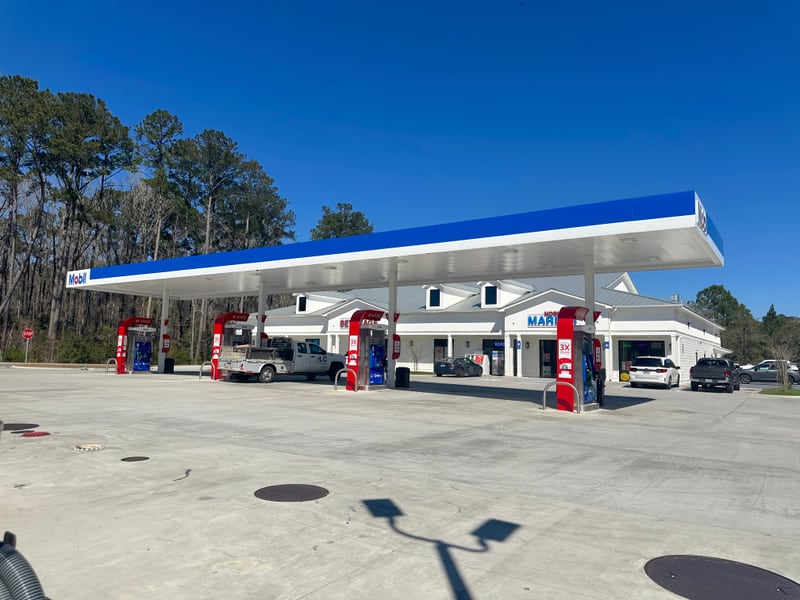
The representative site. A proposed ~5,400-square-foot branded store with twelve fueling positions, a quick-service food program, and a single-bay express tunnel car wash, sited on a ~1.9-acre signalized corner at a state-highway interchange in a Sun Belt secondary market roughly 35 miles from the metro core. Total project cost: ~$5.95 million . The site, trade area, and figures are illustrative composites built from public and industry data to demonstrate methodology; they do not depict a specific client or transaction.
2. The conventional reading: why the headline metrics say “decline”
A surface read of the sector's top-line indicators supports the bear case, and a disciplined study has to state that case fairly before dismantling it. Three pillars carry it.
First, electrification. California's Advanced Clean Cars II rule was written to require 100% zero-emission new-vehicle sales by 2035, with eleven other states adopting the standard (14). If new gasoline vehicles disappear from showrooms, the argument runs, the fuel island has a finite life, and a 25-year loan outlives it.
Second, saturation . The United States carries 151,975 convenience stores as of year-end 2025, a count that has drifted down 0.2% for a second consecutive year (2). A flat-to-declining national store count reads as a mature, fully built-out market with no room for a new entrant.
Third, fuel economics. Motor fuel represents roughly 65% of industry sales dollars, yet retail fuel earns a net margin of only one to two percent after card fees and operating costs (3). An asset that is two-thirds dependent on a commodity it can barely make money selling looks structurally fragile.
Each pillar is factually accurate. Each is also incomplete in a way that reverses its conclusion once the evidence is examined at the level a lender actually underwrites.
3. The first reversal: the demand cliff has been deferred, not avoided
The electrification thesis rests on a timeline. That timeline moved sharply in 2025 and early 2026, and it moved away from the cliff.
Start with the demand base. U.S. motor gasoline consumption averaged 8.9 million barrels per day in 2025, about 1% below 2024 and 4% under the 2019 pre-pandemic peak (8). The mechanism behind that decline is instructive: vehicle miles traveled actually rose 1.2%, but fleet fuel economy improved 1.9%, and the efficiency gain outran the additional driving (8)(9). Demand is eroding because cars use less fuel, not because Americans have stopped driving, a slow, predictable grind rather than a collapse.
Then the policy break. On June 12, 2025 , Congressional Review Act resolutions revoking the federal waivers underpinning Advanced Clean Cars II were signed into law, rendering the 2035 mandate unenforceable pending litigation that remains unresolved as of June 2026 (15). Weeks later, the federal $7,500 electric-vehicle purchase credit expired on September 30, 2025 (10). The market response was immediate: EV share of new-vehicle sales fell to 5.8% in the first quarter of 2026, down from a 7.5% peak the prior summer, as buyers who had pulled purchases forward vanished from the showroom (10).
- Gasoline demand (mn b/d)
- EV share - actual
- EV share - 2024 outlook (pre-reversal)
- EV share - 2025 outlook (current)
The numbers behind this chart
| Category | Gasoline demand (mn b/d) | EV share - actual | EV share - 2024 outlook (pre-reversal) | EV share - 2025 outlook (current) |
|---|---|---|---|---|
| 2019 | 9.31 | 2 | ||
| 2020 | 8.03 | 2 | ||
| 2021 | 8.8 | 4 | ||
| 2022 | 8.78 | 5.8 | ||
| 2023 | 8.93 | 7.6 | ||
| 2024 | 8.99 | 8.1 | 8.1 | 8.1 |
| 2025 | 8.9 | 7.8 | 16 | 11 |
| 2026 | 8.92 | 5.8 | 25 | 14 |
| 2028 | 8.75 | 38 | 21 | |
| 2030 | 8.55 | 48 | 27 |
Forecasters followed the evidence down. BloombergNEF cut its projection for U.S. electric-vehicle penetration to 27% of sales by 2030, nearly half the share it had projected a year earlier, and the International Energy Agency made a comparable reduction to roughly 20% (11)(12). Layered on top is the physics of fleet turnover: the average U.S. light vehicle is now 12.8 years old, and even aggressive new-EV sales take decades to displace an installed base of 289 million gasoline vehicles (13).
Gasoline demand is not falling off a cliff. It is descending a long, shallow ramp, and the ramp is comfortably longer than a 25-year amortization schedule.
Exhibit A, The deferred timeline
| Development | Date | Effect on fuel-demand horizon |
|---|---|---|
| CRA revocation of ACC II waivers | Jun 2025 | 2035 mandate unenforceable; litigation pending |
| $7,500 federal EV credit expires | Sep 2025 | EV share fell to 5.8% (Q1 2026) |
| BloombergNEF 2030 forecast cut | Jun 2025 | ~48% → 27% of sales |
| IEA 2030 forecast cut | Jun 2025 | ~50% → ~20% of sales |
| Average U.S. vehicle age | 2025 | 12.8 yrs, slow fleet turnover |
Policy status is contested and fast-moving; figures current as of June 2026. Sources: CARB; EPA/CRA; BloombergNEF; IEA; S&P Global Mobility.
4. The second reversal: the asset was never a fuel play
The most consequential misreading in the bear case is treating a convenience center as a fuel business. It is not. Fuel is the traffic generator; the store is the business, and the store is where the durable, financeable margin lives.
The numbers make the inversion plain. Fuel accounts for roughly 65% of industry sales but only 38.8% of gross profit dollars. Inside sales run the opposite way: a smaller share of revenue, a far larger share of profit. Within the store, foodservice is the engine, 28.5% of in-store sales generating 38.9% of in-store gross profit, a category that has expanded from under 12% of in-store sales two decades ago (1)(4).
The 2025 figures sharpen the point in a way lenders should internalize. Industry research found the typical in-store basket actually lost roughly seven cents per transaction in 2025 once operating costs were absorbed, meaning fuel margin, which averaged over 40 cents per gallon, was what kept stores profitable that year (5). Read carelessly, that says fuel matters most. Read correctly, it says the opposite for underwriting: a site that depends on commodity fuel margin to break even is fragile, while a site with a differentiated, high-margin food and merchandise program controls its own profitability. The bankable deal underwrites on the blend, and weights the inside store, where the operator has pricing power, over gallons, where it does not.
- Share of sales
- Share of gross profit
The numbers behind this chart
| Category | Share of sales | Share of gross profit |
|---|---|---|
| Motor fuel | 65 | 38.8 |
| Foodservice | 10 | 23.8 |
| Other merchandise | 25 | 37.4 |
Exhibit B, Where the money is made (U.S. convenience channel, 2025)
| Category | % of sales | % of gross profit |
|---|---|---|
| Motor fuel | ~65.0% | ~38.8% |
| Foodservice (in-store) | 28.5% | 38.9% |
| Other merchandise (in-store) | balance | balance |
In-store percentages are shares of in-store totals; fuel percentages are shares of the total business. Source: NACS State of the Industry (2025 data, released April 2026).
5. The third reversal: exurban is the insulated profile
The saturation argument relies on a national store count, but no lender finances a national average. They finance a site in a trade area, and location is precisely where the electrification risk sorts winners from losers.
The Boston Consulting Group's own analysis of fuel retail through the transition is unambiguous on this point: the sites most exposed to EV displacement are urban and residential locations, where drivers will increasingly charge at home and the forecourt loses its reason to exist. The sites most insulated are highway-stop and exurban locations, where refueling demand is generated by travel, not by the resident next door, and where home charging is a weak substitute for a fill-up on a 200-mile trip (24). The representative site sits squarely in the insulated cohort.
And the “saturated market” framing inverts at the trade-area level. The five-mile ring around the site holds a population growing ~2.8% annually, more than five times the national rate, against roughly 14,800 rooftops with another ~3,100 permitted or under construction, served by a combined interchange traffic count near 28,500 vehicles per day (19). Measured against fuel-and-convenience supply per capita, the corridor is not over-stored; it is under-served, with rooftops outrunning the pace of new retail. A national count that is flat conceals local markets that are growing, and this is one of them.
Exhibit C, Trade-area & demand-capture snapshot (representative site, 5-mile ring)
| Indicator | Representative site | National reference |
|---|---|---|
| Population growth (annual) | ~2.8% | ~0.5% |
| Median household income | ~$94,000 | ~$80,600 |
| Existing rooftops (5-mi) | ~14,800 | |
| Permitted / under construction | ~3,100 | |
| Interchange traffic (AADT) | ~28,500 | |
| Fuel-and-convenience supply / capita | below benchmark | benchmark |
Illustrative modeled values constructed from public demographic, traffic, and supply data. Source: MMCG database; U.S. Census; state DOT traffic counts.
6. Unit economics and capital markets
Three reversals establish that the asset is structurally sound. The capital stack and pro forma establish that it is financeable.
The structure. Total project cost of ~$5.95 million is financed through a combined SBA structure: a 504 tranche covering owner-occupied real estate and long-life equipment alongside a 7(a) tranche for soft costs, equipment, and working capital, on roughly 10% borrower equity . The timing is favorable. Effective July 4, 2026 , the SBA's combined 7(a)-plus-504 ceiling doubles to $10 million , decoupling the two programs and giving capital-intensive fuel-and-convenience projects materially more SBA-backed headroom than the prior $5 million cap allowed (16). That change lands days before this analysis and directly expands the financeable project envelope for exactly this asset type.
The ramp. Fuel volume is modeled to build from roughly 92,000 gallons per month in Year 1 to a stabilized ~135,000 gallons per month by Year 3, comfortably above the ~100,000-gallon threshold that separates viable from marginal sites, and well short of mega-format volumes. Inside sales stabilize near $205,000 per month with foodservice at roughly 29% of the inside mix, and the express car wash contributes a high-margin, subscription-driven ~$22,000 per month. On the blended cash flow, debt service coverage stabilizes at 1.41× and holds at 1.28× under a stressed downside that combines a slower ramp with fuel-margin compression, above the 1.25× line a prudent committee requires.
Exhibit D, Capital stack & stabilized economics (representative site)
| Metric | Base case | Stressed case |
|---|---|---|
| Total project cost | ~$5.95M | ~$5.95M |
| Borrower equity | ~10% | ~10% |
| Stabilized fuel volume (gal/mo) | ~135,000 | ~112,000 |
| Stabilized inside sales (mo) | ~$205,000 | ~$182,000 |
| Stabilized DSCR | 1.41× | 1.28× |
Illustrative modeled figures. Stressed case combines a slower demand ramp with fuel-margin compression. Source: MMCG analysis.
The credit context. Fuel-and-convenience is a category lenders understand, but it is also one that demands respect. Analysis of SBA 7(a) and 504 records through the MMCG Feasibility Index places the historical default rate for gasoline stations with convenience stores near 10%, several times the program-wide average, driven by environmental liability, thin fuel margins, and a history of under-qualified operators (18). Two findings from that dataset shape a sound structure rather than a decline. Loan term is decisive: shorter-amortization paper has historically defaulted at multiples of the rate on longer-term, real-estate-secured loans, which argues for the long 504-anchored structure used here. And operator quality dominates outcomes, which argues for an experienced borrower or a retained management partner. Priced and structured for those facts, the elevated category default rate is a premium to manage, not a reason to decline.
7. The risk framework: what can go wrong, and why none of it is disqualifying here
A credible feasibility analysis does not wave away risk; it prices each exposure and shows why a well-structured deal absorbs it.
Fuel-price volatility. Retail fuel margins move inversely to wholesale spikes, when crude jumps, retailers absorb part of the increase to stay competitive, compressing margin in the short run. The 2026 Strait of Hormuz disruption, which pushed U.S. gasoline up roughly a dollar a gallon, is the textbook case (6). This is a cash-flow timing risk for an adequately capitalized operator, not a solvency risk, and the stressed DSCR already reflects it.
Labor. The average convenience-store wage reached $15.04 per hour in 2025 against turnover that runs well above the retail norm, and the foodservice pivot that drives profitability also raises labor intensity (1). The pro forma carries wage inflation and training cost explicitly.
Environmental. Underground storage tanks carry real compliance, financial-assurance, and contamination-history obligations that materially affect acquisition risk and ongoing cost. These are matters for qualified environmental professionals conducting the appropriate site assessments, a diligence input the lender should require at the front of the calendar, distinct from and complementary to the market and financial feasibility analysis. A clean environmental pathway is a condition of the structure described here.
Other exposures. Record card-interchange costs, the channel paid $21.3 billion in 2025, sit second only to labor among operating costs and face an uncertain legislative path (1).
Cigarettes are in structural secular decline and should be modeled as a shrinking annuity, not a growth line. And in trade areas with heavy electronic-benefit dependence, 2025 federal nutrition-program reductions warrant a haircut to inside-sales projections. The representative corridor, higher-income and growth-driven, carries limited exposure on the latter two.
8. What the lender saw: the real risk is execution on the inside, not the transition
Assembled, the analysis relocates the risk . The threat to this asset is not that the automobile goes electric within the loan term, the evidence says it will not, at the pace required to strand a well-sited exurban site. The threat is ordinary operating risk: whether the operator can build and run a differentiated food program, hold fuel margin through volatility, and execute on the inside store where the margin actually lives. That is a risk lenders know how to underwrite.
The sector sorts cleanly into winners and losers over the coming decade, and the representative site falls on the right side of every line.
Exhibit E, Winners and losers over the SBA horizon
| Best positioned | Most at risk |
|---|---|
| High-traffic highway / exurban sites | Urban & residential, home-charging-exposed |
| Foodservice-forward formats | Small-format, fuel-dependent |
| Well-capitalized operators | Undercapitalized single units |
| Strong real estate with land optionality | Poor locations, dated infrastructure |
Framework synthesized from BCG and McKinsey fuel-retail transition analysis. Sources: BCG (2024); McKinsey & Company.
The deal is bankable over a 25-year SBA horizon on five conditions, each satisfied in the structure analyzed: adequate borrower equity; an experienced operator or retained management; genuine foodservice depth rather than a token offer; front-loaded environmental diligence by qualified professionals; and a branded fuel-supply agreement that secures volume. Remove any one and the recommendation tightens.
It would also be intellectually honest to name what reverses the conclusion. Were a court to reinstate the zero-emission mandates, a future Congress to restore EV incentives, and electric-vehicle share in the relevant state to resume climbing past the high teens, the demand-decline curve would steepen and a long-horizon fuel-anchored loan would warrant re-underwriting. None of those conditions holds as of June 2026; all are worth monitoring across the life of the credit.
9. Methodology: how this analysis was built
The feasibility framework integrates national sector performance, SBA program data, demand and policy analysis, and trade-area modeling into a single lender-grade view. Macro and demand evidence is drawn from primary authorities, the U.S. Energy Information Administration, the Federal Highway Administration, the SBA, CARB and the EPA, alongside NACS State of the Industry data and capital-markets research from net-lease specialists. SBA loan-performance benchmarking derives from the MMCG Feasibility Index, our analysis of SBA 7(a) and 504 records . Trade-area, supply, and unit-economics figures for the representative site are illustrative composites constructed from public demographic, traffic, and industry data to demonstrate the methodology a lender receives in a full engagement. The analysis supports the underwriting decisions of lenders and investors; it does not constitute and is independent of the credit decision itself.
Financing or evaluating a fuel-and-convenience asset?
MMCG Invest produces independent, lender-grade feasibility studies for SBA 7(a), SBA 504, USDA B&I, and conventional programs across 30+ asset classes, the analysis a credit committee relies on to underwrite with confidence.
June 29, 2026, by Michal Mohelsky, J.D. Principal of MMCG Invest, LLC, feasibility study company offering feasibility studies for fueling and gas stations with c-stores.
Reach out to discuss how our methodology supports your lending decision.
Michal Mohelsky, J.D. | Principal | mmcginvest.com
Contact: michal@mmcginvest.com
Phone: (628) 225-1110
Representative engagement. This case study presents a representative engagement. The site, trade area, capital stack, and financial figures are illustrative composites constructed from public and industry data to demonstrate MMCG's analytical methodology; they do not depict a specific client, property, or transaction. Statistical and policy data are current as of June 2026 and, where contested, are flagged as such. Nothing herein is investment, legal, or tax advice.
Sources
- NACS, State of the Industry, 2025 data, released April 2026.
- NACS / NIQ TDLinx, Convenience Industry Store Count, as of December 31, 2025.
- NACS, “Who Makes Money Selling Gas?”, retail fuel margin and net-margin analysis.
- NACS Magazine, “5 Key Metrics Defining the Convenience Industry's Health,” June 2026.
- NACS Magazine, “5 Big Takeaways From the 2026 NACS State of the Industry Summit,” June 2026.
- U.S. Energy Information Administration, Short-Term Energy Outlook, 2026 editions.
- U.S. Energy Information Administration, Annual Energy Outlook 2026, April 8, 2026.
- U.S. Energy Information Administration, “Today in Energy”, U.S. motor gasoline consumption, April 2026.
- Federal Highway Administration, Traffic Volume Trends, 2025.
- Cox Automotive / Kelley Blue Book, Electric-Vehicle Sales Report, Q1 2026 (March 2026).
- BloombergNEF, Electric Vehicle Outlook 2025, June 2025.
- International Energy Agency, Global EV Outlook 2026.
- S&P Global Mobility, average age of U.S. light vehicles, May 2025.
- California Air Resources Board, Advanced Clean Cars II regulation.
- U.S. EPA / U.S. Congress, Congressional Review Act resolutions on California emissions waivers, signed June 12, 2025.
- U.S. Small Business Administration, Policy Notice 5000-879058, combined 7(a)/504 limit raised to $10M, effective July 4, 2026.
- U.S. Small Business Administration, SOP 50 10 8, effective June 1, 2025.
- MMCG Feasibility Index, analysis of SBA 7(a)/504 loan records, gasoline stations with convenience stores (NAICS 447110).
- MMCG database, fuel-and-convenience trade-area, supply, and market-sizing estimates.
- The Boulder Group, Net Lease Tenant Profiles Report, Q1 2026.
- Matthews Real Estate Investment Services, C-Store Market Report, 2025.
- Northmarq, Single-Tenant Net Lease Report, Q1 2025.
- BizBuySell, Convenience Store Valuation Benchmarks, 2025.
- Boston Consulting Group, “The EV Opportunity for Fuel Retailers,” 2024.
- McKinsey & Company, fuel-retail and EV-charging value-pool analysis.

Michal Mohelsky, J.D., FMVA, Practicing Affiliate of the Appraisal Institute
Principal, MMCG Invest, LLC
Published June 29, 2026. How this analysis was prepared.
Cite this
Michal Mohelsky, J.D., FMVA (2026). Feasibility Case Study: Underwriting a Gas Station In The Age Of The EV. MMCG Invest, LLC. https://www.mmcginvest.com/post/underwriting-a-gas-station-in-the-age-of-the-ev
Where this goes next
- Gas Station Feasibility StudyMMCG's feasibility study page for this subject.