Summary
For an RV park, a hotel, a glamping resort or a short-term rental, an annual average occupancy figure cannot support a financing decision, because the property services debt one month at a time and defaults at the trough. Yellowstone National Park drew roughly 4.7 million recreation visits in 2024 with a July peak approaching one million and deep winter months in the tens of thousands, a peak-to-trough ratio on the order of twenty-five to one, while Zion drew a comparable annual total on a curve closer to five to one.
Once a property's peak-to-trough ratio exceeds roughly four to one, an annual-average pro forma should be treated as presumptively inadequate and monthly modeling becomes mandatory. The monthly curve produces the two figures a lender uses: the trough-month debt service coverage ratio, measured against SBA's 1.15 to one minimum for most 7(a) loans over $350,000 and hotel minimums that commonly run from the mid-1.30s to 1.50 to one, and the operating reserve, sized from the deepest point of the cumulative cash drawdown.
Written for SBA and USDA lenders, Bank and CDC credit officers, RV park and glamping developers, Hotel and short-term rental sponsors. 22 minute read.
Key figures
- Yellowstone recreation visits
- roughly 4.7 million
- U.S. National Park Service, Visitor Use Statistics [1]2024
- Yellowstone peak-to-trough ratio
- on the order of twenty-five to one
- National Park Service monthly recreation-visit data [1]Monthly distribution across the year
- Peak-to-trough ratio, European accommodation sector
- roughly 3.7 to one on average, ranging above twenty in the most concentrated coastal destinations
- Eurostat, Seasonality in the tourist accommodation sector [2]
- Florida seasonal residents present in winter
- roughly eighty percent, against less than ten percent in summer
- Smith and House (2006), seasonal migration literature [3]January, February and March, against the summer months
- Hotel stabilization ramp
- roughly three years, with about seventy-seven percent of stabilized occupancy in the first year and ninety-one percent in the second
- O'Neill (2011), Cornell Hospitality Quarterly, a study of several thousand hotels [4]First three operating years
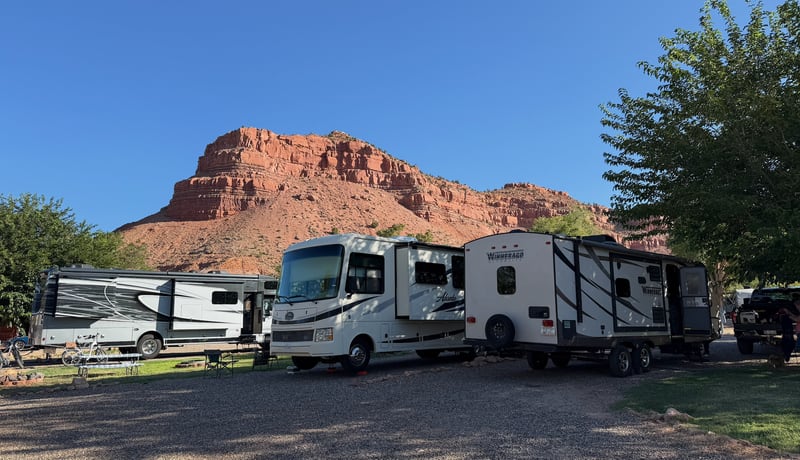
Recreational vehicles drawn up on their gravel pads beneath the banded sandstone cliffs outside Kanab, Utah, a high-desert gateway community on the doorstep of Zion National Park. Sites like these run on a pronounced seasonal rhythm, filling through the spring and fall shoulders and the summer peak that pulls travelers toward the parks, and emptying in the off-season. It is exactly the pattern that makes month-by-month modeling, rather than an annual average, the honest way to underwrite an outdoor-hospitality asset.
Photograph by Michal Mohelsky, principal, MMCG Invest .
A proposed resort hotel pencils out at a 1.40x debt service coverage ratio. The annual numbers are clean, the sponsor is credible, and the loan committee approves. Eighteen months after opening, the property misses a February mortgage payment.
Nothing in the annual model was wrong. The property earned exactly the revenue the feasibility study projected. The failure was structural and entirely predictable: the study reported a single blended occupancy figure for the year, and that figure averaged a near-full July against a near-empty February. The lender underwrote to the mean. The default happened at the trough.
This is the central problem with how seasonality is treated in most feasibility work. For a stabilized office building or a multifamily property with annual leases , an annual average is a fair representation of earning power. For an RV park, a hotel, a glamping resort, or a short-term rental, the annual average is a fiction that hides the only months that matter. A property does not service debt with an annual average. It services debt twelve times a year, one month at a time, and the question that determines survival is whether it can cover its obligations in the worst of those months, not the typical one.
The thesis of this analysis is direct. For highly seasonal assets, annualized occupancy and revenue modeling is not a simplification. It is an analytical failure that produces financing decisions disconnected from the cash flows that actually repay the loan. A defensible feasibility study models seasonality month by month, and then translates that monthly curve into the two outputs a lender requires: the trough-month debt service coverage ratio, and the operating reserve sized to bridge the off-season. Everything that follows is an account of how to do that, and why the alternative is indefensible.
Seasonality Is Not a Footnote
The instinct to annualize comes from a reasonable place. Annual figures are how income is reported, how cap rates are quoted, and how the income approach to value is constructed. The problem is that the four asset classes examined here do not earn income evenly, and they do not even err in the same direction.
Consider two outdoor recreation destinations with nearly identical annual visitation. Yellowstone National Park drew roughly 4.7 million recreation visits in 2024, concentrated almost entirely into a five-month window. Its July peak approached one million visits, while the deep winter months ran in the tens of thousands once the roads closed [1]. Zion National Park drew a comparable annual total, but its monthly distribution is a broad May-through-October plateau with strong spring and fall shoulders and only a mild winter dip [1]. Yellowstone's peak-to-trough ratio runs on the order of twenty-five to one. Zion's is closer to five to one. Two assets, the same headline number, and radically different cash-flow risk. An annual average describes neither.

Viola Sauer of MMCG Invest at the entrance to Zion National Park. Zion is one of the most heavily visited parks in the national system, and that visitation is the demand engine behind the region's lodging, RV, and short-term-rental market, a market whose seasonal curve is broad and shoulder-heavy rather than a single summer spike.
Photograph by Michal Mohelsky.
The directional point is just as important as the magnitude. Seasonality is not a single shape that scales up or down. A northern RV park and a ski-town hotel both peak when a beach rental troughs. A snowbird RV resort in the desert Southwest is the photographic negative of a campground in the upper Midwest: it fills in January and empties in July. The seasonal migration literature documents the scale of this inversion directly. Roughly eighty percent of Florida's seasonal residents are present during January, February, and March, against less than ten percent in the summer months [3]. A model that applies a generic seasonal assumption to a desert asset, or that treats all hospitality as summer-peaking, will be wrong by the full amplitude of the curve.
The takeaway is that seasonality is a property-specific, market-specific, and climate-specific variable. It cannot be borrowed from a generic template, and it cannot be collapsed into one number without destroying the information a lender needs most.
Measuring Seasonality With Precision
If seasonality is going to drive a financing recommendation, it has to be measured, not described. The tourism economics and hospitality literature provides a precise vocabulary for this, and a feasibility study built to a professional standard should use it rather than vague language about a property being "seasonal."
The most intuitive measure is the peak-to-trough ratio : the busiest month's demand divided by the slowest month's. Across the European accommodation sector, this ratio averaged roughly 3.7 to one, but it ranged from near-flat urban markets to factors above twenty in the most concentrated coastal destinations [2]. The ratio is the single number most worth putting in front of a credit committee, because it states plainly how far the trough sits below the peak.
Three further measures add rigor. The coefficient of variation of the twelve monthly figures expresses dispersion as a single dimensionless number, allowing one market to be compared cleanly against another. The seasonality ratio expresses the peak month as a share of total annual demand, capturing how much of the year's revenue is concentrated in a single window. And the Gini index of seasonal concentration , drawn from the same mathematics used to measure income inequality, summarizes the entire distribution on a zero-to-one scale, where zero is perfectly even across the calendar and values approaching one indicate that demand collapses into a single month [2]. Eurostat itself reports the Gini index in its seasonality work, and the academic literature treats it as the best-behaved summary measure of the four.
A study that opens its seasonality section with these four metrics signals immediately that the analysis is quantitative. It also sets up the rest of the report, because the amplitude of the curve determines how much the trough-month and reserve analysis will matter. As a working threshold, once a property's peak-to-trough ratio exceeds roughly four to one, an annual-average pro forma should be treated as presumptively inadequate and monthly modeling becomes mandatory.
Four Asset Classes, Four Distinct Curves
The four asset classes in this analysis are all seasonal, but each is seasonal in its own way, and the structure of that seasonality changes what the feasibility study has to model.
RV Parks: the mix is the curve
The single most important variable in RV park seasonality is the ratio of transient sites to long-term and annual sites . Transient guests pay the highest nightly rates but turn over constantly and concentrate in peak season, which produces a spiky, volatile curve. Long-term and seasonal tenants pay lower effective rates but occupy their sites for months at a time, which smooths both occupancy and revenue and behaves much more like apartment income . Two parks with identical annual occupancy can therefore have entirely different trough-month cash flows depending on how much of the rent roll is locked into annual leases. Industry benchmarking places median full-hookup occupancy in the high sixties across the months of operation, but the distribution behind that figure depends almost entirely on the site mix [12].
Layered on top of the mix is geography. Northern parks run a compressed five-to-six-month season and frequently close entirely from late fall through spring. Sun Belt parks invert the calendar, filling with winter visitors and emptying in the summer heat. A feasibility study that does not specify the mix and the climate zone has not described the asset.
Hotels: the second dimension
Hotels add a complication the other three asset classes do not face: a second seasonal axis running through the week. Business and urban hotels peak midweek, on Tuesday and Wednesday nights, and trough on weekends. Leisure and resort hotels do the reverse, peaking Friday and Saturday and emptying midweek [8]. This means a hotel's true cash-flow trough is not a month but a cell, the intersection of its weakest month and its weakest day of the week. A business hotel's worst night is a Saturday in January; a resort's is a Tuesday in November. A monthly model alone understates the depth of the genuine trough, and segment behavior compounds this further, since group and convention demand carries its own rhythm that concentrates in the spring and fall shoulders.
Glamping: the shortest, most weather-exposed season
Glamping sits at the severe end of the spectrum. Its operating season is set not by the calendar but by what the structure can physically withstand. Uninsulated safari tents and traditional yurts are warm-season products, often viable only four to eight months a year, while insulated cabins and engineered geodesic domes can operate year-round. The result is extreme concentration: warm-season operators frequently earn the large majority of annual revenue in four or five months, with peak occupancy in the seventies to nineties collapsing to off-season figures in the teens and twenties. The asset commands a high average daily rate, reported at roughly $251 nationally in recent industry data , but that rate is realized in a narrow window [13][19]. Weather is the dominant demand driver, severe enough that a category of weather-guarantee insurance products has emerged specifically to protect outdoor-hospitality bookings against it.
Short-term rentals: archetype and regulation
Short-term rentals are the most dispersed of the four. There is no single STR curve, because the curve is defined by what draws demand to the location. A flat urban market can be nearly as stable as a year-round hotel, while a ski cabin can be as concentrated as a glamping tent. National short-term rental occupancy swings from a summer peak around the mid-sixties to a winter trough in the low forties, but that national figure conceals beach markets, mountain markets, desert markets, and lake markets that each behave differently [11]. STR also carries a risk the other three do not: regulatory truncation. A permit cap, a primary-residence requirement, or an outright phase-out can eliminate the income stream by ordinance rather than by weather. This is a discrete, binary risk that no seasonal curve captures, and it belongs in any STR feasibility study as a separate downside scenario.
Building a Curve With No Operating History
The obvious objection to monthly modeling is that a proposed property has no operating history from which to derive a seasonal curve. This is precisely the analytical problem worth solving, and it is where a feasibility study earns its fee. The curve is constructed from external proxy data that shares the subject property's demand drivers and climate, then triangulated across more than one source so that no single dataset carries the whole conclusion.
Several proxies are available, and most of the best ones are free. The National Park Service publishes monthly visitation by park unit going back decades, which is an excellent proxy for outdoor-recreation demand timing relevant to RV parks and glamping [1]. For hotels, the recognized standard is market-level RevPAR seasonality from STR and CoStar [8]. For short-term rentals, market dashboards from AirDNA and reservation-sourced data from property-management aggregators provide monthly occupancy and rate curves by submarket [11]. Underlying all of these, NOAA Climate Normals supply the monthly temperature and precipitation patterns that physically drive outdoor demand and explain the snowbird inversion [15], while gasoline price seasonality from federal energy data serves as a travel-cost signal for drive-to RV markets [16]. Search-interest data rounds out the picture as a leading indicator of demand timing. The discipline is to use the proxy as an analogy for demand timing, disclose the mapping from proxy to subject, and never present a borrowed curve as if it were the property's own.
The method applied to that proxy data should be transparent and appropriate to the thin data available. Monthly hospitality revenue scales with the level of the series, so a multiplicative decomposition is the correct default, and the ratio-to-moving-average method produces interpretable monthly seasonal indices that any credit officer can follow [9]. Where several years of comparable data exist, a more robust decomposition such as STL is appropriate. What is not appropriate is reaching for the heaviest available machinery.
The Census Bureau's X-13ARIMA-SEATS is the gold standard for seasonally adjusting long, mature government time series, but it is designed to need many years of clean monthly history and forbids missing values [10]. A proposed property has no history at all. Applying it here would be a category error, and the simpler proxy-driven approach is not a compromise but the correct fit for the problem.
From Curve to Credit Metric: the Trough-Month DSCR
Once a monthly revenue curve exists, the analysis that lenders actually use becomes possible. Monthly revenue, less monthly operating costs, produces a monthly net cash flow, and that cash flow divided by the monthly debt service produces a debt service coverage ratio for each month of the year . The annual coverage ratio is the figure most reports stop at. The trough-month coverage ratio is the figure that determines whether the loan is safe.
The gap between the two is where the danger lives, and it is wider than intuition suggests because operating costs do not fall as fast as revenue . A property's fixed costs, debt service, insurance, property taxes , and a baseline of staffing and utilities, persist through the off-season even when revenue has collapsed. European data on the accommodation sector illustrates the effect: third-quarter output ran far above the annual average while employment was only modestly elevated, which means fixed costs carry through the trough and amplify the cash-flow stress rather than cushioning it [2]. A property can therefore clear a comfortable annual coverage ratio and still run below break-even for several consecutive months.
The numbers behind this chart
| Category | Series 1 |
|---|---|
| Apr | 1.18 |
| May | 1.75 |
| Jun | 2.35 |
| Jul | 2.61 |
| Aug | 2.4 |
| Sep | 1.7 |
| Oct | 1.15 |
| Nov | 1.06 |
| Dec | 0.62 |
| Jan | 0.55 |
| Feb | 0.5 |
| Mar | 0.78 |
The practical standard is to report both ratios and to count the consecutive months below 1.0x. If every month clears coverage, the deal is structurally sound and a conventional structure will suffice. If one to three months fall short, a reserve or a seasonal line of credit is indicated. If four or more months fall short, which is typical of northern RV parks and single-season resorts, the deal requires a dedicated seasonality structure and will be difficult to finance conventionally without additional equity. None of these distinctions is visible in an annual average.
Sizing the Reserve
The trough-month coverage ratio tells a lender whether a problem exists. The reserve analysis tells them how large it is and how much cash must be set aside to bridge it. This is the second deliverable a monthly model produces, and it is impossible to size honestly any other way.
The method is to run the monthly net cash flow as a cumulative figure across the year. During peak months the cumulative balance builds; during the trough it draws down. The deepest point of that drawdown, the largest cumulative deficit the property reaches before peak revenue replenishes it, is the minimum operating reserve the asset requires. A buffer for stress and timing is then added on top. This is a precise, defensible number derived directly from the curve, rather than a rule of thumb pulled from the air.
The capital markets have built explicit machinery around exactly this problem, and a feasibility study should map its reserve recommendation to the channel that will finance the deal. In the CMBS market, seasonal hotels routinely carry a seasonality reserve escrow that traps extra cash during peak months so that mortgage payments can be made from the reserve during the off-season, when the borrower makes no payments directly [17]. Project-finance-style debt service reserve accounts are conventionally sized at six to twelve months of debt service. On the federal side, the Small Business Administration offers a Seasonal CAPLine, a revolving line of credit sized off the borrower's projected seasonal buildup of receivables, inventory, and labor, available to businesses that can demonstrate an established pattern of seasonal activity [6]. The USDA Business and Industry program permits working capital but requires it to be structured as a term loan rather than a revolving line , a distinction that matters for seasonal operators and that a study should flag [7]. In every one of these structures, the reserve is sized off a monthly curve. A flat annual figure cannot produce any of them.
The Opening-Month Effect and the First-Year Ramp
There is one further dimension that annualized modeling not only obscures but actively mishandles: the first operating year of a newly built property. A new hospitality asset does not open at stabilized occupancy. It ramps over a period of years, and for a seasonal asset that ramp interacts with the seasonal curve in a way that makes the single calendar decision of when to open one of the most consequential variables in the entire model.
The ramp itself is well documented. A study of several thousand hotels found that the average property took roughly three years to stabilize, achieving about seventy-seven percent of its stabilized occupancy in the first year, ninety-one percent in the second, and full stabilization in the third [4]. Other work using a larger sample found that new hotels took close to two years to reach the occupancy levels of comparable established properties, with branded and managed hotels ramping faster than independents [5]. Outdoor-hospitality assets follow a similar trajectory, often opening in the thirty-to-forty percent occupancy range and stabilizing over three to four years.
The opening-month effect compounds with this ramp. The same hotel study encoded the logic in how it treated first years: a property opening in the first quarter was credited a full operating year, one opening mid-year a half year, and one opening in the final quarter effectively a non-operating stub [4]. For a seasonal asset the stakes are sharper than for an urban hotel. A property that opens into its peak season captures the year's concentrated revenue immediately and builds an operating-cash and reputation base before the trough arrives. A property that opens into its trough does the opposite: it burns reserves through months of structurally low demand while sitting at the very bottom of its ramp curve, facing two independent discounts at once, the ramp discount and the seasonal discount, multiplied together.
The implication for method is unambiguous. The first operating year of a seasonal asset must be built forward from the actual opening month, applying the ramp curve and the seasonal index simultaneously. Pro-rating an annual stabilized figure across a partial first year, the common shortcut, systematically overstates early cash flow and understates the reserve the property will need to survive its first winter. A study that runs an opening-timing sensitivity, showing the lender the cash-flow and reserve-burn difference between a peak opening and a trough opening, operationalizes exactly the risk that determines whether a new seasonal property reaches stabilization at all.
What This Means for the Financing Decision
The reason all of this matters is that every lending channel that finances these four asset classes underwrites to monthly cash flow at some level, even when the feasibility study in front of the loan officer reports only annual figures. Connecting the monthly model to the channel is what turns analysis into a financing recommendation.
In the SBA channel, the governing standard requires a minimum debt service coverage ratio of 1.15 to one for most 7(a) loans over $350,000 , computed on annualized cash flow [6]. The Seasonal CAPLine exists alongside it precisely because the annual figure conceals the pre-season working-capital crunch, and a study that sizes that line from the monthly curve gives the lender something it can act on. For owner-operated RV parks, campgrounds , glamping resorts , and small hotels , this channel can finance the interest reserve and post-opening working capital directly into a self-amortizing loan, which is well suited to the ramp.
In the USDA Business and Industry channel, rural assets in eligible markets can access guarantees up to substantial loan sizes, but the program enforces equity and feasibility discipline, requires working capital as a term loan rather than a revolver, and expects debt service coverage modeled with explicit sensitivity testing [7]. For a seasonal asset, that sensitivity testing is not credible without a monthly model.
In the conventional and CMBS channels, the bar is higher. Hotel coverage minimums commonly run from the mid-1.30s to 1.50 to one, debt yield becomes a binding constraint, and lenders cap underwritten occupancy, stress net operating income, and impose lockbox and cash-management structures that can trap cash precisely when a seasonal property most needs it [8][17]. The seasonality reserve escrow is the market's purpose-built answer, and its sizing flows directly from the monthly curve. Recent distress data underscores why lenders insist on this discipline: CMBS lodging delinquency rose sharply in early 2026, the largest property-type increase in its month [17].
Across all four channels, the pattern is the same. The metrics that decide the loan are monthly in nature, the reserve mechanisms are sized off monthly cash flow, and the structure recommendation depends on knowing how many months fall below coverage. A feasibility study that stops at the annual average leaves every one of these questions unanswered and forces the lender either to do the work itself or to approve the loan without it.
The Standard of Care
The argument here reduces to a single proposition. For office, industrial, and stabilized multifamily assets, an annual average is an honest summary of earning power, and seasonality modeling adds little. For RV parks, hotels, glamping resorts, and short-term rentals, the annual average is the one figure most likely to mislead, because it averages away the trough months where these properties default and the off-season cash deficits that determine how much reserve they need. Modeling seasonality month by month, deriving the trough-month coverage ratio, sizing the reserve from the cumulative cash position, and building the first year forward from the actual opening date along both the ramp and the seasonal curve, is not an enhancement to the standard feasibility study for these asset classes. It is the standard, and anything less is an analysis that cannot support the financing decision it claims to inform.
The lenders and investors who rely on these studies are underwriting to the trough whether the study models it or not. The only question is whether the work is done in the feasibility study, where it belongs, or left to be discovered in a February that the annual average never saw coming.
June 22, 2026, by Michal Mohelsky, J.D. Principal of MMCG Invest, LLC, feasibility study company serving feasibility studies for assisted living facilities.
Reach out to discuss how our methodology supports your lending decision.
Michal Mohelsky, J.D. | Principal | mmcginvest.com
Contact: michal@mmcginvest.com
Phone: (628) 225-1110
Disclaimer: This report is provided for informational purposes only and does not constitute investment advice. Data presented herein is derived from proprietary MMCG databases and third-party sources believed to be reliable; however, MMCG Invest makes no representation as to the accuracy or completeness of such information. Figures from third-party industry databases have been independently verified and, where appropriate, adjusted to reflect MMCG's proprietary analytical methodology. Past performance is not indicative of future results.
Sources
[1] U.S. National Park Service, Visitor Use Statistics, IRMA portal ( irma.nps.gov ) and park news releases. Monthly recreation-visit data for Yellowstone and Zion National Parks.
[2] Eurostat, "Seasonality in the tourist accommodation sector," Statistics Explained. Peak-to-trough ratios, seasonality concentration, and the Gini index across the EU accommodation sector.
[3] Smith, S.K., and House, M. (2006), "Snowbirds, Sunbirds, and Stayers: Seasonal Migration of Elderly Adults in Florida," The Journals of Gerontology: Series B, 61(5).
[4] O'Neill, J.W. (2011), "Hotel Occupancy: Is the Three-Year Stabilization Assumption Justified?" Cornell Hospitality Quarterly, 52(2).
[5] Enz, C.A., Peiró-Signes, Á., and Segarra-Oña, M. (2014), "How Fast Do New Hotels Ramp Up Performance?" Cornell Hospitality Quarterly.
[6] U.S. Small Business Administration, Standard Operating Procedure 50 10 8 (effective June 1, 2025), including 7(a) debt service coverage requirements and the Seasonal CAPLine program.
[7] U.S. Department of Agriculture, Rural Development, Business and Industry Guaranteed Loan Program, 7 CFR Part 5001.
[8] STR / CoStar, U.S. hotel performance benchmarks (occupancy, ADR, RevPAR), including day-of-week and segment reporting.
[9] Cleveland, R.B., Cleveland, W.S., McRae, J.E., and Terpenning, I. (1990), "STL: A Seasonal-Trend Decomposition Procedure Based on Loess," Journal of Official Statistics, 6(1).
[10] U.S. Census Bureau, X-13ARIMA-SEATS Reference Manual and program documentation.
[11] AirDNA, U.S. Short-Term Rental Market Review and Outlook reports. National and market-level monthly occupancy and ADR.
[12] Outdoor Hospitality Industry (OHI, formerly ARVC), Industry Benchmarking Report (2023). RV park and campground occupancy and revenue benchmarks.
[13] Cairn Consulting Group, U.S. Glamping Industry Report, presented at Glamping Show Americas (2025). Average daily rate and length-of-stay data.
[14] CBRE Hotels Research, hotel valuation methodology and stabilization guidance.
[15] NOAA National Centers for Environmental Information, U.S. Climate Normals (1991 to 2020). Monthly temperature and precipitation normals.
[16] U.S. Energy Information Administration, Gasoline and Diesel Fuel Update. Seasonal gasoline price patterns.
[17] Trepp, CMBS delinquency data (lodging sector, early 2026), as reported via industry press; CMBS seasonality reserve escrow structures.
[18] RV Industry Association (RVIA), RV shipment data and RV RoadSigns forecast.
[19] Sage Outdoor Advisory, USA Glamping Market Report (2025). Supply-side occupancy and seasonal rate data.
[20] Lundtorp, S. (2001) and Tsitouras, A. (2004), foundational treatments of the Gini index as a measure of tourism seasonality.

Michal Mohelsky, J.D., FMVA, Practicing Affiliate of the Appraisal Institute
Principal, MMCG Invest, LLC
Published June 22, 2026. How this analysis was prepared.
Cite this
Michal Mohelsky, J.D., FMVA (2026). When the Average Lies: Seasonality Modeling in Feasibility Studies for RV Parks, Hotels, Glamping, and Short-Term Rentals. MMCG Invest, LLC. https://www.mmcginvest.com/post/when-the-average-lies-seasonality-modeling-in-feasibility-studies-for-rv-parks-hotels-glamping-a
Where this goes next
- Multifamily Feasibility StudyMMCG's feasibility study page for this subject.