Summary
The U.S. car wash industry has stopped growing, and the era in which market growth forgave underwriting error is over: revenue reaches an estimated $19.2 billion in 2026 after compounding at 1.7% annually since 2021, and the MMCG model projects a 0.3% annual contraction to roughly $18.9 billion by 2031. Professional wash adoption has reached 79% of US drivers against roughly 50% in the mid-1990s, new express openings fell from 943 in 2022 to roughly 550 in 2025, and benchmarked non-member retail revenue dropped 11.9% year over year in Q2 2025.
Profitability holds, with an average operating margin near 14.1% and a profit pool of approximately $2.7 billion, while mature express sites earn 35% to 50% four-wall EBITDA margins against $4 to $8 million all-in development cost. The SBA loan tape shows $6.83 billion across 5,807 car wash loans since FY2010 with a 7(a) charge-off rate of 5.25% of resolved loans versus 7.45% across all industries, even as 7(a) approvals fell 60% from $676 million in FY2021 to $272 million in FY2025.
Written for Lenders and CDCs financing car washes under SBA 7(a) and 504, Investors and sponsors valuing car wash platforms, Developers deciding whether a new tunnel still pencils. 26 minute read.
Key figures
- U.S. car wash industry revenue
- $19.2 billion
- MMCG database, US Car Wash and Auto Detailing Industry Model, July 2026 vintage (source 1)2026 estimate
- Forecast industry revenue
- roughly $18.9 billion (0.3% annual contraction)
- MMCG database, US Car Wash and Auto Detailing Industry Model, July 2026 vintage (source 1)By 2031
- Professional wash adoption, share of US drivers
- 79%
- International Carwash Association consumer research (source 2)Current, versus roughly 50% in the mid-1990s
- New express car wash openings
- 943 locations
- CarwashOS development coverage; Amplify Car Wash Advisors (sources 13, 14)2022
- SBA-guaranteed lending to car washes, 7(a) and 504 combined
- $6.83 billion
- MMCG analysis of SBA 7(a) and 504 FOIA loan-level records (source 10)Since fiscal 2010
- Car wash 7(a) charge-off rate on resolved loans
- 5.25% (versus 7.45% for all industries)
- MMCG analysis of SBA 7(a) FOIA loan-level records (source 10)Fiscal 2010 to present
Performance, consolidation, capital markets, and the outlook to 2031 for lenders and investors.
Executive Summary
The United States car wash industry will generate an estimated $19.2 billion in revenue in 2026, having compounded at 1.7% annually since 2021 (1). The headline suggests a mature service industry drifting comfortably forward. It conceals the most turbulent half-decade in the sector's history: an institutional capital land rush, a building boom that added nearly a thousand express tunnels in a single year, a public listing that minted and then erased billions in equity value, the largest bankruptcy the industry has recorded, and the quiet exit of one of the world's largest automotive services companies from the American wash market.
The forward trajectory is one the sector has never priced. The MMCG industry model projects revenue contracting at a 0.3% annual rate to roughly $18.9 billion by 2031 (1). The logic is structural rather than cyclical. Professional wash adoption has reached 79% of US drivers , against roughly half in the mid-1990s, leaving thin conversion runway (2). New site development has fallen from 943 express openings in 2022 to roughly 550 in 2025 (13)(14). And the non-member retail customer, the marginal growth source for every new tunnel, is retreating: benchmarked retail revenue fell 11.9% year over year in the second quarter of 2025 (16).
Profitability, however, is not collapsing. The industry's average operating margin holds near 14.1% , supporting a profit pool of approximately $2.7 billion (1), because subscription mix, labor automation, and premium wash chemistry are offsetting wage inflation and softer drive-up traffic. Distress has concentrated where leverage met saturation: ZIPS Car Wash entered Chapter 11 carrying $653.9 million of funded debt (6), while disciplined express operators continue to earn 35% to 50% four-wall EBITDA margins at mature sites (14).
For lenders and investors the conclusion is uncomfortable but actionable: the era in which market growth forgave underwriting error is over. Site selection, competitive census, volume realism, and sponsor discipline now determine outcomes. That thesis organizes the nine sections that follow.
Key Car Wash Industry Statistics, 2026
Twenty figures define the state of the industry. Each is discussed, sourced, and stress-tested in the body of this analysis.
• Industry revenue, 2026: $19.2 billion (1)
• Historical growth: 1.7% CAGR , 2021 to 2026 (1)
• Forecast: -0.3% CAGR to $18.9 billion by 2031, the first sustained contraction on record (1)
• Operators: approximately 17,100 businesses across roughly 19,000 locations (1)(25)
• Employment: approximately 181,000 workers ; wages absorb roughly 29% of industry revenue (1)
• Average operating margin: 14.1% ; industry profit pool of approximately $2.7 billion (1)
• Professional wash adoption: 79% of US drivers , versus roughly 50% in the mid-1990s (2)
• New express openings: 943 in 2022 , falling to roughly 550 in 2025 (13)(14)
• Largest operator: Mister Car Wash, approximately $1.05 billion revenue, taken private at roughly $3.1 billion , or $7.00 per share (3)(5)
• Largest failure: ZIPS Car Wash Chapter 11, with $653.9 million in funded debt (6)
• Largest exit: Driven Brands sold its US car wash unit for $385 million after an $851 million goodwill impairment (4)(7)
• Net lease cap rates: 6.2% to 6.4% in 2025 to 2026, roughly 100 basis points wider than the 2022 peak (8)(9)
• Non-member retail revenue: -11.9% year over year in Q2 2025 across benchmarked sites (16)
• Express unit economics: 35% to 50% four-wall EBITDA at mature sites; $4 to $8 million all-in development cost (1)(14)
• Member loyalty: roughly 90% of wash club members express intent to renew, insulating roughly two thirds of platform revenue from discretionary pullback (2)(16)
• SBA-backed financing: $6.83 billion across 5,807 loans to car washes since FY2010, 7(a) and 504 combined (10)
• 7(a) lending arc: FY2021 peak of $676 million , falling 60% to $272 million by FY2025 (10)
• Credit performance: car wash 7(a) charge-off rate of 5.25% of resolved loans, versus 7.45% across all industries (10)
• 504 program: $4.03 billion in total project financing since FY2010, with FY2024 the record year at $163 million in debentures (10)
1. Industry Performance
Industry revenue has climbed from roughly $15.4 billion in 2016 to an estimated $19.2 billion in 2026 , a path interrupted only by the pandemic year, when suspended commuting cut washing occasions before a touchless, exterior-express recovery restored and then exceeded them (1). Growth since 2023 has been earned increasingly through price rather than volume. Subscription tier increases, premium chemistry upcharges, and the normalization of top-tier ceramic and graphene packages carried revenue while transaction counts flattened across maturing markets.
The structural story of the decade is mix. Unlimited wash programs converted an episodic cash purchase into recurring revenue ; at the largest operator, membership programs now contribute roughly three quarters of wash sales (3). Subscription revenue recognizes evenly through weather cycles, smooths the seasonality that once defined the business, and carries materially higher customer lifetime value, which is why every institutional platform built its thesis around it. The same mechanism now defines the industry's downside case: growth in members is the only reliable growth left, and penetration gains are slowing.
Margins remain the industry's most defensible attribute. The average operating margin stands near 14.1% across a fragmented operator base (1), with wages absorbing roughly 29% of industry revenue , a share that runs far leaner, often in the low-to-mid teens, at automated express exterior formats (1)(3). License plate recognition gates, automated pay stations, and centralized multi-site management have held labor hours per car on a downward path even as posted wages rose, and top-tier wash packages carry chemical costs measured in cents against price uplifts measured in dollars .
The numbers behind this chart
| Category | Series 1 |
|---|---|
| 2016 | 15.4 |
| 2017 | 16 |
| 2018 | 16.6 |
| 2019 | 17.2 |
| 2020 | 15.9 |
| 2021 | 17.6 |
| 2022 | 18.3 |
| 2023 | 18.7 |
| 2024 | 18.9 |
| 2025 | 19.1 |
| 2026E | 19.2 |
| 2027F | 19.1 |
| 2028F | 19 |
| 2029F | 19 |
| 2030F | 18.9 |
| 2031F | 18.9 |
Interactive revenue chart, 2016 to 2031, historical performance and MMCG forecast with inflection annotation
Exhibit 1. US car wash industry snapshot, 2021 to 2031F
Metric
2021
2026E
2031F
Revenue
$17.6bn
$19.2bn
$18.9bn
Five-year revenue CAGR
+3.1% (2016 to 2021)
+1.7% (2021 to 2026)
-0.3% (2026 to 2031)
Operators
~16,300
~17,100
~16,700
Employment
~168,000
~181,000
~178,000
Average operating margin
13.6%
14.1%
13.8%
Professional wash adoption (share of drivers)
77%
79%
~80% (ceiling)
Mister Car Wash remains the sector's best performance window even after its return to private ownership. The company generated approximately $1.05 billion of revenue (3), managed post-2023 comparable-store softness through pricing and premium tier migration rather than traffic growth, and was ultimately taken private by Leonard Green & Partners at $7.00 per share , a roughly $3.1 billion valuation (5). The trade said as much about public market patience as about the asset: durable cash flow, but a growth narrative the market no longer believed. MMCG reads the same inflection across the industry model: the first sustained flat-to-negative revenue phase on record, driven by a demand ceiling, a supply overhang , and a customer base sorting itself into loyal members and disappearing drive-ups (1).
2. Supply Side: The Development Wave Crests
The express boom was a construction phenomenon before it was anything else. The industry added an estimated 943 new express locations in 2022 , the crest of a wave that began around 2018 and accelerated once institutional capital validated the subscription model (13)(14). By 2025 the pace had fallen to roughly 550 openings , and MMCG expects further deceleration toward 450 or fewer in 2026 as capital costs, saturation screens, and lender caution converge (1).
Development economics explain much of the slowdown. All-in cost for a new express exterior site now runs $4 to $8 million including land, against $3 to $5 million for comparable projects at the start of the decade (14). Prime one-acre pads on high-count corridors command $1.0 to $2.5 million or more in competitive Sun Belt submarkets; a fully equipped 100 to 150 foot tunnel package from the major vendors prices between $1.0 and $1.5 million ; and Section 232 tariffs on steel and imported components have added measurable cost to both structure and equipment (12)(14). A project that penciled at 2021 land prices, 2021 construction costs, and 2021 interest rates frequently fails all three tests in 2026.
The operating model has professionalized in parallel. A typical express site now runs with 8 to 15 employees , license plate recognition handling member identification at the gate, and subscription management platforms, led by Rinsed with more than 3,000 connected locations , running churn interception and win-back campaigns that did not exist five years ago (12)(16). Water reclamation has moved from differentiator toward requirement: an unreclaimed tunnel draws 30 to 45 gallons of fresh water per car , reclaim systems cut that draw by half or more, and a growing set of jurisdictions mandates reclaim on new builds (12)(19).
Exhibit 2. Express car wash unit economics benchmarks, 2026
Benchmark
Range
Note
All-in development cost
$4.0m – $8.0m
Land the largest swing variable
Tunnel equipment package
$1.0m – $1.5m
100 to 150 ft express tunnel
Mature site revenue
$1.5m – $3.0m
Top quartile exceeds range
Four-wall EBITDA margin
35% – 50%
Mature, automated express
Break-even volume (leveraged new build)
120 to 180 cars/day
MMCG feasibility benchmark
Ramp to maturity
24 to 36 months
Membership base accumulation
Site staffing
8 to 15 FTE
Falling with automation
The numbers behind this chart
| Category | Series 1 |
|---|---|
| 2021 | 820 |
| 2022 | 943 |
| 2023 | 880 |
| 2024 | 700 |
| 2025 | 550 |
| 2026E | 450 |
Interactive bar chart of new express openings by year, 2021 to 2026E, showing the peak and deceleration
Roughly 17,100 businesses operate approximately 19,000 wash locations nationally (1)(25). The census hides the divide that matters: a professionalized express and platform tier that keeps compounding share, and a long tail of legacy full-serve, self-serve, and in-bay sites ceding it. MMCG expects net site count to begin declining before revenue does, as closures among the legacy tail and rationalization of overbuilt corridors outpace a diminished construction pipeline (1).
3. Regional Dynamics: Saturation Is Local
National averages disguise the industry's central geographic fact: oversupply is a corridor-level phenomenon, and it is concentrated in the Sun Belt. Florida, Texas, Arizona, Georgia, and Tennessee absorbed a disproportionate share of the 2019 to 2024 construction wave, drawn by population growth, favorable weather, cheap land, and permissive entitlement. The result in the most active submarkets of Phoenix, Orlando, Jacksonville, San Antonio, and the Dallas-Fort Worth suburbs is visible from the road: multiple competing tunnels within a single retail interchange, each underwritten on capture rates that assumed the others would not exist (13)(14).
Municipal resistance has moved from anecdote to pattern. Cape Coral, Florida enacted restrictions after tunnel density on its retail corridors drew council action; Birmingham, Alabama, Hemet, California, and Perrysburg, Ohio adopted moratoriums or overlay limits within the same window, and planning commissions across Ohio, Michigan, Tennessee, and Texas have processed similar measures (23). The stated rationales repeat: retail corridor dilution, traffic generation without employment density, and a general sentiment that enough is enough. Each new restriction is adverse for developers and quietly favorable for incumbents, hardening the entitlement moat around existing sites.
The under-penetrated map is the mirror image. The Northeast, the Upper Midwest, and dense West Coast urban cores carry materially fewer washes per capita, higher land barriers, and, in the salt belt, a demand profile that road treatment chemistry makes durable: winter salt remains the single most reliable wash trigger in the country (2)(13). MMCG's regional screens consistently show the best risk-adjusted development math not in the high-growth Sun Belt, where growth is priced and often overbuilt, but in supply-constrained northern metros where a single well-located tunnel can anchor a trade area.
Water geography cuts the other way. Colorado River shortage declarations, Arizona's Assured Water Supply framework, and California's conservation rulemaking are converting water from an operating cost into an entitlement variable across the Southwest (19)(23). Reclaim systems, sewer discharge capacity, and documented water budgets increasingly decide whether a project is approvable at all. The same store, in other words, now carries a different risk profile in Mesa than in Milwaukee, and underwriting has to price the difference.
4. Demand: A Ceiling, Not a Cliff
The industry's growth engine for three decades was conversion: persuading drivers to stop washing at home. That engine is near the end of its run. 79% of US drivers now report washing most often at a professional facility, against roughly 50% in the mid-1990s , per International Carwash Association consumer research (2). The curve's shape matters more than its level: each five-year gain has been smaller than the last, and MMCG models a practical ceiling near the low 80s, reflecting a residual base of home washers, garage keepers, and rarely-washed vehicles that no price point converts (1)(2).
Interactive line chart of professional wash adoption, 1996 to 2026, with estimated ceiling band
Within the professional base, behavior is bifurcating. Members wash more, in some cohorts two to three times monthly, treat the subscription as a household utility, and renew at high rates: roughly 90% of members express intent to renew (2)(16). Retail drive-up customers behave like discretionary spenders, and in the 2025 to 2026 consumer environment they acted like it: benchmarked non-member retail revenue fell 11.9% year over year in the second quarter of 2025 as tariff-driven price pressure and softening confidence bit (16). Operators report trade-down before cancellation: members step from ceramic tiers to base tiers, preserving the relationship while compressing average revenue per member.
Demographics favor the industry's installed base even as they cap its expansion. Younger cohorts show the highest professional wash usage, valuing time over the Saturday ritual their parents kept; newer and financed vehicles are washed more often; and record average vehicle age supports maintenance washing as owners protect assets they intend to keep (2)(21). Electric vehicles, an occasional bear talking point, wash at frequencies equal to or above the fleet average, with finish care attitudes that skew premium (2)(12).
The macro read is therefore asymmetric. Subscription revenue, now the majority of express platform sales, is demonstrably recession-resistant, an affordable luxury priced under a streaming bundle. Retail revenue is not, and every new tunnel underwritten on drive-up capture is exposed to it. Vehicle miles traveled have plateaued at pre-pandemic levels, vehicles in operation grow slowly, and weather remains the strongest short-run demand variable in the model (21)(22). Demand, in sum, is not falling. It has simply stopped growing fast enough to absorb the supply the industry built.
5. Investment Landscape: The Roll-Up Meets Reality
Between 2020 and 2022, the car wash became institutional capital's favorite Main Street asset. The logic was legible: subscription revenue, 35 to 50 percent four-wall margins, fragmented ownership, and a real estate layer that sale-leaseback buyers would finance at premium pricing. Platform transactions printed at reported multiples of 18 to 20 times EBITDA and above at the peak, and sponsors including Leonard Green, KKR, Warburg Pincus, Golden Gate Capital, Access Holdings, and Oaktree-affiliated vehicles built or backed national and super-regional chains (12)(14)(15).
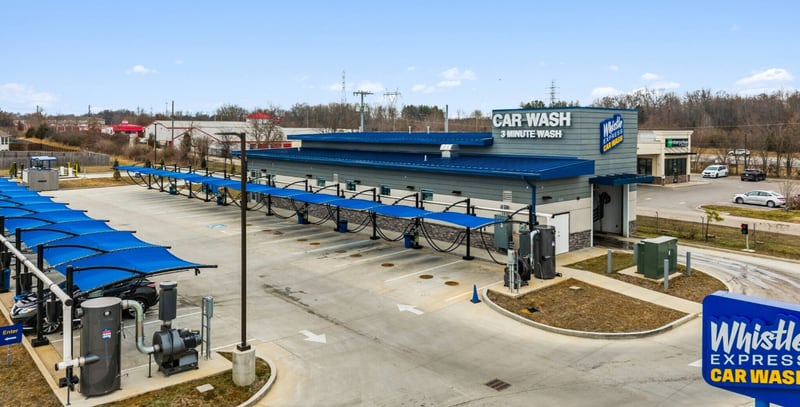
Three events then reset the tape. Mister Car Wash , which listed in June 2021 and briefly traded above $20, spent three years derating before Leonard Green took it private again at $7.00 per share , roughly $3.1 billion (3)(5). ZIPS Car Wash, an aggressive leveraged consolidator, filed Chapter 11 in early 2025 carrying $653.9 million of funded debt , closing underperforming sites through the process (6). And Driven Brands, having taken an $851 million goodwill impairment on its US wash segment, exited entirely, selling Take 5 Car Wash to Whistle Express for $385 million , a fraction of aggregate invested capital (4)(7).
Exhibit 3. Major platform ownership map, mid-2026 (unit counts approximate, MMCG estimates)
Platform
Sponsor / ownership
Approx. footprint
Status
Mister Car Wash
Leonard Green & Partners
500+ sites
Taken private, 2026
Whistle Express
Oaktree-backed
500+ post-acquisition
Active consolidator
Take 5 Car Wash (US)
Driven Brands, divested
~380 sites at sale
Sold to Whistle, 2025
ZIPS Car Wash
Post-restructuring owners
Reduced footprint
Emerged from Ch. 11
Quick Quack
KKR
250+ sites
Expanding
Tidal Wave Auto Spa
Golden Gate Capital
300+ sites
Expanding
El Car Wash
Warburg Pincus
100+ sites, Florida-led
Regional densification
Tommy's Express
Founder / franchise
230+ sites
Franchising
The multiple structure has reset accordingly. Platform trades that cleared in the high teens now price in the high single digits to low double digits of EBITDA, with the broad industry valued near 0.5 to 0.6 times revenue on MMCG's model (1)(14)(15). Buyer behavior has shifted from growth-at-any-price to basis discipline: the most active acquirers in 2025 to 2026 are buying distressed singles, small chains, and entitled sites below replacement cost rather than paying for pipelines. Consolidation continues, but its character has changed from land rush to salvage-and-scale, and the sponsors still deploying, KKR behind Quick Quack, Warburg behind El Car Wash, Oaktree behind Whistle, are underwriting density in defensible regions rather than national flags (12)(14).
6. Capital Markets: Repricing the Box
The sale-leaseback machine that financed the boom has cooled without closing. Car wash net lease trades that printed in the mid-5 percent cap rate range at the 2022 peak now clear at 6.2 to 6.4 percent , roughly 100 basis points of decompression, with buyers, still dominated by 1031-exchange private capital, interrogating rent coverage and operator credit in a way peak-cycle buyers did not (8)(9). The ZIPS bankruptcy educated the market: a lease is only as good as the tunnel's four-wall economics, and single-use buildings with dated equipment carry real re-tenanting risk.
Tax policy then handed the asset class an unexpected gift. The July 2025 tax legislation permanently restored 100% bonus depreciation , and car wash structures, which generally qualify as 15-year property, are among its purest beneficiaries (20). The provision re-energized private buyer demand for wash real estate in late 2025 and improved development math at the margin, partially offsetting rate and cost headwinds. MMCG treats it as a demand floor under net lease pricing rather than a growth catalyst: depreciation shelters income, it does not create car counts.
The SBA channel, the lifeblood of independent operators, tightened on its own schedule. SOP 50 10 8, effective June 2025, rewired underwriting standards, and active car wash lenders, a group led by Live Oak Bank, ReadyCap, Metro City Bank, Celtic Bank, and Stone Bank, responded to the sector's distress headlines with concentration limits, higher equity injection expectations, deeper feasibility scrutiny, and conservative treatment of special-purpose collateral (10)(11)(12). Cars-per-day projections that sailed through committee in 2021 now draw line-item interrogation, and independent third-party feasibility studies have shifted from formality to gating requirement at many institutions.
Leverage is the system's slow variable. Floating-rate platform debt raised at 2021 to 2022 pricing has repriced painfully, hold periods have extended, and sponsor exits increasingly route through continuation vehicles rather than sales. MMCG expects distress to remain a trickle rather than a wave: a steady tape of individual site foreclosures, small-chain workouts, and lender-driven dispositions that recapitalizes the industry's weakest corridors at lower bases without breaking the sector's core economics (1)(12)(15).
The Loan Tape: What 5,807 SBA Loans Reveal
To move past narrative, MMCG analyzed loan-level records for every SBA-guaranteed car wash loan approved since fiscal 2010 , drawn from the agency's FOIA releases for the 7(a) and 504 programs (10). The tape covers 4,227 7(a) loans totaling $5.26 billion in gross approvals and 1,580 504 projects carrying $1.58 billion in debentures alongside $2.46 billion in third-party lender dollars, roughly $4.03 billion of total 504 project financing. Combined, the government-guaranteed channel has put $6.83 billion behind car washes since 2010, and it is the channel through which nearly the entire independent tier of the industry is built and bought.
The lending arc tracks the investment cycle with uncomfortable precision. The average 7(a) car wash loan tripled from $675,000 in fiscal 2010 to $1.73 million at the fiscal 2021 peak , the signature of bigger boxes, costlier land, and the wholesale shift to express construction (10). Volume then broke: 7(a) approvals fell from $676 million in FY2021 to $272 million in FY2025 , a 60% decline , with average loan size retreating to $1.12 million as lenders pulled back from large new-build requests. The 504 program tells the opposite story, setting its record in FY2024 at $163 million in debentures; real-estate-heavy, lower-leverage structures are precisely what a cautious credit committee prefers, and borrowers migrated accordingly (10)(11).
Exhibit 4. SBA lending to US car washes (NAICS 811192), FY2019–FY2026 YTD
Fiscal year
7(a) loans
7(a) gross approvals
Avg. 7(a) loan
504 debentures
FY2019
286
$472m
$1.65m
$120m
FY2020
235
$392m
$1.67m
$101m
FY2021
391
$676m
$1.73m
$130m
FY2022
274
$420m
$1.53m
$146m
FY2023
236
$287m
$1.22m
$131m
FY2024
261
$306m
$1.17m
$163m
FY2025
243
$272m
$1.12m
$151m
FY2026 YTD
81
$77m
$0.95m
$42m
The numbers
| Category | Series 1 | Series 2 |
|---|---|---|
| FY10 | 0.675 | 129.7 |
| FY11 | 0.978 | 212.3 |
| FY12 | 0.852 | 161.1 |
| FY13 | 0.976 | 198.1 |
| FY14 | 1.01 | 244.4 |
| FY15 | 0.978 | 274.7 |
| FY16 | 1.082 | 325.8 |
| FY17 | 1.318 | 403.3 |
| FY18 | 1.397 | 403.7 |
| FY19 | 1.652 | 472.4 |
| FY20 | 1.668 | 391.9 |
| FY21 | 1.728 | 675.6 |
| FY22 | 1.533 | 420.1 |
| FY23 | 1.216 | 287 |
| FY24 | 1.171 | 305.7 |
| FY25 | 1.121 | 272.4 |
| FY26 YTD | 0.949 | 76.9 |
Credit performance is the tape's contrarian finding. Across all resolved 7(a) loans since fiscal 2010, car washes charged off at a 5.25% rate against 7.45% for all industries , and on a dollar basis at 0.62% of approvals against 1.50% (10). The asset class the trade press describes as feared by lenders has, on sixteen years of government data, defaulted at roughly two thirds of the SBA baseline. MMCG's read is that the fear premium attaches to a vintage, not a category: the 2021 to 2022 cohorts, underwritten at peak land costs, peak multiples, and peak capture-rate optimism, are still seasoning, and the current watch list of 37 loans in liquidation and 42 delinquent or past due is where that vintage will surface first. The headline rate is a resolved-loan measure and will drift upward as those cohorts mature; the baseline comparison, however, has held through every prior cycle in the data.
| Measure | Car washes (811192) | All industries |
|---|---|---|
| Loans approved | 4,227 | 919,732 |
| Charge-off rate, resolved loans | 5.25% | 7.45% |
| Dollars charged off / dollars approved | 0.62% | 1.50% |
- Car washes
- All industries
The numbers behind this chart
| Category | Car washes | All industries |
|---|---|---|
| Charge-off rate, resolved loans | 5.25 | 7.45 |
| Dollars charged off / dollars approved | 0.62 | 1.5 |
The lender map is narrower than the industry realizes. Celtic Bank leads the sixteen-year tape with $539 million across 283 loans , followed by Metro City Bank at $391 million ; Huntington has written the most individual loans among major banks at 277, at materially smaller tickets (10). Since fiscal 2020 the active set has concentrated further: Celtic at $299 million , Metro City, Stearns Bank, Paradise Bank, Stone Bank, and Live Oak account for the bulk of new-build financing. Concentration is the transmission mechanism for credit conditions: when a handful of specialist institutions impose exposure limits, raise equity injections, or add feasibility requirements, the financing market for independent operators reprices essentially overnight, which is exactly what the post-ZIPS tape shows (6)(10)(12).
7. Opportunities
Acquisition below replacement cost. The most attractive entry in a decade is buying the last cycle's mistakes. Distressed singles, undermanaged small chains, and stalled development sites are trading below the $4 to $8 million cost of new construction, and moratorium-driven entitlement scarcity gives every approved site option value the market has not fully priced (13)(14)(23).
Subscription yield management. With member acquisition slowing, the margin frontier is retention and monetization: churn-interception tooling, win-back automation, tier architecture, and price-pack discipline. Operators on modern membership platforms measurably outperform on churn, and the gap between managed and unmanaged member bases is widening into a durable competitive moat (16).
Premiumization. Ceramic and graphene top tiers carry chemical costs in cents and price uplifts in dollars. Migrating even a modest share of members up-tier moves site EBITDA more reliably than traffic growth in a flat market, and the vendor chemistry pipeline keeps supplying new upgrade rungs (12).
Supply-constrained geographies. The salt-belt and Northeast opportunity set combines under-penetration, durable winter demand, and entitlement barriers that protect the operator who gets there first. MMCG's screens repeatedly find better risk-adjusted math in a Milwaukee or Hartford infill site than in a fifth tunnel on a Phoenix arterial (1)(13).
Operational technology and water. License plate recognition, centralized multi-site management, and remote monitoring keep compressing labor per car; reclaim systems now pay back through sewer and water savings while simultaneously clearing regulatory gates in the Southwest. Both convert regulatory pressure into cost advantage for capitalized operators (12)(19). The restored bonus depreciation regime, finally, materially improves after-tax returns for owner-operators and net lease investors alike (20).
8. Risks
The risk register has migrated from macro to regulatory and operational. Saturation and churn lead it: every incremental tunnel in an overbuilt corridor dilutes capture for all, and subscription bases built on promotional pricing carry untested elasticity into a softer consumer cycle. Leverage concentrates both: platforms and independents financed at peak multiples and peak costs have the least room for the traffic misses that saturated corridors now routinely produce (6)(13)(16).
Regulation is tightening on three fronts at once. Water: Colorado River shortage tiers , Arizona's Assured Water Supply regime , and California conservation rules are converting water access into an entitlement variable , with reclaim mandates spreading (19)(23). Environmental: the EPA's July 2024 designation of key PFAS compounds as hazardous substances has put wash chemistry supply chains on notice (19). Trade: Section 232 tariffs continue to inflate equipment and structural costs, taxing both new builds and equipment refresh cycles (12)(14).
Labor risk has hardened from background to headline. California's registration and bonding regime for wash operators is enforced aggressively, with wage citations of $1.2 million against a Newport Beach operator and $1.3 million in the Los Angeles South Bay within the survey window (17). Cal/OSHA heat standards and the federal heat rulemaking raise compliance costs for outdoor labor, and the industry recorded a $185,991 OSHA citation following a tunnel fatality at a ZIPS location (18). Most disruptive, 2025 immigration enforcement actions detained more than 250 workers across 80-plus Los Angeles-area car washes , an acute labor supply shock that pushed wages and turnover across affected markets (17)(18). Municipal moratoria, finally, keep spreading; adverse for pipelines, protective for incumbents, and a scheduling risk for any project not yet entitled (23).
Exhibit 6. Risk register, 2026 (MMCG assessment)
Risk
Vector
Severity
Corridor saturation
Capture dilution, price competition
High, Sun Belt-concentrated
Retail traffic erosion
Consumer confidence, tariff price pressure
High, structural
Subscription churn
Promotional bases, trade-down
Moderate, rising
Leverage / refinancing
2021 to 22 vintage debt repricing
High for peak-basis borrowers
Water and environmental rules
Entitlement, reclaim mandates, PFAS
Moderate, Southwest-acute
Labor enforcement and supply
Wage actions, heat rules, immigration enforcement
High in California, rising elsewhere
Municipal moratoria
Entitlement delay or denial
Moderate, spreading
- Outlook to 2031
MMCG's base case is a flat industry with sorting underneath. Revenue drifts from $19.2 billion to roughly $18.9 billion by 2031 , margins hold near 14% , and net site count peaks then declines as legacy closures and corridor rationalization outrun a diminished pipeline (1). Consolidation continues at reset multiples; the platforms that survive the leverage cycle emerge with regional density, modern technology stacks, and member bases that behave like annuities. The long tail keeps ceding share. None of this resembles a crisis. All of it punishes the underwriting habits of 2021.
Five indicators will tell observers which way the model is breaking: benchmarked retail traffic, membership churn rates, net lease cap rates, the count of jurisdictions with active moratoria, and the SBA default tape for the sector. Sustained deterioration in the first two would push MMCG's revenue path lower; stabilization through a full consumer cycle would confirm the annuity thesis and likely re-rate the sector's surviving platforms (1)(10)(16).
For lenders, the practical translation is discipline on three numbers: cars per day, competitive census, and break-even coverage. A leveraged new build clearing at 120 to 180 cars per day breakeven leaves no room for a fourth competitor at the interchange, and the difference between a fundable project and a future workout is almost always visible in the market study before it is visible in the operating statement. That is precisely the analysis an independent feasibility study exists to provide.
Frequently Asked Questions
How big is the car wash industry in the United States?
The US car wash and auto detailing industry generates an estimated $19.2 billion in annual revenue in 2026, produced by approximately 17,100 businesses operating roughly 19,000 locations and employing about 181,000 workers (1)(25).
Is the car wash industry growing?
It has stopped. Revenue compounded at 1.7% annually from 2021 to 2026, but MMCG projects a 0.3% annual contraction through 2031 , the industry's first sustained flat-to-negative phase, as professional wash adoption plateaus near 79% of drivers and overbuilt corridors absorb existing demand (1)(2).
How profitable is a car wash?
The industry averages a 14.1% operating margin across all formats, but the dispersion is the real story: mature, automated express exterior sites earn 35% to 50% four-wall EBITDA margins , while legacy full-serve and self-serve formats run far thinner (1)(14).
How much does it cost to build an express car wash?
All-in development cost runs $4 to $8 million in 2026, including $1.0 to $2.5 million for a prime one-acre pad and $1.0 to $1.5 million for a 100 to 150 foot tunnel equipment package. Land is the largest swing variable between markets (14).
How much revenue does a car wash make?
A mature express exterior location typically generates $1.5 to $3.0 million in annual revenue, with top-quartile sites exceeding that range. New builds generally need 24 to 36 months to accumulate the membership base that defines maturity (1)(14).
What do car washes sell for?
Platform transactions that cleared at 18 to 20 times EBITDA at the 2021 to 2022 peak now price in the high single digits to low double digits, and the broad industry is valued near 0.5 to 0.6 times revenue . Car wash net lease real estate trades at 6.2% to 6.4% cap rates in 2025 to 2026 (1)(8)(14)(15).
Can you get an SBA loan for a car wash?
Yes, and the channel is large: SBA programs have guaranteed $6.83 billion across 5,807 car wash loans since fiscal 2010. Lending standards tightened materially after 2022, with higher equity injections, concentration limits at specialist lenders, and independent feasibility studies now standard for new-build requests (10)(11)(12).
What is the default rate on car wash loans?
Lower than the market assumes. Car wash 7(a) loans have charged off at a 5.25% rate on resolved loans since fiscal 2010, versus 7.45% across all industries , and at 0.62% of approved dollars versus 1.50% . The caveat: peak-vintage 2021 to 2022 loans are still seasoning (10).
Is the car wash market oversaturated?
At the corridor level in the Sun Belt, frequently yes. New express openings fell from 943 in 2022 to roughly 550 in 2025 as saturated interchanges, municipal moratoriums, and lender caution converged. The Northeast, Upper Midwest, and dense urban West remain comparatively under-penetrated (13)(14)(23).
Do car washes do well in a recession?
The subscription base does; the drive-up customer does not. Roughly 90% of members express intent to renew, while benchmarked non-member retail revenue fell 11.9% year over year in Q2 2025. Sites underwritten on retail capture carry the cyclical risk; member-heavy sites behave like annuities (2)(16).
Methodology and About MMCG
Figures attributed to the MMCG database reflect MMCG Invest's proprietary industry model, calibrated against public company filings, bankruptcy court records, trade association research, government data, and the trade press sources cited below. The SBA lending analysis reflects MMCG's examination of loan-level FOIA records covering every 7(a) and 504 approval from fiscal 2010 through the current release, filtered to NAICS 811192; charge-off rates are computed on resolved loans and stated as such. Model estimates are denoted as such; primary disclosures are cited to their sources. Forecast figures represent MMCG's base case as of July 2026 and are subject to revision.
MMCG Invest, LLC is a national feasibility study consulting firm serving lenders, CDCs, and investors across SBA 7(a), SBA 504, USDA, and conventional loan programs in more than 30 asset classes, including express and full-service car washes. Our studies are independent, third-party analyses prepared for credit decision support.
Request a car wash feasibility study: info@mmcginvest.com | mmcginvest.com/feasibility-study
July 4, 2026, by Michal Mohelsky, J.D. Principal of MMCG Invest, LLC, feasibility study company serving feasibility studies for SBA projects.
Reach out to discuss how our methodology supports your lending decision.

Michal Mohelsky, J.D. | Principal | mmcginvest.com
Contact: michal@mmcginvest.com
Phone: (628) 225-1110
Disclaimer: This report is provided for informational purposes only and does not constitute investment advice. Data presented herein is derived from proprietary MMCG databases and third-party sources believed to be reliable; however, MMCG Invest makes no representation as to the accuracy or completeness of such information. Figures from third-party industry databases have been independently verified and, where appropriate, adjusted to reflect MMCG's proprietary analytical methodology. Past performance is not indicative of future results.
Sources
(1) MMCG database, US Car Wash and Auto Detailing Industry Model, July 2026 vintage.
(2) International Carwash Association, US consumer study series, 1996 to 2026.
(3) Mister Car Wash, Inc., SEC filings, annual reports, and earnings call materials.
(4) Driven Brands Holdings, Inc., SEC filings and investor communications.
(5) Leonard Green & Partners / Mister Car Wash take-private transaction announcements.
(6) ZIPS Car Wash, LLC, Chapter 11 filings, US Bankruptcy Court, 2025.
(7) Driven Brands / Whistle Express, US car wash divestiture announcements, 2025.
(8) The Boulder Group, Net Lease Car Wash Market Reports, 2022 to 2026.
(9) Northmarq, single-tenant net lease research, 2024 to 2026.
(10) US Small Business Administration, 7(a) and 504 loan program data (FOIA releases).
(11) US Small Business Administration, SOP 50 10 8, effective June 2025.
(12) Professional Carwashing & Detailing, industry coverage, 2023 to 2026.
(13) CarwashOS, development and market coverage, 2023 to 2026.
(14) Amplify Car Wash Advisors, market publications, 2024 to 2026.
(15) Car Wash Advisory, M&A and valuation commentary, 2023 to 2026.
(16) Rinsed, subscription benchmarking data across connected car wash locations, 2024 to 2026.
(17) California Department of Industrial Relations, Labor Commissioner enforcement releases, 2024 to 2026.
(18) US OSHA and Cal/OSHA enforcement records, 2024 to 2026.
(19) US Environmental Protection Agency, PFAS hazardous substance designation, July 2024; state water agency rules.
(20) Public Law 119-21, bonus depreciation provisions, July 2025.
(21) US Bureau of Labor Statistics, employment and wage data.
(22) Federal Highway Administration, vehicle miles traveled series.
(23) Municipal planning and zoning records: Cape Coral FL, Birmingham AL, Hemet CA, Perrysburg OH, and others.
(24) Public equity market data, Mister Car Wash trading history, 2021 to 2026.
(25) US Census Bureau, County Business Patterns, NAICS 811192.

Michal Mohelsky, J.D., FMVA, Practicing Affiliate of the Appraisal Institute
Principal, MMCG Invest, LLC
Published July 4, 2026. How this analysis was prepared.
Cite this
Michal Mohelsky, J.D., FMVA (2026). The US Car Wash Industry in 2026: The Gold Rush Meets Its Ceiling. MMCG Invest, LLC. https://www.mmcginvest.com/post/the-us-car-wash-industry-in-2026-the-gold-rush-meets-its-ceiling
Where this goes next
- Car Wash Feasibility StudyMMCG's feasibility study page for this subject.