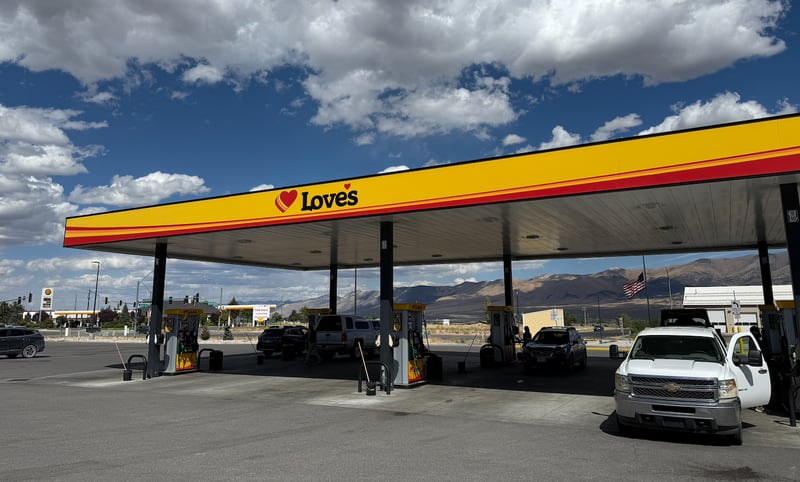
Summary
Pilot and Love's run opposite ownership, food, maintenance and growth models yet compound on the same logic: fuel is priced to win the stop and profit is earned on everything that happens after the truck is parked, and a project financed against them should be modeled the same way. Berkshire's audited filings put Pilot's revenue at $56.8 billion in 2023 and roughly $42.2 billion in 2025, with pre-tax earnings falling from $1,056 million to $190 million, while Love's discloses only operations: 669 locations in 42 states as of February 2026 and a 2026 plan of $700 million for 20 new builds and 35 remodels.
The inversion behind both is that fuel generated about 80 percent of TravelCenters of America's fiscal 2022 revenue but only about 31 percent of its gross profit. With one truck parking space for every eleven drivers nationally and a standard site costing $8 million to $25 million to develop, parking and the non-fuel stack decide whether an independent site is bankable.
Written for Travel center and truck stop developers, SBA 504, SBA 7(a) and USDA B&I lenders underwriting fuel sites, Analysts sizing the professional diesel segment. 22 minute read.
Key figures
- Total consideration for Pilot across three tranches
- approximately $13.6 billion
- Berkshire Hathaway 2023 Annual ReportOctober 2017 to January 2024
- Pilot full-year revenue
- $56.8 billion in 2023, $46.9 billion in 2024, roughly $42.2 billion in 2025
- Berkshire Hathaway Form 10-K (FY2024) and FY2025 Annual Report2023 to 2025
- Pilot pre-tax earnings
- $1,056 million in 2023, $614 million in 2024, $190 million in 2025
- Berkshire Hathaway FY2024 and FY2025 Annual Reports2023 to 2025
- Love's locations
- 669 locations in 42 states
- Transport Topics, February 2026, and Love's corporate releasesas of February 2026
- Love's 2026 capital plan
- $700 million for 20 new builds and 35 remodels
- Love's corporate releases, the February 5, 2026 Road Ahead plan2026 plan
- Driver income lost to the search for parking
- about $4,600 a year
- American Transportation Research Institute (ATRI)annual, 2025 research
Updated: Jul 16
For most of their history, comparing America's two largest travel center chains was an exercise in guesswork. Both were private. Neither filed financials. Trade press counted stores, Forbes estimated revenue, and everyone else repeated whatever number was closest at hand.
That changed on January 16, 2024, when Berkshire Hathaway acquired the final 20 percent of Pilot Travel Centers and made the company a wholly owned subsidiary (1). Pilot's revenue, earnings, fuel gallons, and store counts now sit inside Berkshire's audited SEC filings. One half of the duopoly became legible overnight. The other half, Love's Travel Stops, remains what it has been since 1964: a family-held company in Oklahoma City that tells you exactly what it wants you to know and nothing more.
At MMCG, we prepare feasibility studies for travel center and truck stop projects financed through SBA 504, SBA 7(a), USDA Business & Industry, and conventional channels. Every one of those studies eventually collides with the same two names. A borrower planning a 15-acre diesel-anchored site on a freight corridor is not competing with an abstraction called "the market." They are competing with Pilot and Love's, and increasingly with a bp-backed third player behind them. This article consolidates what the filed record, the trade press, and our own database actually support about how these two companies work, where they differ, and what that means for anyone trying to finance a site against them.
The $13.6 billion education of Warren Buffett
Berkshire's acquisition of Pilot happened in three tranches, and the pricing across those tranches tells a story no press release would.
In October 2017, Berkshire bought 38.6 percent of Pilot for roughly $2.76 billion, implying an enterprise value near $7.1 billion (2). In January 2023, it bought another 41.4 percent for about $8.2 billion, taking control at 80 percent. That price implied an enterprise value of roughly $19.8 billion (3). One year later, in January 2024, the Haslam family sold Berkshire the final 20 percent for $2.6 billion, implying an enterprise value of about $13 billion (3, 4). Total consideration across all three tranches: approximately $13.6 billion, a figure confirmed when Berkshire's 2023 annual report disclosed the final payment (4).
Read those numbers again. The implied valuation of the same company fell by roughly a third between January 2023 and January 2024. That collapse was not an accident of markets. It was the product of a contract, and it produced one of the strangest legal fights in Berkshire's modern history.
The Haslams held a put option entitling them to sell the last 20 percent to Berkshire in an annual window, priced at ten times Pilot's prior-year stated earnings (5). That formula made one accounting question worth billions: how do you calculate "stated earnings"? In October 2023, the Haslam family sued Berkshire in Delaware Chancery Court, alleging that Berkshire had imposed pushdown accounting after taking control, depressing Pilot's reported net income and, with it, the put price (5). Berkshire counterclaimed the following month with an allegation of its own: that Jimmy Haslam had promised side payments to senior Pilot executives to inflate short-term 2023 earnings and pump the same formula in the other direction (6). Federal prosecutors in the Southern District of New York reportedly took an interest (6). A two-day trial was set for January 8, 2024, with Greg Abel expected to testify. On January 6 the judge canceled the trial. On January 7 the parties announced a full settlement, terms undisclosed. Nine days later the Haslams sold at $2.6 billion (4).
Whatever one thinks of the merits, the episode fixed a public price on a company that had never had one, and it put Pilot's operating results into the filed record permanently. For analysts, that is the durable gift of the whole affair.
What the filed numbers actually show
Pilot's disclosed trajectory since consolidation is a lesson in why travel center revenue is a treacherous metric. Full-year revenue ran $56.8 billion in 2023, $46.9 billion in 2024, and roughly $42.2 billion in 2025 (1, 7, 8). Pre-tax earnings fell harder: from $1,056 million in 2023 to $614 million in 2024 to $190 million in 2025 (7, 8). Fuel volume declined from roughly 16.2 billion gallons in 2023 to 11.4 billion in 2024 and 10.9 billion in 2025, with part of that drop attributable to changed reporting scope in the wholesale book rather than lost retail share (7, 8).
Berkshire attributes the revenue decline mostly to lower fuel prices and reduced wholesale volumes, not to deterioration at the pump (7). That is credible. Roughly 80 percent of a travel center's revenue is fuel, and fuel dollars move with commodity prices whether or not a single additional truck pulls in. The 2025 earnings figure is the number that deserves scrutiny: $190 million of pre-tax profit on $42 billion of revenue is a 0.45 percent margin, squeezed by weak wholesale fuel margins, softer in-store gross margins, and rising operating costs (8). Greg Abel's 2025 shareholder letter was unusually candid about the acquisition itself, noting that Berkshire's contractual delay in taking control until 2023 was a mistake that "will not happen again" (8).
Love's, by contrast, publishes no financials at all. Forbes and FactSet estimate its revenue at roughly $25.5 billion on the most recent list, within a historical band of $22 billion to $26.5 billion (9). We treat that band as exactly what it is, an unaudited estimate, and we would advise any lender or analyst to do the same. What Love's does disclose, consistently and to its credit, is operational: 669 locations in 42 states as of February 2026, more than 40,000 employees, more than 430 truck care locations, and more than 50,000 truck parking spaces (10, 11).
Scale, measured honestly
Store counts in this industry are a genre of marketing literature. Pilot's public materials cite "more than 900" locations across the Pilot, Flying J, and One9 networks (12). The audited figure in Berkshire's FY2025 annual report is more modest: 675 travel centers plus 82 fuel-only locations across the United States and five Canadian provinces, held through 663 company-owned sites and 94 unconsolidated joint venture locations (8). The gap between roughly 757 and "900+" is filled by dealer sites and One9 network access points, which are predominantly affiliated fueling lanes rather than owned travel centers (12). Independent point-of-interest scrapes land between those poles, at 821 to 924 U.S. locations depending on methodology (13).
Love's 669 is a cleaner number, corroborated across company releases and trade press with only trivial variance (10, 11). Behind both chains sits TravelCenters of America, acquired by bp in May 2023 for $1.3 billion and now past 300 locations (14), and around the edges sit companies that get named in these comparisons but do not belong in them. Buc-ee's, with 56 stores across 13 states, prohibits 18-wheelers entirely; it is a destination retailer that happens to sell gasoline, not a trucking competitor (15). Kwik Trip's 900-plus stores are Upper Midwest convenience retail tethered to a daily-delivery commissary. Neither constrains Pilot or Love's in the professional diesel segment at all.
The truest single proxy for professional trucking capacity is not store count but truck parking. Pilot operates roughly 75,000 spaces, TA roughly 51,000, Love's roughly 50,000 and targeting 52,000 by the end of 2026 (11, 12, 14). Note what that comparison reveals: TA matches Love's parking capacity on fewer than half the locations, a legacy of its large-format Petro sites. Anyone modeling competitive density from store counts alone will misread the market.
The inversion at the heart of the business
Here is the fact that governs everything else in this industry, and the one most first-time developers get wrong: fuel is where the revenue is, and inside is where the money is.
The last large operator to publish clean, travel-center-specific financials was TravelCenters of America, in its final full year before the bp acquisition. In fiscal 2022, fuel generated about 80 percent of TA's revenue but only about 31 percent of its gross profit. Non-fuel operations, the convenience store, foodservice, showers, parking, and truck repair, produced roughly 69 percent of gross profit on one-fifth of revenue, at a blended non-fuel gross margin near 60 percent (16). The broader convenience channel shows the same shape in softer form: per NACS 2025 industry data, fuel was 65 percent of sales dollars but under 39 percent of gross profit dollars, while foodservice delivered 38.9 percent of in-store gross profit on 28.5 percent of in-store sales (17).
- Fuel
- Non-fuel
The numbers behind this chart
| Category | Fuel | Non-fuel |
|---|---|---|
| Share of Revenue | 80 | 20 |
| Share of Gross Profit | 31 | 69 |
The mechanism is diesel pricing. The overwhelming majority of a travel center's diesel moves to fleets under negotiated, cost-plus arrangements; TA disclosed that more than 90 percent of its diesel volume was sold under fleet pricing or rebate programs (16). Layer on fleet card economics and the pump margin thins further. Two payment networks, FLEETCOR and WEX, control close to 70 percent of an over-the-road card market with roughly $375 billion in gross spend, and 99 percent of truck stops accept one or both (18). The truck stop pays a transaction fee on the order of eight to ten cents per gallon and grants negotiated fleet discounts that scale with volume. Diesel is the traffic magnet that covers fixed costs . The driver walking from the fuel island to the shower line, the deli counter, and the merchandise aisle is the profit model.
Both chains understand this perfectly, which is why their most interesting strategic choices are all on the non-fuel side. And it is on the non-fuel side that Pilot and Love's have made genuinely different bets.
Two theories of food, two theories of trucks
On foodservice, Pilot has chosen margin capture and Love's has chosen brand draw.
Pilot has been building proprietary food capability since it launched PJ Fresh in 2013, and in March 2026 it consolidated the program under the "Pilot eats" banner, rolling a full hot deli to roughly 400 travel centers and a grab-and-go format to about 200 more, alongside some 350 owned quick-service franchise units moved to 24/7 operation (19). Owning the food program keeps foodservice gross margin, the richest margin pool in the store, in house. It also means Pilot carries the capex, the labor model, and the menu risk itself, an approach that makes considerably more sense with Berkshire's balance sheet behind it than it would for almost anyone else.
Love's went the other way decades ago and never looked back. It has operated franchise quick-service restaurants since 1990 and now partners with roughly 20 national brands, Arby's, Carl's Jr., Hardee's, Subway, Chester's, Godfather's, Bojangles and others, layered over its own Love's Fresh Kitchen concept (11). Franchising surrenders a slice of food economics to the franchisor in exchange for national brand pull, lower menu development risk, and simpler unit operations. For a company that opens twenty stores a year with a lean family-owned structure, that trade is coherent.
On truck maintenance, the positions reverse in a way that is almost elegant. Love's owns its network outright: Love's Truck Care and Speedco together form the largest over-the-road maintenance provider in the country, with more than 430 locations and north of 1,400 service bays, built in part on the 2017 acquisition of Speedco from Bridgestone, and holding exclusive warranty relationships with Freightliner and International (20). Pilot outsources the same function. Its 2021 alliance with Southern Tire Mart, the largest independent commercial tire dealer in the U.S., handed operation of Pilot's legacy shops to a specialist that had grown the network to roughly 70 locations by late 2024 (21).
Maintenance matters more than its revenue line suggests. A fleet that can fuel, service, and clear a warranty repair in one stop routes its trucks to that brand. It is the stickiest amenity in the industry, and Love's decision to own it, while Pilot owns the food instead, is the cleanest expression of how two companies in the same business can hold opposite theories about where the moat is.
Both then wrap the customer in loyalty economics. Pilot's myRewards Plus pays professional drivers up to four points per gallon with roughly $450 in annual redeemable value plus shower credits and reserved parking; Love's My Love Rewards pairs points with free showers and drinks on 50-gallon fills, redeemable across the store, the restaurants, and the truck care bays (11, 12). Stack those on top of fleet card discounts and the switching cost facing any new entrant becomes concrete: the driver isn't just choosing a fuel price, they are walking away from an accumulated ecosystem.
The compounder and the remodeler
The growth strategies diverge as sharply as the operating models.
Love's is the sector's metronome. It opened 28 stores in 2022, roughly 25 to 33 in 2023 depending on how rebuilds are counted, 15 to 20 in 2024, and 18 in 2025 against a stated goal of 20 (10, 22). Its 2026 plan commits $700 million to 20 new builds and 35 remodels, adding 1,500 truck parking spaces to push the network past 52,000 (11). The parking series is the most honest growth telemetry any company in this sector publishes: 2,200 spaces added in 2022, about 2,000 in 2023, 1,500 to 2,000 in 2024, roughly 1,000 in 2025, and a 1,500 target for 2026 (10, 11, 22). Read as a curve, it shows a compounder that has slowed modestly from its post-pandemic pace but has never stopped laying asphalt.
Pilot under Berkshire is running a different play. Footprint growth is modest, on the order of ten company builds a year plus dealer additions (12). The capital is going into the existing estate: the $1 billion-plus New Horizons program, launched in March 2022 to fully remodel more than 400 Pilot and Flying J travel centers, had completed roughly 200 by early 2025 (23). The company's December 2024 flagship in Stanton, Tennessee, at over 20,000 square feet, is the template, and Pilot reports that guests are markedly more likely to return after visiting a remodeled site (23). Add the food rollout and an EV charging partnership with GM and EVgo that had reached approximately 245 travel centers by the FY2025 report, against a target of 2,000 stalls at up to 500 sites (8), and the picture resolves: Pilot is defending and monetizing the largest installed base in the industry rather than racing to expand it.
Neither strategy is obviously wrong. Love's is buying the scarcest asset in the sector, new interchange positions, at twenty a year. Pilot is raising the yield on interchange positions it already controls. Which approach wins depends on a question we take up next: how scarce are those positions, really?
Real estate is the moat
Strip away the loyalty programs and the brisket sandwiches and the travel center business is an interstate real estate business. A full-service site needs 10 to 25 acres at an interchange with truck-grade ingress and egress, and the number of such parcels on any given freight corridor is finite and mostly spoken for (24). Development runs $8 million to $25 million or more all-in for a standard format; NATSO's guidance notes a ground-up build can easily exceed $20 million and take two years through land assembly, entitlement, and construction (24). Buc-ee's mega-format, for calibration, runs $60 million to $95 million per store (15). Professional drivers plan fuel stops across a 30-to-50-mile corridor radius, not a local trade area, which means one chain holding the prime corner at a high-truck-count exit effectively forecloses that exit (24). This is why both chains overwhelmingly own their land rather than leasing it, and why acquiring a struggling independent has always been understood internally as buying the location, not the business.
The institutional capital markets have quietly confirmed the quality of these assets. When bp acquired TA, Service Properties Trust amended its master leases over 176-plus TA travel centers at $254 million in aggregate annual minimum rent with 2 percent escalators, now guaranteed by BP Corporation North America at investment grade (25). Branded travel plaza net-lease assets trade around a 7.5 percent cap rate, wider than prime convenience credits like Wawa near 4.9 percent, a spread that prices real special-purpose and environmental risk but also confirms a durable, financeable income stream (25). Pilot and Love's, notably, sell almost nothing into this market. Owners with low cost of capital do not monetize scarce corners.
So is "duopoly" the right word? In the narrow segment that matters for trucking, coast-to-coast networks of full-service travel centers with diesel lanes, overnight parking, showers, and fleet fuel programs, the framing is defensible: Pilot and Love's are the two dominant operators, with bp-backed TA a credible third whose trajectory depends on how much bp chooses to reinvest (14, 26). Widen the aperture to fuel and convenience retail generally and the claim dissolves; 7-Eleven, Circle K, and Casey's each dwarf both chains by store count (26). Precision here is not pedantry. A borrower's feasibility study should model the segment they are actually entering, and in the professional diesel segment the competitive set is two and a half names deep.
The demand backdrop: parking is the product
Whatever happens to diesel, trucks will keep parking. That sentence carries more underwriting weight than it appears to.
Federal hours-of-service rules force drivers off the road for mandatory rest, and the country has nowhere near enough places for them to stop. The most recent ATRI and AASHTO work, released in April 2025, puts the national ratio at one truck parking space for every eleven drivers (27). FHWA's Jason's Law survey found 98 percent of drivers reporting problems finding safe parking, three-quarters of them at least weekly (28). ATRI estimates the average driver loses about $4,600 a year in income and 9,300 revenue miles to the daily search for parking (27). The median public space costs $93,500 to build, and roughly $750 million in recent federal grants produced only about 2,000 new spaces (27). This is a structural deficit that no plausible policy program closes within a loan term.
Meanwhile the freight base underneath it keeps growing. Trucks hauled 11.27 billion tons in 2024, 72.7 percent of domestic tonnage, generating $906 billion for motor carriers (29), and federal projections have total freight activity growing roughly 50 percent by 2050 (30). Diesel itself is the complicated variable: near-term demand is rising into 2026 and 2027, while the long-run federal outlook has distillate declining gradually, not collapsing, through 2050 as fleets turn over into more efficient and alternative powertrains (31). Heavy-duty electrification is real but back-loaded and, for now, concentrated on coastal and high-volume corridors; ATRI puts the full infrastructure and vehicle cost of a battery-electric transition above $1 trillion (27). The sober read for a 20-to-25-year hold: fuel volumes erode slowly at the margin, terminal-value risk lives in years 15 and beyond, and the parking, food, and services demand that actually drives gross profit is powertrain-agnostic. An electric truck must park for its rest break exactly as a diesel one does.
What this means for borrowers and lenders
We will close where our own work begins, with the developer or lender looking at a specific parcel on a specific corridor and asking whether a project pencils against these two incumbents.
Start with the honest disadvantages. An independent new-build gives up scale on every lever this article has described: wholesale fuel procurement, negotiated fleet contracts and card fees, loyalty lock-in, national food brands, maintenance networks, and brand trust built over decades. Fuel alone will not carry the credit. A model that underwrites primarily on gallons and cents-per-gallon margin is fragile by construction, because the incumbents can and do compete hardest exactly there.
What makes a single site bankable, in our experience, is the disciplined stacking of the things the inversion chart rewards. A location decision anchored to truck traffic counts and logistics activity in the corridor, with the nearest full-service competitor far enough away that the site fills a genuine gap rather than splitting an exit. Fleet card acceptance from day one, because a site without FLEETCOR and WEX rails forfeits most carrier volume before opening. A recognized quick-service franchise rather than an unproven proprietary food concept, trading margin for a de-risked draw, the same trade Love's made. Generous, well-lit, monetizable truck parking, because the federal data above says parking is the scarcest commodity on the interstate. And truck care held as a second phase, funded only when demonstrated traffic supports bay utilization, since idle bays are among the fastest ways to burn equity in this asset class.
The financing architecture matters as much as the site plan. The SBA classifies truck stops as special-purpose properties under SOP 50 10 8, which raises equity requirements to 15 percent or more and mandates an independent third-party feasibility study as a condition of the loan (32). For rural sites, and most viable new interchange positions are rural, the USDA Business & Industry program is frequently the better fit: guarantees up to 80 percent on loans as large as $25 million, with fully amortizing terms that can extend toward 30 years and no balloon, a structure well matched to a high-fixed-cost asset with a long earning life (33). USDA underwriting standards are explicit that the guarantee will not paper over a marginal deal, which returns the weight, once again, to the quality of the feasibility work underneath it.
That is the real conclusion of the Pilot and Love's comparison. Two companies with opposite ownership structures, opposite food strategies, opposite maintenance models, and opposite growth programs are both compounding for the same reason: they price fuel to win the stop and earn their profit on everything that happens after the truck is parked. Any project financed against them, and any lender evaluating that project, should be modeled on exactly the same logic.
MMCG Invest, LLC is an independent feasibility study company which prepares bank-ready feasibility studies for travel center, truck stop, and fuel-and-convenience projects nationwide, supporting SBA 504, SBA 7(a), USDA B&I, and conventional financing. Our work draws on the MMCG database, federal freight and energy data, and site-level market fieldwork across more than 30 asset classes.
Michal Mohelsky, J.D. | Principal | mmcginvest.com
Contact: michal@mmcginvest.com
Phone: (628) 225-1110
Disclaimer: This report is provided for informational purposes only and does not constitute investment advice. Data presented herein is derived from proprietary MMCG databases and third-party sources believed to be reliable; however, MMCG Invest makes no representation as to the accuracy or completeness of such information. Figures from third-party industry databases have been independently verified and, where appropriate, adjusted to reflect MMCG's proprietary analytical methodology. Past performance is not indicative of future results.
Sources
1) Berkshire Hathaway Inc., Form 10-K for fiscal year 2024, U.S. Securities and Exchange Commission.
2) Reuters and contemporaneous coverage of Berkshire Hathaway's October 2017 acquisition of a 38.6% interest in Pilot Travel Centers.
3) FreightWaves, implied enterprise value analysis of the January 2023 and January 2024 Pilot tranches.
4) CSP Daily News, "Berkshire Hathaway's Pilot Acquisition Totals About $13.6 Billion," February 26, 2024; Berkshire Hathaway 2023 Annual Report.
5) Pilot Corp. v. Berkshire Hathaway, Delaware Court of Chancery, October 2023 complaint; coverage via Land Line Media and Reuters.
6) Berkshire Hathaway counterclaim, November 2023, Delaware Court of Chancery; reporting on SDNY interest via Land Line Media.
7) Berkshire Hathaway Inc., FY2024 Annual Report, Pilot segment discussion (revenue $46.9B; pre-tax earnings $614M; ~11.4B gallons; ~29,200 employees).
8) Berkshire Hathaway Inc., FY2025 Annual Report and shareholder letter (revenue ~$42.2B; pre-tax earnings $190M; ~10.9B gallons; 675 travel centers and 82 fuel-only locations; ~245 EV charging sites).
9) Forbes, America's Largest Private Companies, 2023-2025 editions (FactSet estimates).
10) Transport Topics, February 2026 (669 locations in 42 states); CSP Daily News, December 19, 2025 (18 openings against a 20-store goal).
11) Love's Travel Stops corporate releases, loves.com , including the February 5, 2026 "Road Ahead" plan ($700M; 20 new builds; 35 remodels; 1,500 parking spaces toward 52,000+).
12) Pilot Company corporate materials, pilotcompany.com (network counts; One9 Fuel Network; myRewards Plus).
13) ScrapeHero (June 2026) and xMap (November 2025) point-of-interest datasets, U.S. location counts.
14) bp p.l.c., acquisition of TravelCenters of America, completed May 2023 ($1.3 billion); TA network disclosures.
15) Buc-ee's project filings and company statements, 2025-2026 (56 locations; 13 states; no 18-wheeler policy; project costs).
16) TravelCenters of America Inc., Form 10-K for fiscal year 2022 (fuel and non-fuel revenue and gross margin detail).
17) NACS State of the Industry, 2025 data, released April 2026.
18) Activant Capital, "Pain at the Pump," analysis of the over-the-road fleet card market.
19) Pilot Company, "Pilot eats" launch materials, March 2026; PJ Fresh program history.
20) Love's Travel Stops and CSP Daily News, Love's Truck Care and Speedco network disclosures (430+ locations; 1,400+ bays); Speedco acquisition from Bridgestone, 2017.
21) Southern Tire Mart at Pilot Flying J, alliance announcements and network updates, 2021-2024.
22) CSP Daily News and Love's releases, annual opening and truck-parking additions, 2022-2025.
23) Pilot Company, "New Horizons" announcement, March 9, 2022, and program updates through 2025-2026 (Stanton, TN flagship).
24) NATSO and NATSO Foundation, travel center development and site selection guidance.
25) Service Properties Trust disclosures regarding amended TA master leases (aggregate minimum rent $254.0M; BP Corporation North America guarantee); net-lease market cap rate surveys, 2023-2026.
26) CSP Top 202 ranking, 2025 edition (store counts as of January 1, 2025).
27) American Transportation Research Institute (ATRI) and AASHTO, truck parking research, April 2025; ATRI Critical Issues in the Trucking Industry, 2025.
28) Federal Highway Administration, Jason's Law Truck Parking Survey and inventory.
29) American Trucking Associations, American Trucking Trends 2025.
30) FHWA/BTS Freight Analysis Framework, long-range freight projections.
31) U.S. Energy Information Administration, Annual Energy Outlook 2026 and Short-Term Energy Outlook.
32) U.S. Small Business Administration, SOP 50 10 8, special-purpose property provisions.
33) U.S. Department of Agriculture, Business & Industry Guaranteed Loan Program regulations and FY2026 fee notices.

Michal Mohelsky, J.D., FMVA, Practicing Affiliate of the Appraisal Institute
Principal, MMCG Invest, LLC
Published July 15, 2026. Last updated July 16, 2026. How this analysis was prepared.
Cite this
Michal Mohelsky, J.D., FMVA (2026). Pilot Flying J vs. Love's Travel Stops: Inside the Economics of America's Travel Center Duopoly. MMCG Invest, LLC. https://www.mmcginvest.com/post/pilot-flying-j-vs-love-s-travel-stops-inside-the-economics-of-america-s-travel-center-duopoly
Where this goes next
- Truck Stop Feasibility StudyMMCG's feasibility study page for this subject.