Summary
FIELDS will not build a fertilizer plant, it will tip one that is already close to financeable, and the feasibility study is the document that serves both the grant and the debt. The program offers $500 million in competitive grants, individual awards of $15 million to $150 million, approximately ten awards, a hard 50 percent non-federal match, and a close at 11:59 p.m. Eastern on August 17, 2026.
Against real plant costs the maximum award is catalytic: 1.8 percent of BHP's Jansen Stage 1, roughly 4 percent of Blue Point, 25 percent of Gulf Coast Ammonia's build cost and 43 percent of Simplot Rock Springs. Every application must carry a third-party feasibility study dated no more than three years before submission, and 55 of the rubric's 100 points sit in the two criteria that study feeds.
Written for Fertilizer producers weighing a FIELDS application, Cooperatives and independent producers, Project finance lenders and sponsors, Consultants scoping FIELDS feasibility studies. 28 minute read.
Key figures
- FIELDS total program funding
- $500 million in competitive grants
- USDA announcement by Secretary of Agriculture Brooke Rollins, July 1, 2026FY2026
- Individual FIELDS award range
- $15 million to $150 million
- FIELDS FY2026 Notice of Funding Opportunity and USDA announcementFY2026 cycle
- Non-federal matching requirement
- 50 percent of total eligible project costs
- FIELDS FY2026 Notice of Funding OpportunityFY2026 cycle
- U.S. net import reliance on potash
- 92 percent, with Canada supplying 79 percent of imports
- U.S. Geological Survey, Mineral Commodity Summaries 20262025
- Urea price increase and anhydrous ammonia price
- urea up 47 percent, ammonia from roughly $828 per ton to over $1,120
- American Farm Bureau Federationlate February to mid-April 2026
Updated: Jul 11
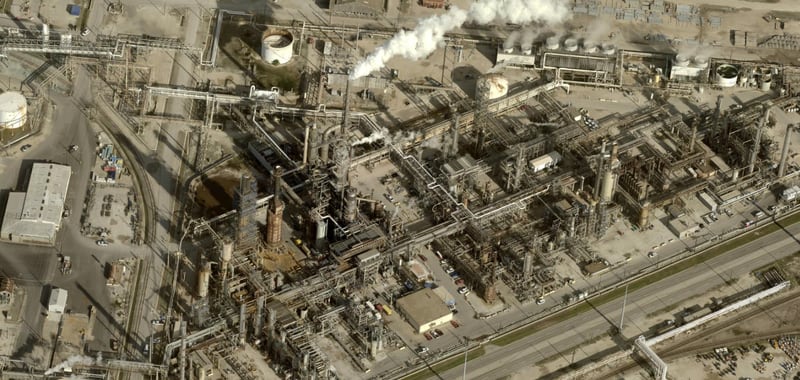
An operating Gulf Coast ammonia and nitrogen complex, Texas City, Texas. The dense cluster of towers and the scaffolded reformer block at left are the plant's core, converting natural gas to hydrogen and then to ammonia, with pipe racks, storage, and a rail spur handling feedstock and product. The visible plume is process steam. A complex on this scale runs to hundreds of millions in build cost, the reason the FIELDS program's grant is catalytic rather than load-bearing and a bankable feasibility study must carry the rest of the stack.
On July 1, 2026, Secretary of Agriculture Brooke Rollins announced the Fertilizer Investment and Expansion for Long-term Domestic Supply Program, known as FIELDS: $500 million in competitive grants, funded through the Commodity Credit Corporation and administered by USDA Rural Development's Rural Business-Cooperative Service, to expand domestic production of nitrogen, sulfur, phosphate, and potash fertilizers.
The program moves fast. Applications opened with the announcement and close at 11:59 p.m. Eastern on August 17, 2026, a window of roughly six weeks. Individual awards range from $15 million to $150 million. USDA anticipates approximately ten awards, with announcements indicated for late 2026.
Most coverage of FIELDS has stopped at the press release. This analysis goes further, because for any serious applicant the press release is not the operative document. The Notice of Funding Opportunity (RD-RBS-26-01-FIELDS) is, and it contains a requirement that determines whether an application is even complete: an independent, third-party feasibility study, prepared by a qualified consultant, that the Agency must concur is acceptable and adequate.
That requirement, and the capital-stack arithmetic that surrounds it, is the subject of this report.
What Is the USDA FIELDS Program?
FIELDS is a cost-share grant program authorized under Section 5(b) of the Commodity Credit Corporation Charter Act (15 U.S.C. 714c(b)), which permits CCC funds to be used to make available materials and facilities required in the production and marketing of agricultural commodities. It is the successor, and in design terms the corrective, to the Biden-era Fertilizer Production Expansion Program (FPEP).
The core parameters, per the FY2026 NOFO and USDA's announcement:
Funding. $500 million total, delivered as competitive cost-share grants. The Agency has stated it may increase total funding at its discretion.
Award size. $15 million minimum. The ceiling requires care: USDA's press release and the amended NOFO (revised July 7, 2026, per the Grants.gov change log) state a $150 million maximum, while some USDA-hosted program materials have circulated a $100 million figure. Applicants should verify the operative ceiling against the live NOFO on Grants.gov before sizing a request. We treat $150 million as the operative maximum in this analysis and flag the discrepancy where it matters.
Cost share. A hard 50 percent non-federal matching requirement on total eligible project costs. The NOFO's own example: a project with $50 million in total eligible costs may request up to $25 million and must provide at least $25 million in matching funds. Projects that have not secured the required match are ineligible, and the match must be documented before the financial assistance agreement is executed.
Period of performance. 60 months from award, with no-cost extensions of up to 24 months considered case by case. Awards are anticipated in the December 2026 to January 2027 window per the NOFO, although USDA officials indicated verbally at the launch that they hoped to announce awards as early as September or October.
Eligible uses. Construction of a new facility or purchase of an existing one (including land), modernization and expansion of existing facilities, and purchase and installation of process-manufacturing equipment. Pre-development costs, working capital, and fertilizer logistics (distribution, transportation, storage) are eligible but cannot be the primary use of funds. Build America, Buy America domestic-content requirements apply.
Ineligible activities. Research and development, products not commercially available and in use, nutrient substitutes, and standalone mixing, blending, bagging, storage, or distribution operations that do not materially increase domestic process-manufacturing capacity. Indirect costs are not eligible.
Eligible applicants. Entities of essentially any legal structure: for-profit companies, cooperatives, non-profits, Tribes and Tribal entities, and state and local governments. Two conditions do the real screening. Private entities must be independently owned and operated. And no applicant, including its affiliates as defined by SBA regulation 13 CFR 121.103, may hold a production market share greater than or equal to the fourth-largest producer of nitrogen, sulfur, phosphate, or potash. Applicants must certify compliance.
That last rule is not boilerplate. It is the grant-side expression of a broader competition policy, and it defines who this program is actually for: independent producers, cooperatives, and new entrants, not the incumbents who dominate each nutrient segment.
The Market FIELDS Is Trying to Fix
The strategic logic of FIELDS rests on two structural facts about the U.S. fertilizer market, and one acute disruption that turned both into a political emergency.
Fact one: import dependence is nutrient-specific, and extreme where it is extreme. Per the U.S. Geological Survey's Mineral Commodity Summaries 2026, the United States was 92 percent net-import-reliant on potash in 2025, with Canada supplying 79 percent of imports, Russia 12 percent, and Israel 3 percent. Phosphate rock import reliance stood at 16 percent and rising as Florida reserves deplete. Nitrogen, by contrast, was just 5 percent import-reliant: the shale-gas advantage has made the U.S. one of the world's low-cost ammonia producers. "Reshoring fertilizer" is therefore three different problems wearing one name, and the investment case for new domestic capacity is strongest precisely where the import exposure is largest.
Fact two: each nutrient segment is highly concentrated. University of Illinois farmdoc daily analysis (May 2026) found that CF Industries alone controls 39 percent of U.S. ammonia production capacity, Nutrien another 16 percent, and the top four firms roughly 70 percent, up from 50 percent as the number of U.S. ammonia plants fell from 46 to 33 between 2000 and 2023. In potash, Nutrien and Mosaic together control approximately 89 percent of North American production capacity. In phosphate, Mosaic and Nutrien hold more than 90 percent of North American capacity. This concentration is exactly why the FIELDS eligibility bar excludes top-four producers, and why USDA framed the program explicitly around restoring competition.
The disruption: 2026. The Iran-Israel war and the closure of the Strait of Hormuz removed a large share of globally traded fertilizer from the market. Countries exposed to instability around the Persian Gulf account for roughly 49 percent of global urea exports and about 30 percent of ammonia exports, per American Farm Bureau Federation analysis. U.S. fertilizer imports from affected Middle East ports fell to zero in May 2026. Urea prices rose 47 percent between late February and April, the largest month-to-month percentage increase on record per AFBF, and anhydrous ammonia moved from roughly $828 per ton before the conflict to over $1,120 by mid-April. In an AFBF survey of more than 5,700 farmers conducted in April, roughly 70 percent said they could not afford all the fertilizer they needed.
FIELDS is the supply-side response to that moment. Whether it can actually change the supply picture depends on arithmetic the press release does not discuss.
FPEP Failed. FIELDS Is Built on the Autopsy.
FIELDS cannot be understood apart from its predecessor. FPEP launched in 2022 with $500 million, later expanded to a ceiling of $900 million, and by December 2024 had obligated approximately $517 million across 76 facilities. Awards ranged from $1 million to $100 million with no matching requirement.
The outcome, in Secretary Rollins' words at the FIELDS launch: "Of the 121 projects that were identified in the last administration, only eight were moved to completion." Ninety projects lacked signed agreements; USDA characterized the program as achieving roughly 6 percent of its stated production goal.
Set aside the political framing, which is contestable, and the structural causes are instructive for anyone building a FIELDS application. FPEP grants were small relative to the cost of real fertilizer plants, so they could not close financing gaps. There was no matching requirement, so awards flowed to projects that had not assembled private capital and never would. And construction-cost inflation after 2022 (BHP's Jansen potash project rose from a US$5.7 billion estimate at sanction to US$8.4 billion) stranded marginal projects. The binding constraint was never the grant. It was everything around the grant.
FIELDS responds point by point: larger checks ($15 million to $150 million against FPEP's $1 million to $100 million), a mandatory 50 percent non-federal match that must be secured and documented, an explicit implementation-readiness screen, and a scoring rubric that rewards confirmed financing over preliminary intentions.
How Applications Are Scored
The NOFO's Section 5.1 sets out a weighted merit rubric. Eligible, complete applications are scored, ranked, and funded in strict rank order until the money runs out. The criteria:
Criterion 1: Financial Viability and Technical Merit, 0 to 25 points. Strength of financial projections and their supporting documentation, the track record of the proposed technology, and, critically, the extent to which financing is secured. The NOFO states plainly that applicants with confirmed commitments for matching funds receive more points than those with preliminary ones.
Criterion 2: Market Impact and Market Demand and Opportunities, 0 to 30 points. The largest single block. Split between market impact (0 to 12): input-supply plans, expansion of domestic capacity, competition effects, producers and acres benefited; and market demand (0 to 18): validated demand, end-user commitments, commercial linkages, and sustainability of the project beyond the grant period.
Criterion 3: Work Plan and Budget. The NOFO's header states 0 to 25 points, but the three documented sub-parts (Work Plan 0 to 7, Budget 0 to 6, Key Personnel and Service Providers 0 to 6) sum to 19. Read at 19, the full rubric totals exactly 100, which indicates the header is a drafting error. We score-plan at 19 and recommend applicants confirm with the Rural Business-Cooperative Service if the difference is material to strategy.
Criterion 4: Major Risks and Mitigation, 0 to 6 points. Construction delays, equipment availability, labor, operating capital, regulatory compliance, and credible mitigation for each.
Criterion 5: Nitrogen or Sulfur-Related Products, up to 5 bonus points , reflecting the acute 2026 shortage in nitrogen products.
Criterion 6: Executed Off-Take Agreements, up to 5 bonus points , with executed agreements weighted above those under negotiation.
Criterion 7: Administrator Points, 0 to 10 discretionary points for rural economic recovery, geographic diversity, and applicants that have not previously received an FPEP award.
Two observations for applicants. First, 55 of 100 points sit in the two criteria that a rigorous feasibility study directly feeds: financial viability and market demand. Second, the overarching lens the NOFO applies across every criterion is implementation readiness: documented, in-place evidence (executed contracts, secured permits, signed commitment letters) scores higher than assumptions and contingent plans, everywhere.
The Grant Is a Slice of the Stack
Here is the arithmetic that separates FIELDS analysis from FIELDS coverage.
A world-scale fertilizer facility costs between several hundred million and several billion dollars. CF Industries' Blue Point low-carbon ammonia complex in Louisiana, the largest by nameplate capacity in the world when complete, carries an estimated cost of $3.7 to $4.0 billion for 1.4 million metric tons per year. The Iowa Fertilizer Company complex at Wever cost roughly $3 billion to build. Michigan Potash's mine and plant is backed by a Department of Energy loan-guarantee commitment of up to $1.26 billion. Gulf Coast Ammonia's Texas City plant was built for roughly $600 million. Even a compact, captive brownfield plant, J.R. Simplot's 600-ton-per-day ammonia facility at Rock Springs, Wyoming, came in around $350 million.
Against those numbers, the maximum FIELDS award of $150 million represents:
1.8 percent of BHP's Jansen Stage 1 potash project (US$8.4 billion, included as an international scale benchmark)
Roughly 4 percent of Blue Point
5 percent of the Wever build cost
About 12 percent of Michigan Potash
25 percent of Gulf Coast Ammonia's build cost
43 percent of Simplot Rock Springs
The conclusion is not that FIELDS is small. It is that FIELDS is catalytic rather than load-bearing. A grant of this size can tip a marginal project to a final investment decision, reduce the equity requirement, or close a defined financing gap. It cannot carry a plant. For every FIELDS applicant, the binding constraint remains the other 57 to 98 percent of the capital stack: sponsor equity, senior debt, possibly a USDA Business and Industry guaranteed tranche (capped at $25 million per borrower, $40 million for qualifying cooperatives), and, for low-carbon nitrogen projects, monetized 45Q or 45V tax credits, which now carry a construction-start deadline of January 1, 2028.
And every debt tranche in that stack, whether B&I, conventional, or institutional project finance, runs on the same fuel: independently validated evidence that the plant will sell nutrient at prices and volumes that service the debt. Project-finance lenders in commodity-exposed sectors typically require minimum debt-service coverage in the 1.3x to 1.5x range, higher for merchant exposure without contracted off-take, and they require third-party feasibility validation before term sheets, not after.
This is the tell that runs through the entire program. The phrase "financially viable" does double duty: grant reviewers score it, and lenders underwrite it. One document sits at the intersection.
Does FIELDS Require a Feasibility Study? Yes. Here Is Exactly What It Requires.
The NOFO's application requirements leave no ambiguity. Every FIELDS application must include:
A third-party feasibility study , recently completed, prepared for the project, dated no more than three years before submission, and signed by a qualified consultant. The study must demonstrate that the proposed project is practical and viable and assess its likelihood of success. The Agency must concur that the study is acceptable and adequate.
A business plan , including pro forma and financial statements sufficient to evidence project viability.
Three years of historical balance sheets and income statements (or what exists, for younger companies).
A current balance sheet and income statement dated within 90 days of the application.
Two years of projected financial analysis : balance sheet, income statement, and cash-flow, with stated assumptions.
Unlike some USDA programs where the feasibility requirement triggers only above a dollar threshold, the FIELDS award floor of $15 million puts every applicant above any historical threshold. There is no FIELDS application without a feasibility study.
What does "acceptable and adequate" mean? USDA Rural Development's own regulatory definition, at 7 CFR 5001.3, is precise: a feasibility study is a report by an independent qualified consultant evaluating the economic, market, technical, financial, and management feasibility of the proposed project in terms of its expectation for success. Independence means the consultant holds no financial interest in the project or the applicant. The FIELDS Feasibility Study Guide, posted with the application package, follows the same architecture as its FPEP predecessor: the five feasibility dimensions, plus the consultant's recommendation and a statement of the consultant's qualifications.
The financial-feasibility dimension carries a definition worth quoting in substance: the ability of the project to achieve sufficient income, credit, and cash flow to sustain itself over the long term and meet all debt obligations. The regulatory standard for the grant is, itself, a debt-service test.
That is why we describe the feasibility study as the connective tissue of the FIELDS capital stack. Built once, to the right standard, it does four jobs simultaneously: it completes the grant application, it feeds the 55 points of scoring weight concentrated in financial viability and market demand, it anchors the pro forma financials the NOFO separately requires, and it seeds the credit file that the debt providers filling the other half of the stack will underwrite from. A study built only to grant-minimum scope will need expensive rework when the lenders arrive. A study built to lender standard over-satisfies the grant.
One precision, because overstating equivalence would be a disservice: senior lenders layer additional diligence on top of the feasibility study, typically an independent engineer's report, more conservative downside cases, and covenant structures no grant reviewer imposes. The feasibility study is the shared analytical core of both processes, not a substitute for lender due diligence. Applicants should budget for both, sequenced so the feasibility model becomes the reference case the independent engineer tests against.
The Policy Architecture: Why FIELDS Is Not a One-Off
Three regulatory developments, all within the past ten months, frame FIELDS as part of a coherent policy structure rather than an isolated grant announcement. Sophisticated applicants, and their lenders, should read the program in this context.
Critical-minerals designation. On November 7, 2025, the Department of the Interior published the Final 2025 List of Critical Minerals, adding ten minerals including phosphate and potash, the former at USDA's recommendation citing its importance to food security. Designation is not a subsidy and not a tariff; what it legally unlocks is expedited federal permitting under FAST-41, Defense Production Act Title III eligibility, and priority treatment in industrial-base programs. For a fertilizer project navigating NEPA review, which FIELDS awards are conditioned on, the permitting channel matters.
Antitrust enforcement. USDA and the Department of Justice signed a memorandum of understanding on competition in agricultural inputs on September 26, 2025. A DOJ criminal antitrust probe into fertilizer pricing was reported in March 2026, and the Federal Trade Commission announced a formal investigation on May 28, 2026; reporting has named Mosaic, Nutrien, CF Industries, Koch, and Yara as subjects of scrutiny, all of whom deny wrongdoing, and no charges have been filed. At the FIELDS launch, Deputy Secretary Stephen Vaden confirmed both agencies are investigating the fertilizer market civilly and criminally. The FIELDS top-four eligibility bar is the grant-side mirror of that enforcement posture: while the enforcers press the incumbents, the grant program seeds their competitors.
CCC Section 5 as a repeatable template. FIELDS runs on the same statutory authority that funded the 2018-2019 trade-aid programs and FPEP itself, and it launched one day after SPUR, a parallel $500 million CCC program for independent beef processors carrying an identical fourth-largest-producer exclusion. The Government Accountability Office has upheld USDA's discretion to use Section 5 funds for programs not itemized in its budget; Congress has periodically tried and failed to restrict it. The practical read for applicants: this administration has built a repeatable mechanism for seeding competition in concentrated agricultural markets, and FIELDS is unlikely to be the last exercise of it. A near-miss application this round may find a second window.
The Timeline Is the Strategy
Work backward from the deadline and the shape of a competitive application becomes clear.
Applications are due through Grants.gov by 11:59 p.m. Eastern on August 17, 2026 (the NOFO and program page control; USDA's press release stated August 15, and applicants should treat the earlier date as the safe planning assumption). Late submissions are not considered absent a waiver requested at least 48 hours before closing. SAM registration with an active UEI must be in place at submission, and new SAM registrations can take weeks, so that clock starts immediately.
The longest-lead mandatory deliverable is the feasibility study itself. It must be project-specific, signed by a qualified independent consultant, and strong enough to survive Agency concurrence review, and its findings feed the project narrative, the scoring criteria discussion, and the pro forma financials. The 50 percent match must be secured and papered with signed commitment letters, because unsecured match is not a scoring weakness but an eligibility failure. Off-take agreements, worth up to 5 points executed and materially more through their effect on the market-demand criterion, take time counterparties do not compress.
For a program window this short, the feasibility study is not a compliance document prepared at the end. It is the first workstream, and everything else in the application inherits from it.
How MMCG Prepares a FIELDS Feasibility Study
MMCG Invest is a national feasibility consulting practice serving lenders, investors, and sponsors across SBA, USDA, and conventional credit programs. Our studies are built to the standard the strictest consumer in the capital stack requires, which for FIELDS means both of them at once:
Full compliance with the five feasibility dimensions of 7 CFR 5001.3 and the FIELDS Feasibility Study Guide: economic, market, technical, financial, and management feasibility, with a signed consultant opinion and statement of qualifications.
A lender-grade financial model beneath the grant document: cash flows available for debt service, coverage-ratio outputs, sensitivity and downside cases, and capital-stack scenarios with and without the grant, so the same engagement that completes the application also opens the debt conversation.
Independent market analysis drawing on our proprietary datasets and subscriptions, aligned to the NOFO's market-impact and market-demand criteria where 30 of the 100 points sit.
Transparent sourcing throughout, including the documented discrepancies in the program's own materials, because Agency reviewers and credit committees both reward analysis that shows its work.
The FIELDS window is short and the feasibility study is its critical path. If you are evaluating an application, the right time to commission the study was the day the NOFO published. The second-best time is this week.
Book a Meeting to scope a FIELDS feasibility study with our team.
Frequently Asked Questions
What is the USDA FIELDS program? FIELDS (Fertilizer Investment and Expansion for Long-term Domestic Supply) is a $500 million USDA competitive grant program announced July 1, 2026, funding construction and expansion of domestic nitrogen, sulfur, phosphate, and potash production facilities. It is administered by USDA Rural Development's Rural Business-Cooperative Service using Commodity Credit Corporation funds.
How much can a FIELDS award be? The minimum individual award is $15 million. The amended Notice of Funding Opportunity and USDA's announcement state a $150 million maximum, though some USDA materials have circulated a $100 million ceiling; verify against the live NOFO on Grants.gov . USDA anticipates roughly ten awards.
When is the FIELDS application deadline? The NOFO and USDA Rural Development program page state 11:59 p.m. Eastern on August 17, 2026, via Grants.gov . USDA's press release cited August 15. Prudent applicants should plan to the earlier date.
Does the FIELDS program require a feasibility study? Yes. Every application must include a recently completed feasibility study, prepared for the project, dated within three years of submission, and signed by a qualified independent consultant. USDA must concur that the study is acceptable and adequate. There is no award tier below the requirement.
What must a FIELDS feasibility study include? Under USDA Rural Development's standard (7 CFR 5001.3) and the FIELDS Feasibility Study Guide: economic, market, technical, financial, and management feasibility, concluding with the consultant's opinion on the project's likelihood of success and a statement of the consultant's qualifications and independence.
Who is eligible for FIELDS? For-profit entities, cooperatives, non-profits, Tribes and Tribal entities, and state and local governments, provided private entities are independently owned and operated. Applicants and their affiliates may not hold a production market share at or above the fourth-largest producer of nitrogen, sulfur, phosphate, or potash.
Is there a matching requirement? Yes. Applicants must provide non-federal matching funds equal to 50 percent of total eligible project costs, secured and documented. Projects without secured match are ineligible.
How is FIELDS different from FPEP? FPEP (2022) obligated roughly $517 million across 76 facilities with awards of $1 million to $100 million and no match requirement; USDA states only 8 of 121 identified projects were completed. FIELDS raises the award range, imposes the 50 percent match, screens for implementation readiness, and scores confirmed financing above preliminary commitments.
MMCG Invest, LLC prepares lender-grade feasibility studies for SBA, USDA, and conventional financing programs nationwide. This analysis is based on the FY2026 FIELDS Notice of Funding Opportunity (RD-RBS-26-01-FIELDS), USGS Mineral Commodity Summaries 2026, USDA and agency primary sources, and company disclosures, current as of July 10, 2026. Program terms are controlled by the live NOFO on Grants.gov ; applicants should verify all figures against it. This report is informational and does not constitute legal or financial advice.
July 10, 2026, by Michal Mohelsky, J.D. Principal of MMCG Invest, LLC, feasibility study company serving feasibility studies for USDA and FIELDS projects.
Reach out to discuss how our methodology supports your lending or investment decision.

Michal Mohelsky, J.D. | Principal | mmcginvest.com
Contact: michal@mmcginvest.com
Phone: (628) 225-1110
Disclaimer: This report is provided for informational purposes only and does not constitute investment advice. Data presented herein is derived from proprietary MMCG databases and third-party sources believed to be reliable; however, MMCG Invest makes no representation as to the accuracy or completeness of such information. Figures from third-party industry databases have been independently verified and, where appropriate, adjusted to reflect MMCG's proprietary analytical methodology. Past performance is not indicative of future results.

Michal Mohelsky, J.D., FMVA, Practicing Affiliate of the Appraisal Institute
Principal, MMCG Invest, LLC
Published July 10, 2026. Last updated July 11, 2026. How this analysis was prepared.
Cite this
Michal Mohelsky, J.D., FMVA (2026). USDA FIELDS Program: What It Is and Why Your Application Needs a Feasibility Study. MMCG Invest, LLC. https://www.mmcginvest.com/post/usda-fields-program-what-it-is-and-why-your-application-needs-a-feasibility-study
Where this goes next
- USDA Feasibility StudyMMCG's feasibility study page for this subject.