Summary
San Francisco's development cycle appears to be at or near bottom, with housing the one segment that still carries demand and office development effectively frozen. CoStar counts around 170 developments in the pipeline, but only 22 are under construction and 144 remain proposed or in early planning; 120 of the 170 are residential, yet by the end of 2024 the city had approved only 7,300 units against the 82,000 it is mandated to add by 2031.
Office vacancy hit 21.7% in early 2024 after 23 million square feet of space was given back since 2020, and only 4 office projects, about 750,000 SF in total, are under construction. Flex and lab space carries 18% vacancy with over 5.3 million SF under construction in the metro area, and hotel occupancy is projected at roughly 64% in 2025 against pre-pandemic norms near 80%.
Written for Investors weighing San Francisco development or distressed acquisitions, Lenders underwriting Bay Area construction and conversion loans, Developers timing entitlements under the Housing Element rezoning. 36 minute read.
Key figures
- Developments in the pipeline citywide
- around 170
- CoStar data on major projects2025 (article updated Oct 7, 2025)
- Projects under construction
- 22 projects (roughly 13%)
- CoStar data on major projects2025 (article updated Oct 7, 2025)
- Housing projects planned in the pipeline
- 120 projects
- CoStar development pipeline data (Table 1)2025 (article updated Oct 7, 2025)
- Office projects under construction
- 4 office projects (~750,000 SF)
- CoStar data2025 (article updated Oct 7, 2025)
- Housing units approved (about 9% of target)
- 7,300 units
- San Francisco Planning Department data (2024 San Francisco Housing Inventory, article Sources)By end of 2024
- Housing units San Francisco is mandated to add
- 82,000 units
- California state housing mandate (Housing Element), as stated in the articleBy 2031
Updated: Oct 7, 2025
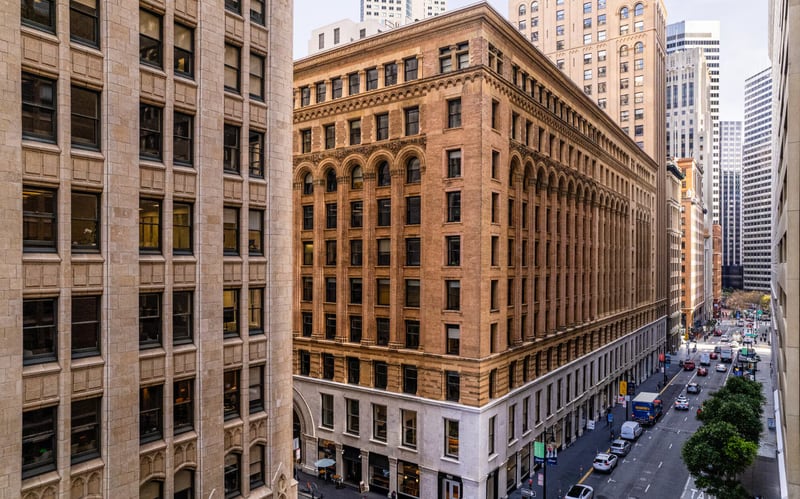
The Mills Building
Economic and Demographic Overview
San Francisco’s economic landscape has been reshaped in recent years by the pandemic and its aftermath. The city experienced a sharp population decline of roughly 7% in 2020-2022 – losing more residents than any major U.S. city – due to remote-work driven outmigration. As of early 2025, the population remains about 3 to 4% below pre-pandemic levels. There are signs of stabilization – the city even eked out a small gain of ~1,200 people from 2022 to 2023 – but overall San Francisco is still well below its 2019 peak population and struggling to regain growth momentum. This population trend directly impacts real estate, reducing near-term demand for some asset classes (notably office and retail) while tempering, but not eliminating, the chronic housing demand.
Economically, San Francisco remains a global tech and innovation hub, but the tech sector’s recent volatility has reverberated through the real estate market. Major technology employers have implemented layoffs and downsized office footprints since 2022, contributing to a surge in office vacancies. By Q1 2024, office attendance downtown averaged only ~45% of pre-COVID levels as hybrid work became entrenched. At the same time, venture capital and startup activity continue to position the region for future growth in fields like AI and life sciences, indicating long-term prospects remain intact. In short, San Francisco’s economic fundamentals are in a delicate balance: the city faces current headwinds from outmigration, tech sector downsizing, and a tourism slowdown, even as long-term drivers – a highly educated workforce, top-tier VC funding, and innovative industries – signal resilience.
Development Pipeline Overview
The development pipeline in San Francisco reflects both the city’s pressing needs (especially for housing) and the cautious environment for new projects. According to CoStar data on major projects, there are around 170 developments in the pipeline citywide, spanning all phases from proposals to active construction. However, the vast majority are still in planning. Only 22 projects (roughly 13%) are under construction, with just 4 in a “final planning” stage, while 144 projects (over 85%) remain in proposed or early planning stages. This indicates that much of the pipeline is not yet breaking ground – a sign of the challenging conditions for moving projects forward.
| Asset Class | Under Construction | Final Planning | Proposed | Total Projects |
|---|---|---|---|---|
| Multi-Family (Housing) | 14 | 1 | 105 | 120 |
| Office | 4 | 0 | 13 | 17 |
| Hospitality (Hotel) | 0 | 3 | 8 | 11 |
| Flex (R&D/Life Sci) | 1 | 0 | 8 | 9 |
| Specialty Use | 1 | 0 | 4 | 5 |
| Retail | 1 | 0 | 3 | 4 |
| Industrial (Warehouse) | 0 | 0 | 2 | 2 |
| Health Care | 1 | 0 | 0 | 1 |
| Sports/Entertainment | 0 | 0 | 1 | 1 |
| Total | 22 | 4 | 144 | 170 |
As Table 1 illustrates, new development in San Francisco is overwhelmingly concentrated in housing (multi-family) . Approximately 120 projects – roughly 70% of the total pipeline – are residential, far outnumbering planned projects in any other category. In contrast, only 17 office projects are in the works, and even fewer industrial (2) or retail (4) developments. The city’s development focus has clearly shifted toward addressing the housing shortage, while office construction has slowed to a trickle in the face of high vacancies. Notably, even within the housing pipeline, very few projects are actually under construction (just 14, despite 120 total planned), underscoring the slow conversion of proposals into built units.
In terms of scale, the multi-family projects in planning total nearly 33 million square feet of space, which could equate to on the order of 30,000 new housing units if realized. This is significant yet still falls well short of the 82,000 units San Francisco is mandated to add by 2031 under California’s housing goals. In other words, even if every planned housing development were built (an unlikely scenario), the city would produce only around one-third of the units needed – and current production is lagging badly. By end of 2024, San Francisco had approved only 7,300 units (about 9% of its target), reflecting “sluggish development” and many projects stuck in “permit purgatory” without financing. This gap between ambitions and reality highlights both a challenge and an opportunity: there is enormous room (and pressure from the state) for development to accelerate, especially in housing, if economic and policy conditions become more favorable.
Residential Development and Housing Market
Residential (Multifamily) construction is the dominant engine of development activity in San Francisco’s pipeline. With roughly 120 projects in the works, the city has tens of thousands of new apartments and condos on the drawing board. Key planned projects span from high-profile mixed-use “megaprojects” to smaller infill apartment buildings:
Megaproject examples: The Parkmerced expansion in the southwest city is one of the largest, with plans for several million square feet of new apartments (a 3.5 million SF phase is in planning). On the central waterfront, Pier 70 and the Potrero Power Station redevelopment each envisage around 2,000 new housing units alongside commercial space. Another major initiative is Mission Rock (by the SF Giants and Tishman Speyer) which will ultimately deliver up to 1,200 new homes in a new mixed-use neighborhood by Oracle Park. These large projects, backed by institutional developers, aim to create new residential communities at scale over the coming decade.
Infill and mid-sized projects: The bulk of housing developments, however, are mid-rise and high-rise projects scattered across the city’s neighborhoods. Many target formerly underutilized sites – for example, the redevelopment of a former gas station or parking lot into a 100-unit apartment building. A notable trend is the inclusion of affordable housing projects: sites like 1515 South Van Ness (now under construction with ~150 affordable units) and 700 Stanyan (a 186,000 SF affordable housing project on a city-owned lot) are moving forward with public and nonprofit support. These contribute to the pipeline alongside market-rate projects by private developers.
This robust housing pipeline is a response to San Francisco’s chronic housing shortage and high rents. Apartment market fundamentals have started to recover from the pandemic dip: as of Q1 2024 the residential vacancy rate was down to 5.9% , the lowest since early 2020. Positive absorption of about 2,300 units over the past year was recorded, although renter demand has softened somewhat due to tech layoffs and high interest rates slowing household formation. Rents, which fell in 2020, have been rebounding – climbing about 5% from Feb 2024 to Feb 2025 according to one index – but still remain slightly below their pre-pandemic peaks on average. In short, demand for housing in San Francisco persists, bolstered by limited homeownership affordability (high home prices and mortgage rates are keeping people in the rental market).
On the supply side , actual construction of new housing has been very low in recent years. Only 860 new units were delivered in the city in the past year – the lowest annual total since 2012. This is partly due to pandemic disruptions and economic uncertainty causing many projects to pause. Looking ahead, about 4,600 units are under construction citywide (roughly 2.6% of existing inventory), and forecasts expect approximately 2,000 new units to complete in each of 2024 and 2025 as some larger projects finish. Notably, a large share of the region’s apartment construction is happening outside the city – e.g. in South San Francisco, San Mateo, and Redwood City – whereas San Francisco proper will see only ~600 units delivered in 2024 (including some on Treasure Island). This underscores that despite the extensive pipeline on paper, real new supply in the near term is quite modest.
For investors, the housing sector in San Francisco presents a mix of strong long-term fundamentals and short-term hurdles . Occupancy is healthy and rent growth is resuming, which supports the case for new development. The sheer undersupply of housing and state pressure to build more create a favorable demand outlook: vacancy rates are far below the national average and new high-quality projects often lease up quickly. However, challenges include the high cost of construction, lengthy entitlement processes, neighborhood opposition, and now significantly higher interest rates, which make financing development more difficult. Indeed, many of the 105 “proposed” housing projects in the pipeline lack funding or approvals to commence – as the Planning Department’s data show, San Francisco is not on track to meet its housing goals without a dramatic acceleration. Some movement is occurring on the policy front (discussed further below) to streamline housing permits and rezone areas for more density, which could unlock additional opportunities. Overall, residential development remains the primary opportunity in San Francisco real estate – the demand for housing is structurally robust – but execution risk is high. Investors must be selective, favoring well-capitalized projects in prime locations or with public support (grants, tax credits, etc.), and be prepared for a protracted timeline to navigate approvals and construction.
Office Market: Weak Demand and Limited Development
San Francisco’s office sector has undergone a dramatic swing from boom to bust, directly impacting development activity. The pandemic’s shift to remote and hybrid work has left the city with a glut of office space: the vacancy rate hit 21.7% in early 2024 and is still rising, a stark change from the sub-5% vacancies seen in the mid-2010s. Net absorption has been deeply negative for four consecutive years – totaling 23 million square feet of space given back since 2020 – as companies downsized or exited leases. By 2023, San Francisco was approaching record-high levels of space availability (including nearly 12 million SF of sublease space). Rents have fallen substantially from their peak, and property values for offices have been under severe pressure, with some high-profile buildings trading at large discounts or going into default.
Unsurprisingly, new office development has nearly ground to a halt . Developers are extremely hesitant to start speculative office projects in the current environment, and even permitted projects are being deferred until market conditions improve. In CoStar’s data, only 4 office projects are listed as under construction in San Francisco (accounting for ~750,000 SF of space in total). The most notable is the Mission Rock office tower (Phase II) , a 750,000 SF waterfront project that secured anchor tenants (e.g. Visa’s new HQ) and is moving forward as part of the larger mixed-use development. The other few offices underway are small in scale – for instance, a 52,000 SF addition at 545 Sansome St – or are specialized (one is a 34,000 SF building at UCSF’s campus, likely tailored for life sciences or institutional use). Importantly, no new traditional downtown office towers are rising, and several previously approved high-rises are stalled. The once highly anticipated Oceanwide Center – a planned 910-foot skyscraper including 1.35 million SF of offices – stands as an empty excavation pit after the Chinese developer halted construction in 2019 and went into liquidation. This project’s failure (and others like it) has become a symbol of the post-COVID downtown slump and the risks in speculative office development.
Given these conditions, the office development pipeline in San Francisco is very thin. Only 13 office projects are in the proposed stage, and many of those are unlikely to proceed in the near term. The city also has an annual cap (Proposition M) limiting new large office approvals to ~875,000 SF per year, but in the current climate that cap isn’t binding – demand is so weak that few developers are lining up for allocations. In fact, policy has shifted to reduce barriers: voters passed Proposition C in 2024 to incentivize office-to-residential conversions (e.g. exempting conversions from certain taxes and allowing demolished office space to be “credited” toward new office quotas). This reflects an acknowledgement that San Francisco simply has too much old office space and not enough housing. A few projects are exploring conversion feasibility, but challenges (zoning, high conversion costs, floorplate layouts) mean we haven’t yet seen a wave of successful office conversions – it remains an opportunity area if costs can be brought in line.
For investors, San Francisco offices represent the most distressed segment of the market currently. Fundamentals are near historic lows: in addition to high vacancies and rent declines, office property values have fallen (by 20-40% or more in some cases), and loan defaults are rising as buildings struggle to achieve pre-pandemic revenues. This creates potential opportunities to acquire assets at a deep discount – especially Class B/C offices or those in the hard-hit downtown core – but the outlook for recovery is uncertain. The upside case would hinge on a revival of demand (for example, via AI and life science firms expanding , as there have been some sizable AI-related leases nationally) or successful repositioning of obsolete offices to alternative uses. San Francisco still boasts a world-class tech ecosystem and substantial venture funding, so one can argue the office market could find a new equilibrium as the economy evolves. However, any new ground-up office development in the next few years will likely be limited to build-to-suit projects for specific tenants (especially life science) , or part of mixed-use projects where offices are just one component. Indeed, most active “office” construction is actually life-science (lab) space in disguise, often categorized under Flex/R&D (discussed below). Until vacancy rates compress significantly and rents justify new construction, speculative office towers will remain on the shelf. Investors eyeing the office sector should be prepared for a long recovery timeline and focus on assets with unique demand drivers (e.g. lab conversion potential, or premier Class A buildings that can outperform in a flight-to-quality trend).
Industrial and Life Sciences (Flex/R&D) Outlook
San Francisco has a relatively small industrial base in terms of pure warehouse/logistics properties, but it plays an outsized role in the life sciences R&D sector . Much of the city’s “industrial” development pipeline is actually Flex space – high-tech R&D buildings often used as biotech labs. The data show 9 flex projects in planning or construction, versus only 2 traditional industrial projects. This aligns with the regional pattern: the South San Francisco and Peninsula submarkets (just south of the city) have become biotech hubs, and that growth is extending into the city’s Dogpatch/Mission Bay area in the form of new lab buildings.
Currently, San Francisco’s industrial availability is mixed. On the one hand, logistics (warehouse) space remains tight – vacancy is around 6%, near historical norms – as there’s limited supply in the city and steady demand for last-mile distribution, urban manufacturing, and maker space. On the other hand, the flex/R&D segment has seen vacancy jump to 18% . This rise is due to a combination of surging new supply and a recent cooling of demand from biotech firms. Over 5.3 million SF of new flex/lab space is under construction in the metro area, a historically high level of development for that sector. Notably, many of these projects were launched to capitalize on the life science boom of 2019 to 2021, when VC funding for biotech was abundant and lab rents were soaring. In the past 18 months, however, higher interest rates and a biotech market correction have caused tenants to scale back expansion plans. Venture funding for early-stage life science firms has pulled back, leading to slower leasing of new lab buildings. Thus, San Francisco now faces a short-term glut of lab space, with new deliveries hitting the market just as demand decelerated.
Despite this, the long-term outlook for life sciences real estate in San Francisco remains positive . The city and surrounding region host world-renowned research institutions (UCSF, Stanford) and a skilled workforce that continues to attract biotech and pharma companies. Investors have taken note – many new developments in the pipeline are backed by experienced life science developers (e.g. Alexandria Real Estate, BioMed Realty) and targeted to specific user needs. For example, projects in Mission Bay, Pier 70, and SoMa are adding modern lab facilities that can command premium rents from lab users, which often still exceed traditional office rents. All 5.3 million SF under construction are flex/lab buildings aimed at life science tenants. Key developments include expansions around UCSF’s Mission Bay campus and new lab buildings in the Dogpatch/Central Waterfront area (often as part of mixed-use campuses like Pier 70’s planned labs, or the Potrero Power Station project’s life science component).
For pure industrial/logistics uses, San Francisco’s development is limited by land scarcity and zoning constraints – only a couple of small industrial projects (like a 17,500 SF warehouse at 470 Bayshore Blvd) are proposed. However, there is notable activity in last-mile distribution adaptation of existing space, exemplified by the recently opened 725,000 SF Amazon Delivery Station at 900 7th Street (a reuse of a former distribution center). This reflects e-commerce demand for urban fulfillment centers, though new ground-up warehouse builds in the city are rare.
From an investment perspective , industrial and life science properties have been darlings of the real estate world, and San Francisco is no exception in terms of investor interest. During the pandemic, life science properties in the Bay Area saw cap rates compress and values climb thanks to their perceived resilience. Now, with the sector’s short-term headwinds, there may be an emerging opportunity to invest at slightly better pricing. Rents for lab space have plateaued or softened in some submarkets, but the top-quality facilities still see strong tenant interest. The key risk is timing – the current vacancy in flex space (18% in SF and even higher in South SF) could take time to be absorbed, potentially putting pressure on rents and returns in the near term. Nonetheless, given the lack of new office development , many developers are repurposing plans towards lab usage, which suggests confidence in the sector’s prospects. For example, several approved office high-rises in Central SoMa are reportedly being reconsidered as life science projects when they revive, to chase the more active tenant base. Investors considering development or conversion to lab use should be mindful of the specialized nature of these buildings (higher construction costs for ventilation, safety, etc.) and the importance of clustering near research anchors. But if any segment of SF commercial development is likely to see cranes in the air, it is this hybrid industrial/life-science category, supported by the Bay Area’s continued leadership in biotech.
Retail and Hospitality Considerations
The retail sector in San Francisco has been a tale of two markets: the struggling downtown core and the comparatively resilient neighborhood retail corridors. Overall, the city’s retail vacancy has been creeping upward, and new retail development is extremely limited. As of Q1 2024, retail construction activity in SF was at a historic low , with only about 200,000 SF of retail space under construction (a single new Safeway store and a few small mixed-use project components) – barely half the normal volume of past years. For context, a five-year average was ~380,000 SF annually, so developers have largely shelved standalone retail projects. The reasons are clear: a combination of long-standing constraints and recent shocks. San Francisco has very few large developable sites for new retail (and strict planning limits on chain stores in some areas), and now the population decline and work-from-home shift have reduced retail demand in key areas. Downtown, where office workers and tourists once filled stores, has seen foot traffic plummet, leading to higher vacancies especially around Union Square and the Financial District. Several big-name retailers (like Nordstrom and Old Navy) have closed flagships, citing reduced sales and urban challenges.
By contrast, neighborhood retail strips – the “Main Street” shopping and dining areas in places like Hayes Valley, the Mission, or Clement Street – have held up better. These areas benefit from local resident patronage and have more small independent shops and restaurants. The retail mixes there remain “active and vibrant”, with eateries and boutiques rebounding as residents return to local businesses. In fact, some districts outside downtown have seen flat or even improving retail performance, helping the city achieve a modest gain in occupancy in late 2023. Still, overall retail rents are under pressure and any development of new retail is typically as a minor component of mixed-use projects (ground-floor retail beneath new housing, for example). This reflects a development strategy where retail is included to activate streetscapes but not as a primary revenue driver for the project.
For hospitality (hotels) , San Francisco’s tourism industry is in a protracted recovery. The pandemic dealt a heavy blow: hotel occupancy fell below 30% in 2020. It has since improved but remains well under pre-pandemic norms (which were ~80% occupancy annually). In 2023, the city’s hotels averaged around 62 to 64% occupancy, and 2024 has been softer than hoped. High-profile conventions and events (like Dreamforce) have not yet fully restored the weekday business travel that hotels rely on. San Francisco Travel (the tourism bureau) projects occupancy to tick up to roughly 64% in 2025 with the help of a resurgence in convention bookings, but international tourism – a big demand segment – is still down, particularly from Asia. Hotel room rates (ADR) are recovering a bit (forecast around $230 in 2025, up from $225 in 2024), but revenue per available room is still much lower than 2019. The challenges in downtown (street conditions, perceptions of safety) have also been cited by some hotel operators as hindrances to demand. In mid-2023, two large Union Square hotels (the Hilton San Francisco Union Square and Parc 55) were handed back to lenders, highlighting distress in the hospitality sector.
Given this backdrop, new hotel development is sparse . The pipeline shows 11 hospitality projects (8 proposed, 3 in final planning), but many are likely on hold until performance improves. No hotels are currently under construction in the city. Some proposed projects, like a long-planned Waldorf Astoria tower (part of Oceanwide Center), are effectively shelved. A few smaller hotel or hostel projects may proceed (for example, converting older office buildings or adding boutique hotels in tourist areas once financing is viable). One bright spot: as travel rebounds, San Francisco’s unique appeal as a destination (culture, scenery, business hub) suggests hotel occupancy will rise over the medium term. Indeed, convention bookings for 2025 are reportedly up 50% versus the prior year, which should lift downtown hotels significantly. Investors with a contrarian view might see opportunity in acquiring or renovating hospitality assets now at a discount, ahead of a fuller recovery by 2026 to 2027. But in terms of development, ground-up hotel projects likely won’t pencil until occupancy and ADR recover enough.
In summary, retail and hospitality in San Francisco present a cautious picture for development. Retail development is largely limited to serving new residential projects (fulfilling neighborhood retail needs) or repositioning vacant downtown storefronts rather than building new square footage. Hospitality development is paused, pending a clearer rebound in tourism and business travel. For an investor, retail in San Francisco is a yield play on existing assets – street-front retail in strong neighborhoods can still perform – whereas downtown retail and hotels are more speculative turnaround stories. Creative reuse is a theme: some empty retail spaces downtown are being repurposed as art galleries, entertainment venues, or even gyms to fill gaps. The city’s efforts to revitalize Union Square (through beautification, events, and potentially converting some space to other uses) are ongoing, and success there would help underpin future retail attraction.
Major Developers and Investors in the Market
Despite the challenges, major real estate players continue to engage in San Francisco’s development scene, often with a long-term perspective. A few key developers and investor groups stand out:
Brookfield Properties – A global development giant, Brookfield is behind the ambitious Pier 70 project (28 acres on the waterfront). They have invested heavily in site infrastructure and rehabilitating historic structures as they phase the project. Pier 70 will eventually include 2,000 homes and 1.75 million SF of offices, plus retail and arts space. Brookfield had to pause some vertical construction during the pandemic (plans for new offices and apartments were delayed when an anchor tenant and financing fell through). However, Brookfield’s strategy shows patience – they completed the horizontal improvements and activated a big event space (Building 12) to create a destination that will attract tenants as the market recovers. Brookfield’s continued commitment (despite “not all smooth sailing”) signals confidence in San Francisco’s long-term appeal, albeit tempered by short-term caution.
Tishman Speyer & the San Francisco Giants – This partnership is developing Mission Rock , a new neighborhood on 28 acres of Port land across from the baseball stadium. Phase 1 of Mission Rock, costing $1.5 billion, is nearly complete with two office towers and two residential buildings (537 units) plus a park. Major tenants like Visa (300,000 SF HQ lease) and the Golden State Warriors (office space) have signed on. In 2025, a private equity firm (Sixth Street) even bought a 10% stake in the Giants and Mission Rock development, valuing the combined enterprise in the billions. When fully built, Mission Rock will have 1,200 homes and 2.7 million SF of offices/labs, plus retail and 8 acres of parks. This project exemplifies a well-capitalized, phased approach – backed by a local institution (the Giants) and a top-tier developer (Tishman) – to urban placemaking. Investors see it as a long-term bet on San Francisco’s waterfront and innovation economy (lab-ready office space is a focus for later phases).
FivePoint/Lennar – These developers (Lennar’s spinoff FivePoint) are master developers of the Hunter’s Point Shipyard and Candlestick Point redevelopment in the southeastern city. This multi-decade project was to deliver over 10,000 housing units. Progress has been slow, partly due to environmental cleanup issues at the Shipyard. A few hundred homes have been built in earlier phases, but much of it is on hold pending regulatory approvals. Their perseverance (and lobbying for federal support on cleanup) keeps the possibility alive that these massive sites will eventually see substantial development, which would be game-changing for SF housing supply.
Local Housing Developers – A number of local firms are active in mid-sized housing projects. Examples include Crescent Heights (proposing a 55-story residential tower at 10 South Van Ness, which would be the city’s tallest residential building), Build Inc. (behind the India Basin project, ~1,200 units planned), Strada Investment Group and SKS Partners (pursuing various mixed-use projects), and affordable housing developers like TNDC and Mercy Housing (which are constructing 100% affordable projects, often with city funding). These players operate in the background of big headline projects, steadily adding units in neighborhoods across the city.
Institutional Investors and REITs – Companies such as Kilroy Realty, Boston Properties, Vornado, Paramount Group have historically owned or developed major San Francisco assets (e.g. Salesforce Tower by Boston Properties). Currently, their development pipelines in SF are minimal (Kilroy delivered the 2.2 million SF Exchange at Mission Bay labs a few years ago and then paused; Boston Properties’ planned Fourth & Harrison office is on hold). Some, like Kilroy, have shifted focus to life science projects down the Peninsula. Alexandria Real Estate Equities , a leading life-science REIT, is an important player – they have a presence in Mission Bay and are likely behind or eyeing some future lab developments. Prologis , the industrial REIT headquartered in SF, actually plays more of a role globally than in SF city (due to limited industrial land), though they have invested in last-mile facilities and even in the concept of converting some downtown real estate to logistics/micro-fulfillment.
Overall, the investment landscape in San Francisco development is bifurcated. On one side are those with a long-term, strategic commitment to the city – they tend to be involved in the large phased projects and have deep pockets to weather cycles (Brookfield, Tishman, public-private joint ventures). On the other side, many opportunistic or smaller developers have pulled back or redirected capital elsewhere in the face of SF’s difficulties. The number of active construction cranes is low, which indicates that only the most well-conceived and well-financed projects are moving ahead. We are also seeing an influx of private equity interest in distressed assets – for example, Starwood, Oaktree, and others have reportedly been scouting for undervalued office towers or hotels they can buy at a fraction of replacement cost. Some recent notable deals include the acquisition of the Genesis South Tower (a life science building) by GI Partners, and Sixth Street’s aforementioned stake in Mission Rock, showing creative ways investors are getting exposure to the market.
Policy Environment and Regulatory Factors
San Francisco’s development is heavily influenced by its policy and regulatory environment , which is both notorious for constraints and gradually evolving toward reform. Key factors include:
Land Use and Zoning: San Francisco historically has strict zoning, with large swaths of the westside limited to single-family homes and height limits in many neighborhoods. This has constrained where new dense development can occur (mostly downtown and eastside neighborhoods). However, under the state-mandated Housing Element update, the city is now crafting rezoning plans to allow more housing density citywide. The goal is to enable those 82,000 new housing units by 2031 , which will require upzoning many areas that haven’t seen development in decades. The Mayor and Planning Department have rolled out proposals (sometimes called the “Rezoning for Equity” or “SF Family Zoning Plan”) to permit mid-rise apartments on transit corridors and to streamline adding units in well-off neighborhoods that were once off-limits. These changes face political debate, but the state’s ultimatum (meet housing targets or lose local control) provides pressure. If enacted, such rezoning could unlock new project sites and attract developers to parts of the city that previously were untouchable.
Approval Process: San Francisco’s entitlement process has a reputation for being slow and complex, with extensive community input (and potential opposition), environmental reviews, and high impact fees. A typical large project can take 2 to 4 years (or more) from application to groundbreaking. Recognizing this as a barrier, the city is introducing initiatives like “PermitSF” – a program to dramatically cut permitting times. Additionally, state laws like SB35 (which streamlines approval for compliant housing projects in cities falling short of housing goals) have begun to be used in SF, bypassing some local red tape. For example, a 500-unit project at 469 Stevenson Street was recently resubmitted under SB35 to avoid a lengthy discretionary review. The use of state density bonus laws is also increasing, allowing developers to add extra height in exchange for more affordable units. All told, while SF’s process is still arduous, there is a clear trend toward faster approvals for housing , especially affordable housing. This is a positive sign for investors – time is money, and any reduction in entitlement timelines improves project viability.
Office Development Cap (Prop M): As mentioned, Prop M limits large office approvals to 875,000 SF per year (with unused quota rolling over). During the 2010s boom, this cap was actually binding – a queue formed of office projects awaiting allocations. Today, with little demand, the queue is effectively paused. Moreover, Proposition C (2024) has created new “office demolition/conversion credits” that have expanded the pool by adding back 2.5 million SF of quota from scrapped projects. In short, the office cap is not a pressing concern now, but it could re-emerge as a constraint if/when the office market recovers and multiple projects vie to be built. Investors should still be aware that any large office project needs an allocation, and politics can come into play in those decisions at the Planning Commission.
Affordable Housing Requirements: San Francisco imposes some of the nation’s highest affordable housing mandates on new development. Larger residential projects must typically make around 20%–24% of units affordable (or pay an in-lieu fee or dedicate off-site units). These requirements, while addressing social goals, add to project costs. There is ongoing debate about the optimal level – too high a requirement can stifle development altogether. Recently the city slightly reduced certain fees and requirements for projects that provide additional middle-income units, trying to spur more inclusionary housing. The city also aggressively pursues grants for affordable housing and has its own funding (from housing bonds, etc.) to partner on fully affordable projects. For investors, it’s crucial to factor these requirements into pro formas. Joint ventures with nonprofit housing providers or selling land to affordable developers at a discount can sometimes be strategies to fulfill mandates while focusing on the market-rate portion.
Other Regulatory Factors: San Francisco’s building codes and design review processes can affect costs – for instance, strict seismic requirements, facade materials standards, and sustainability mandates (electric-only new construction, solar panels, etc.). The city is progressive on green building; all new large buildings must meet LEED Gold or equivalent. There are also new discussions on adaptive reuse incentives – how to encourage conversion of older offices to housing/hotel/other uses via code flexibility (e.g. relaxing certain light well or egress requirements that are hard to meet in older structures). If these materialize, they could create new development opportunities by making currently economically infeasible conversions pencil out.
Political Climate: Local politics in SF are famously divided on growth vs. preservation. In recent years, pro-housing “Yes in My Backyard (YIMBY)” groups have gained influence, pushing the city to approve more projects and comply with state housing law. Meanwhile, community and neighborhood groups continue to demand scrutiny on projects’ impacts (traffic, shadows, etc.). The current Mayor and newly elected officials in 2024 have campaigned on revitalizing downtown and adding housing, indicating a more development-friendly stance than a decade ago. Still, any large project can expect to navigate public hearings and potential appeals. Investors often engage politically – working with community organizations early, or securing endorsements from labor unions (construction unions often support projects that will create jobs). The regulatory landscape, therefore, rewards those who do their homework and build local support.
In summary, San Francisco’s policy environment is slowly bending toward facilitating development (out of necessity), but it remains a complex matrix to navigate. Successful development players in the city often have dedicated teams for entitlement strategy, and they factor in longer timelines and higher upfront costs than one would in many other cities. For those who manage to get approvals, the rewards can be significant given the high barrier to entry for competitors. As one planning official noted, it is “already much easier to build housing in San Francisco than it was five years ago” – a trend likely to continue under state oversight and local leadership eager for economic recovery.
Risks and Opportunities for Investors
Investing in San Francisco real estate development at this juncture comes with a unique set of risks and opportunities . An honest analysis must weigh both:
Key Risks:
Market Softness and Absorption Risk: Perhaps the foremost risk is that new projects, once built, may face slow lease-up or sales due to the current demand shortfalls in certain sectors. The office market is the clearest example – a new office building would enter a market with 20 to 30% vacancy and could struggle to attract tenants or command sustainable rents. Even residential projects, while fundamentally undersupplied, could face pricing pressure if the city’s population does not grow or if a glut of new units all come online simultaneously. The pipeline “logjam” of 170 projects, mostly unbuilt, suggests a scenario where if financing improves, many projects could start around the same time, potentially leading to competitive leasing conditions in a few years. Investors must underwrite conservative absorption paces and not assume the go-go demand of the 2010s will immediately return.
Construction Costs and Financial Feasibility: San Francisco has some of the highest construction costs in the nation. Labor and materials were already expensive, and recent inflation has only made it worse. Many projects currently pencil out poorly – one reason so many are stalled. High interest rates amplify this, as both construction loans and required returns on equity are higher. The result is a viability gap for development: even with strong long-term rents, the near-term costs and financing make the proforma returns marginal or negative without adjustments (like cheaper land, public subsidies, or cost engineering). We saw this with Pier 70’s housing being put on hold due to rising costs and falling rents during the pandemic. If inflation in construction persists or capital costs remain elevated, some projects will simply not move forward, and those that do face risk of cost overruns and thinner profit margins.
Regulatory/Approval Delay: While improvements are underway, the risk of delays due to lawsuits or lengthy approvals is still real. For example, any project that requires an environmental impact report could face years of process and possibly litigation under CEQA (the state environmental law). Even after approval, San Francisco allows discretionary appeals on many permits which can add uncertainty. Delays can be fatal to project economics, especially in a rising rate environment. There’s also political risk: a shift in the political winds could bring back stricter controls or new taxes on development (e.g. the city has contemplated vacancy taxes, “empty homes” taxes, etc. that could affect pro formas). Investors must navigate this landscape with expert legal and political counsel and community engagement to mitigate opposition.
Economic and Perception Risks: San Francisco’s image has taken some hits – media stories about downtown “doom loop,” homelessness, and retail theft have arguably scared off some investors and even residents. While some of this is overstated, the perception issue is a risk: it can reduce capital inflows and make lenders more cautious about funding SF projects. For instance, Brookfield cited how negative national media about crime and homelessness made financing Pier 70’s next phases harder. Macro-economic factors also loom: if the U.S. enters a recession, San Francisco could be disproportionately affected given its tech concentration (we saw how tech layoffs in 2022-2023 impacted the office market). Further Fed tightening would also directly hurt development feasibility.
Execution Risk and Oceanwide-type Failures: The case of Oceanwide Center stands as a cautionary tale – a marquee project by a foreign investor that ended up as a “costly hole” downtown. It underscores that even well-capitalized developments can fail spectacularly if timing and execution falter. The risk of construction starting and then halting (due to cost overruns or loss of financing) is something investors will be keenly aware of. Such an outcome can tie up capital for years and create no income – a worst-case scenario. To avoid this, developers now often seek pre-leases (for offices) or only build in phases they can finance fully. But risk remains, especially for complex high-rise projects.
Key Opportunities:
Buying Low in a Down Cycle: The current downturn in certain segments offers a classic contrarian opportunity. Asset values for offices and hotels are down significantly – investors with patience and a value-add strategy could acquire properties or development sites at a fraction of peak prices. For example, an office building that sold for $300M in 2018 might trade near $150M today; if one can reposition or simply wait for a market rebound, the upside could be substantial. The same goes for land – some entitled development sites (especially for offices) might be acquired inexpensively now and later repurposed for housing or life science when conditions improve. Private capital appears to be circling : we see firms like Sixth Street investing in Mission Rock, and other private equity groups targeting distressed real estate in San Francisco. Those who can endure the near-term uncertainty may lock in assets that would be prohibitively expensive in a boom.
Housing Demand and Policy Tailwinds: On the residential side, the need for housing is undeniably an opportunity. The political will to add housing means public resources and policies are increasingly aligned to help. State laws effectively force the city to approve compliant housing projects, reducing entitlement risk. Additionally, potential state and federal funding (for affordable housing, infrastructure grants, etc.) could support large projects. For instance, the city is seeking federal mega-grants for transit and affordable housing that could benefit developments near transit lines. An investor focusing on residential development in SF might find a more favorable reception now than at any point in the last few decades. If you can create projects that check the boxes (e.g. include affordable units, are near transit, transform underused sites), there may be expedited approval pathways and community support. And with housing vacancies low, any delivered product is likely to find renters or buyers, especially at price points the middle class can afford (there’s pent-up demand there even if luxury condos have cooled a bit).
Life Sciences and Innovation Clusters: As noted, life science real estate has a strong long-run story in SF. The city’s proximity to top research hospitals and universities means the cluster effects are real – Mission Bay didn’t exist 20 years ago and is now a thriving biotech hub. There remain parcels and older buildings that can be developed or converted to lab use to meet future demand. The initial froth may have subsided (which is healthy, as it curbs oversupply), but looking five years out, an investor who delivers modern lab space in San Francisco could be in a commanding position. Moreover, AI and tech innovation could drive the next cycle of office demand – already AI companies have leased millions of square feet in the Bay Area in recent years. San Francisco is attracting AI startups (e.g. OpenAI is headquartered in SF). If these firms grow, they may require significant space, effectively picking up slack from traditional tech. Forward-looking development that caters to these sectors (flexible office/lab hybrid spaces, creative office campuses) could pay off.
Downtown Revitalization Initiatives: There is a concerted effort by city leaders and business groups to revive Downtown SF. Initiatives include improving public safety (increased police and ambassadors), tax incentives to fill empty storefronts, converting certain streets to pedestrian zones or public spaces, and even proposals to allow easier office-to-residential conversions as mentioned. The passage of Prop C (2024) is one tangible step in this direction. As downtown stabilizes, properties there could see outsized gains from their depressed base. An opportunistic strategy might involve acquiring a distressed downtown office now and planning to convert it into housing or a mixed-use “innovation hub” in cooperation with the city – essentially being a first mover in the downtown reinvention. The risk is high, but the civic priority to not let downtown languish means investors might find public-private partnership opportunities (e.g. subsidies, expedited permits for conversions, etc.). If successful, such projects would both benefit investors and help solve city problems, a win-win.
Infrastructure and Future Transit Projects: San Francisco continues to invest in infrastructure that can spur development. The new Central Subway extension recently opened, improving transit to neighborhoods like Chinatown and Mission Bay. Plans for the Downtown Rail Extension (connecting Caltrain to the Salesforce Transit Center) are back on the table, and if realized, could dramatically boost transit accessibility by late this decade. Furthermore, the city is exploring freeway removals (e.g. tearing down a portion of I-280 or redesigning Highway 101 approaches) which could free up land. These infrastructure changes often create new parcels or make certain areas more attractive for investment. An investor mindful of these longer-term shifts could position to develop in areas that will become the next hot spots. For example, if the Port prioritizes redevelopment of piers for climate resiliency , there could be new waterfront opportunities beyond Pier 70 and Mission Rock.
In weighing these factors, a prudent approach for investors is to adopt a scenario-based strategy : prepare for a slower recovery scenario (with conservative underwriting and a focus on resilient asset types like housing and lab space), but also maintain optionality for an upside scenario (such as acquiring strategic sites or assets at low basis now that could greatly appreciate if San Francisco’s economy bounces back stronger than expected). Partnering with experienced local developers can mitigate execution risk, as they know the intricacies of entitlements and building in SF.
It’s also worth noting that San Francisco has rebounded from adversity before. After the dot-com crash in 2001, downtown had high office vacancy and pessimism – yet a few years later the city was booming with the rise of social media and mobile tech. After the Great Recession in 2008 to 09, construction was dormant – but by the mid-2010s cranes dotted the skyline again (Salesforce Tower, Transbay District, etc.). The city’s inherent strengths – talent, location, quality of life – remain, even if tempered currently. Thus, the opportunity for investors is to be positioned for the next upswing , whenever it comes, while navigating the current slump. Those who can solve present challenges (through creative redevelopment, securing advantageous financing, or leveraging public incentives) will be poised to reap rewards in the future.
Conclusion
San Francisco’s real estate development outlook is a complex mix of urgent needs, cautious capital, and hopeful long-term prospects. The attached data on the development pipeline underscores a fundamental point: the city needs development – especially housing – like never before , yet getting projects from concept to reality is fraught with obstacles. Housing dominates the pipeline with 120 projects planned, reflecting strong demand and policy support for new residential construction. Meanwhile, the office sector’s malaise has virtually frozen new office development, pivoting attention toward alternative uses such as life science labs and residential conversions. Other sectors like retail and hospitality are in a holding pattern, awaiting fuller economic recovery.
For investors, San Francisco presents a classic high-risk, high-reward proposition. In the near term, caution is warranted – leasing fundamentals in offices are weak, construction costs are high, and the city is still finding its post-pandemic footing. Some projects will undoubtedly falter or require restructuring (as seen with Oceanwide Center’s fate and other stalled endeavors). Yet, this period could also be seen as San Francisco on sale – a moment when astute investors can acquire or entitle projects at lower costs, with the conviction that a city with such strong innovation engines and scarcity of buildable land will rebound. The market dynamics today are challenging, but they are also cyclical.
San Francisco’s identity has always been one of reinvention and resilience. The current push by public and private sectors to “build back better” – adding housing, diversifying the economy beyond pure tech offices, and revitalizing downtown – is essentially a reinvention in progress. Investors who align their strategies with these initiatives (for example, focusing on mixed-use developments that bring people and activity to underused areas) can not only benefit financially but also play a role in shaping the city’s next chapter. The development activity, modest as it is now, will likely pick up pace as confidence returns. When it does, those projects that were carefully planned and positioned during the down times will be the first to move forward.
In conclusion, real estate development in San Francisco requires patience, creativity, and a solid read of policy trends. The attached data provided a grounded picture of what is in the pipeline; the broader analysis above has tried to explain why some projects advance and others stall, and where opportunities might lie amidst the risks. For an investor readership, the message is: San Francisco is down, but not out. The city’s fundamentals – a high-income population, world-leading companies and universities, and an enduring appeal to talent – suggest that development projects meeting the market’s evolving needs (affordable housing, flexible workspaces, life science labs, experiential retail, etc.) will find success. As the economic and demographic tides turn, those who invest intelligently now may find themselves owning the crown jewels of San Francisco’s future landscape. Each asset class has its own cycle, but taken as a whole, the city’s real estate cycle appears to be at or near bottom, with significant upside on the horizon over a multi-year horizon. Cautious optimism and diligent analysis should guide any investment decision, but the opportunities in San Francisco development – in transforming a challenged city into a renewed one – are unmistakably present for those ready to navigate the challenges.
June 15, 2025, by a collective of authors of MMCG Invest, LLC (retail/hospitality/multi family/sba) feasibility study consultants.
Sources:
How San Francisco got the megaprojects moving, San Francisco Business Times
Towers at Candlestick Point? Revived project to redevelop S.F.’s waterfront is changing, San Francisco Chronicle
Real estate pros hope new San Francisco law makes office conversions feasible, CoStar News
Why California is falling behind on housing requirements, CoStar News
Mayor Breed Proposes Eliminating Office-to-Housing Conversion Fees to Advance “30X30” Plan for Downtown, City of San Francisco
2024 San Francisco Housing Inventory, San Francisco Planning Department
Retail

Michal Mohelsky, J.D., FMVA, Practicing Affiliate of the Appraisal Institute
Principal, MMCG Invest, LLC
Published July 15, 2025. Last updated October 7, 2025. How this analysis was prepared.
Cite this
Michal Mohelsky, J.D., FMVA (2025). San Francisco Real Estate Development: Investment Analysis 2025. MMCG Invest, LLC. https://www.mmcginvest.com/post/san-francisco-real-estate-development-investment-analysis-2025
Where this goes next
- Feasibility Study Company for Commercial Real Estate LendingMMCG's feasibility study page for this subject.