Summary
San Francisco's Downtown Revitalization Financing District, signed into law in February 2026, rebates part of a conversion project's cost through incentive payments for up to 30 years backed by future property taxes, and it is the first city measure aimed squarely at why office-to-residential conversions have not penciled since the 418-apartment project at 100 Van Ness Avenue in 2015. The case for it rests on two sets of figures: about 42 million square feet of office space sat vacant in late 2025, with vacancy still roughly 21 to 22% in early 2026, while citywide apartment vacancy is 4 to 5%, rents rose over 6% in the past year, and only 2,900 units are under construction.
Pilot conversions at 988 Market Street and 785 Market Street stalled because a conversion today costs around 70% more than a decade ago, even after the city waived most development fees in early 2024. New York converted 3.3 million square feet of offices in 2024 and Boston's program drew applications for 1,517 units, which is the track record San Francisco is now trying to match. Whether the program works will show within the next year or two, depending on whether developers file plans and secure financing for several major conversions.
Written for multifamily developers evaluating office-to-residential conversions in San Francisco, lenders underwriting adaptive reuse of older downtown office buildings, owners of pre-war office stock weighing conversion against demolition, CDCs and public agencies tracking conversion incentive programs. 17 minute read.
Key figures
- State housing mandate for San Francisco
- 82,000 new housing units by 2031
- California state housing mandate, as stated in the reportby 2031
- Term of incentive payments under the Downtown Revitalization Financing District
- up to 30 years
- Downtown Revitalization Financing District law signed February 2026 (CoStar News, Feb. 17, 2026)from February 2026
- Cost increase for an office conversion versus ten years prior
- around 70% more
- Marc Babsin, president of Emerald Fundnow versus ten years prior
- Boston office-to-residential conversion applications
- 22 applications, 1.2 million square feet, roughly 1,517 housing units
- City of Boston press release, December 2023end of 2023
- New York office space converted to housing in 2024
- 3.3 million square feet
- Smart Cities Dive, Oct. 9, 20252024
Updated: Mar 26
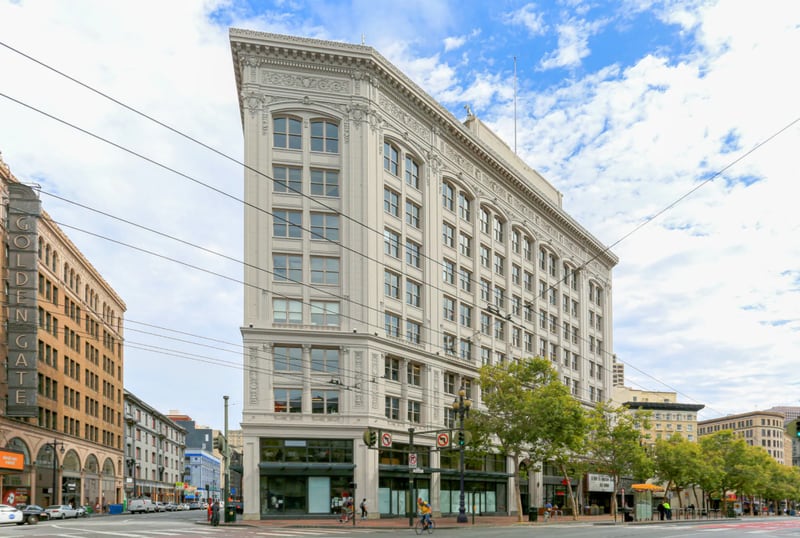
Warfield Building at 988 Market Street, San Francisco, CA
A Downtown of Vacant Offices and Pricey Housing
San Francisco’s downtown has been caught in a paradox: gleaming office towers sit half-empty while the city suffers a notorious housing shortage. The pandemic emptied out many high-rises as remote work took hold, pushing the office vacancy rate to record heights – nearly one-third of office space sat unused at the peak. By late 2025, about 42 million square feet of San Francisco offices were still sitting vacant, even as tech companies began inking new leases again. At street level, the once-bustling Financial District and SoMa blocks grew eerily quiet, with shuttered shops and sparse foot traffic. Yet at the same time, housing in San Francisco remained scarce and expensive , with rents among the highest in the nation and homelessness a visible crisis. It’s a bitter irony: so much unused office space and so little housing .
City leaders have long dreamed of solving both problems at once by converting offices into apartments . The concept is simple – take those ghostly office floors and remake them into living spaces – but the reality has been anything but. For years, high costs, complex regulations and mismatched building designs stymied conversion plans. As a result, San Francisco has not seen a single major office-to-residential conversion in over a decade . A rare example, the conversion of the old California State Automobile Association headquarters at 100 Van Ness Avenue into 418 apartments, was completed back in 2015. Since then, no comparable projects have followed, even as office vacancies climbed and housing needs became ever more dire. Past mayors floated incentives and task forces, but little changed. The math simply didn’t pencil out for developers – costs were too high and returns too low in a city famous for construction hurdles.
Now, after years of false starts, San Francisco is trying a bold new approach. In February 2026, Mayor Daniel Lurie signed a “Downtown Revitalization Financing District” into law, a measure designed specifically to sweeten the financial equation for office-to-housing conversions. This new law is essentially a special financing program that will use future property tax revenues to help fund conversion projects . Eligible projects in a broad swath of downtown can receive annual incentive payments for up to 30 years , backed by the increased property taxes that a converted building would generate once it’s full of residents. In other words, the city will rebate some of the project costs over time, on the bet that turning offices into apartments will pay off through higher property values (and thus higher taxes) once people move in. Mayor Lurie touted the district as a “ critical piece ” in the effort to revive downtown: “Downtown’s economy is in a new phase of opportunity that calls for focused and innovative strategies,” he said, adding that investors are already interested in taking advantage of the program. City officials hope this tax-increment financing model will finally tip the scales and make dozens of long-discussed conversion projects financially feasible.
From Tech Bust to a Housing Crunch
San Francisco’s pivot to office conversions comes after several turbulent years for both its office market and its housing market. Before 2020, the city’s gleaming towers were packed with tech workers and its office vacancy rate hovered in single digits. The “work-from-home” era changed everything: as tens of thousands of employees stayed home or left the Bay Area altogether, companies shed office space. By 2023, office vacancies soared to an all-time high of around 30%. The once-thriving down town became dotted with “For Lease” signs, and a few high-profile buildings even went into foreclosure as their values plummeted by half or more. While some of the strongest tech and AI firms have recently begun re -expanding in San Francisco’s core, leading to a modest uptick in leasing, the overall downtown recovery has been slow and uneven. As of early 2026, the city’s office vacancy rate stands at roughly 21 to 22% – an improvement from the worst of the pandemic, but still about double pre-pandemic levels. Leasing activity has rebounded to its healthiest pace since 2019, with over 12 million square feet leased in the past year . Net absorption (the increase in occupied space) turned positive by about 3.9 million square feet over the last 12 months, indicating more office space was filled than emptied – a hopeful sign. But 44 to 45 million square feet remain available on the market when sublease space is included, and sublet availability alone tops 7 million square feet. The demand that does exist is increasingly concentrated in the highest-quality bui ldings , while many older offices languish. The writing on the wall: San Francisco simply has far more office space than its businesses currently need, especially the outdated buildings that tenants now shun.
Meanwhile, on the housing side, the city faces the opposite dynamic: too little supply for all the demand . For decades San Francisco has built new housing at a trickle, constrained by strict zoning, high construction costs, neighborhood opposition and other barriers. The result is a perennial housing shortage and sky-high costs . The state has mandated that San Francisco permit and build 82,000 new housing units by 2031 to help alleviate California’s housing crunch. That would mean roughly 10,000 new homes each year – a target the city is nowhere close to meeting . In reality, San Francisco added only a few thousand units per year on average, barely a fraction of the goal. In the downtown area, several planned apartment towers have stalled or been canceled, as rising interest rates and construction expenses made new development prohibitively expensive. Paradoxically, even during the pandemic exodus, housing vacancy in the city remained low . And as people and jobs have trickled back, the rental market has snapped back to being one of the nation’s tightest . Citywide apartment vacancy is now around 4 to 5% – the lowest in about a decade . In the past year, San Francisco absorbed nearly 3,000 more rental units than were built , tightening the market further. Rents, which dipped in 2020, have surged over 6% in the past year alone , the fastest climb in the country, thanks to renewed hiring (particularly in tech and AI) and very little new inventory coming online . Only about 1,600 new apartments opened in 2025 , and today a mere 2,900 units are under construction across the entire city – far below historical levels. With demand returning and so few new homes being built , it’s no surprise that San Francisco’s rents are soaring and young workers struggle to find affordable places to live .
This stark contrast – vacant offices on one hand, housing scarcity on the other – underpins the city’s new push for office-to-residential conversions. If even a slice of that 42 million square feet of empty office space can be transformed into apartments, it could provide thousands of new homes without breaking new ground, while also breathing life into moribund downtown blocks. It’s an alluring win-win scenario: fill darkened office towers with new residents , alleviate some pressure on the housing market, and foster a more mixed, 24/7 downtown that isn’t reliant on 9-to-5 office workers alone.
Hard Math and Past False Starts
San Francisco is no stranger to ambitious conversion plans that fizzled out. Early in the pandemic recovery, city leaders championed a handful of pilot projects to show how converting offices to housing could work. One highly touted effort was the historic Warfield Building at 988 Market Street , a 12-story 1907 office structure near Sixth Street. In 2022, a developer announced plans to turn it into over 300 apartments – what would have been the city’s first downtown office-to-housing conversion after COVID hit. But after months of challenges, that plan fell apart. Instead of apartments, the century-old Warfield was sold in 2025 to a nonprofit group that is now repurposing it as an arts and media hub for a public radio station and arts organizations. The city’s flagship conversion prospect thus produced zero new housing units.
Another closely watched project was the Humboldt Bank Building at 785 Market Street , an ornate 120-year-old former bank and office building. A local developer, Forge Development Partners, held a celebratory groundbreaking in early 2024, proposing to gut the vacant offices and create 124 modern apartments behind the historic façade. But by late 2025 that effort, too, had stalled . The reason: the financial math still didn’t work . In San Francisco, converting an old office isn’t cheap – you might have to seismically retrofit the structure, add kitchens and bathrooms, meet updated fire and accessibility codes, all while the building likely generates no income during construction. Forge Development struggled to make the numbers pencil out as rents were still not high enough to cover the outsized costs of the conversion. Rising interest rates and inflation only made it tougher. Marc Babsin, president of Emerald Fund (a developer that successfully converted an office building a decade ago), noted that doing the same project now would cost around 70% more than it did ten years prior. Inclusionary housing fees, permitting costs, and other city-imposed exactions piled on additional expense, leading developers to repeatedly say conversions “just don’t pencil.”
City Hall took notice of these roadblocks. Over the past three years, officials have been chipping away at the barriers: streamlining permitting steps, waiving many fees (including affordable housing fees) for conversion projects , and changing zoning to allow housing in commercial districts. Former Mayor London Breed championed these changes as part of a broader downtown recovery plan. By early 2024, San Francisco eliminated most city development fees for office-to-residential conversions, removing a significant cost burden. Even with those moves, though, developers still weren’t biting at large scale. The new financing district is intended to be the final missing piece . By offsetting some of the hefty construction cost with future tax revenues, the city is essentially sharing the risk and reward with developers. “This is modeled after programs that have already worked in cities like New York and Boston,” said Supervisor Danny Sauter as Mayor Lurie signed the law. “It’s the next step in our downtown comeback.”
Crucially, San Francisco planners understand that not every empty office tower can – or should – become housing . Many 1970s-’80s office high-rises have huge floor plates and sealed windows, making it difficult to get natural light and fresh air into would-be apartments. The city’s analysis found that only a limited subset of buildings have the “right bones” for conversion – typically, older buildings with operable windows, thinner floor plates, and lower ceilings . Interestingly, features that make an office building obsolete for today’s tech firms (like lower ceilings or lack of modern HVAC) can be benefits for housing. An architecture study by Gensler noted that a 12-foot office ceiling, once you remove drop ceilings and ducts, could yield a generous 11-foot residential ceiling height – something that would be considered a luxury apartment feature. Smaller floor plans mean every unit can have a window. In short, many grand early-20th-century office buildings – think brick and terra-cotta structures that predate World War II – may be the best candidates for residential reuse. Conveniently, those are also the buildings most struggling to attract office tenants today. The new program is likely to focus on these older, underused gems rather than the glass-box skyscrapers. By targeting the “low-hanging fruit” , officials hope to prove out a few successful conversions that can inspire more.
Following Other Cities’ Lead
San Francisco is hardly alone in grappling with empty offices and a housing crunch, and in looking to adaptive reuse as a solution. In fact, city officials admit they took inspiration from peers back East. New York City in particular has moved aggressively over the past two years to promote office-to-residential conversions in Manhattan’s business districts. Facing a record 94 million square feet of vacant offices and a similar housing shortage, New York State and City leaders rolled out a slate of reforms: new zoning rules, tax incentives, and streamlined approvals. In 2024 the state enacted a law (known as “Section 467-m” ) providing up to 35 years of property tax breaks for office conversions that include affordable housing units. Mayor Eric Adams launched an Office Conversion Accelerator to walk building owners through the process of rezoning and permitting. And the city changed its zoning code to make more buildings eligible for conversion – for example, lifting an old cap on residential floor area and allowing newer office buildings (built as late as 1990) to be converted, whereas previously only pre-1961 structures qualified. The results? Office conversions in NYC have surged . In 2023, about 1.6 million square feet of offices were converted to housing in New York; in 2024, that jumped to 3.3 million square feet, and by mid-2025 over 4 million square feet of conversions were underway. Even some marquee Class A office towers in Manhattan are now being partly or fully transformed into apartments or hotels – a shift few would have imagined pre-pandemic. New York’s experience shows that clear incentives and rule changes can unlock a wave of adaptive reuse , though even there officials caution it will only make a dent in the overall office glut.
Boston offers another playbook. Under Mayor Michelle Wu, Boston launched a pilot Office-to-Residential Conversion program in late 2023 that has quickly exceeded expectations. By the end of that year, the city had received 22 conversion applications, covering 1.2 million square feet of offices to be turned into roughly 1,517 housing units . The program provided a combination of financial incentives (such as tax abatements) and an expedited permitting process to entice owners of older office buildings. Crucially, Boston also updated its downtown zoning to remove a thicket of obstacles – conversion projects no longer need case-by-case zoning appeals, and an interagency team coordinates reviews so approvals happen in as little as six months. Four projects with 236 units are already under construction, and one small converted building is already open and fully leased to residents. Given this momentum, Boston just extended the program into 2024 and is eyeing another 1,000 units via conversions in the coming year. “Office-to-residential conversions – putting homes close to jobs – is just good policy,” one Boston developer said, noting that it reduces downtown office vacancies while adding much-needed housing . The influx of new residents living downtown is seen as a boon to local businesses and the vibrancy of the city’s center.
Even Washington, D.C. – a city with a notoriously overbuilt office market – has jumped on the trend. D.C.’s downtown vacancy hit record highs after federal agencies and lobby firms downsized space. In response, Mayor Muriel Bowser’s administration rolled out not one but two incentive programs in 2024: one for housing and one for other uses. The “Housing in Downtown” program offers a generous 20-year tax abatement to developers who convert offices into residential use. Separately, an “Office-to-Anything” initiative freezes property taxes for 15 years for conversions to other purposes like hotels, arts, or educational facilities. The goal is to add 15,000 new residents downtown by 2028 and diversify the district beyond just offices. D.C.’s leaders recognized that without such incentives, “conversion math rarely works” for developers – a refrain familiar to San Francisco. These programs are starting to bear fruit: several major D.C. office buildings are now in the pipeline to become apartments, and developers are actively scouting for underutilized properties that could qualify. Suburban jurisdictions like Arlington, VA have also slashed red tape to encourage adaptive reuse, speeding up approvals to as little as 4 to 6 months. The common lesson across these cities is clear: conversions won’t happen at scale without public-sector help , whether through tax breaks, regulatory relief, or direct subsidies. San Francisco, late to the game, is now moving to provide that help.
Notably, Los Angeles pioneered a similar idea two decades ago with its Adaptive Reuse Ordinance, which successfully turned dozens of old downtown LA office and industrial buildings into lofts and jump-started a residential boom in that city’s center. More recently, Los Angeles updated its policies to allow conversions of newer commercial buildings with streamlined approvals. And other cities from Chicago to Philadelphia are studying their own programs. In many ways, San Francisco has lagged behind these peers. Despite having the nation’s highest office vacancy and worst housing affordability , the city until now struggled to get conversion projects off the ground, while places like Washington, New York and Los Angeles found creative ways to make them work. That track record added urgency for San Francisco officials to act – they could point to elsewhere and say, if they can do it, so can we . The new financing district, as Supervisor Sauter noted, is explicitly modeled after those proven programs .
A Cautious Optimism for Urban Revival
For developers eyeing San Francisco’s incentive program, the big question is: Will it be enough to turn proposals into reality? The early signs are encouraging, city officials say. They report a number of inquiries from building owners and investors since the law’s passage, with some potential conversion projects already being scoped out in the Financial District and around Market Street. The financing incentives could effectively fill a crucial gap in the capital stack – functioning like a long-term, forgivable loan from the city that makes a marginal project pencil out. “These incentive programs can be what moves the needle and gets a deal across the line,” as one D.C. developer put it. Especially in today’s high-interest-rate environment, any source of patient, lower-cost financing is welcome. And by tying the subsidies to future tax revenue generated by the project, San Francisco avoids paying upfront from an already-stretched budget. If a conversion flops or never materializes, the city isn’t on the hook; but if it succeeds, the city shares the new wealth it helped create.
Of course, challenges and risks abound . Construction costs in San Francisco remain dauntingly high – among the highest in the world – and skilled labor is in short supply. Developers must still navigate design and engineering hurdles to retrofit old structures for residential use. And not every building that can be converted will necessarily attract investors; some aging offices may simply be cheaper to demolish in the long run. There is also the matter of timing : real estate cycles can shift. If the tech sector wobbles again or if interest rates climb further, the economics of conversion could worsen. The city’s incentives might need to be supplemented by state or federal support (for instance, tax credits) to truly catalyze a large wave of projects. Past experience tempers optimism – San Francisco’s downtown rebound has been predicted before, only to be delayed by new setbacks (a surge in remote-friendly tech jobs, or economic downturns). The success of this program will likely become evident in the next year or two: if developers formally submit plans and secure financing for several major conversions, that will validate the approach. If projects still don’t pencil out even with the new law, the city may have to consider expanding the incentives or lowering requirements further.
For the people of San Francisco, though, even a handful of high-profile conversions would be welcome. Every old office turned into housing is one less derelict building and a few hundred more places to live. Residents could benefit from lower rents or at least a moderating of rent hikes if enough new units come online in the next few years. And a more residential downtown could feel safer and more lively after dark – instead of windswept empty streets after 6 p.m., there would be lights on in apartment windows, dog-walkers and shoppers patronizing local businesses. Urban planners have long argued that a diversified, mixed-use downtown is a resilient downtown. San Francisco’s heavy reliance on tech offices was a vulnerability; a post-pandemic urban core with a greater mix of housing, education, retail, and even arts spaces (like the Warfield conversion) will be better cushioned against economic swings .
Local businesses and civic boosters are certainly cheering the prospect of more downtown residents. “Less vacant office space and more residents downtown will help stabilize the office market… and support downtown restaurants and retail,” noted one Boston developer involved in conversions, articulating a vision that easily applies to San Francisco. More people living in the heart of the city means more customers for cafes, more riders for public transit, and more “eyes on the street” to improve safety. It could even aid the office sector in an indirect way: a vibrant neighborhood is a selling point for companies deciding where to locate offices, meaning a residential infusion might make remaining offices more attractive.
Even broader, there’s a psychological boost at stake. San Francisco’s struggles – empty offices, persistent homelessness, a faltering downtown economy – have become a national cautionary tale in recent years. A visible turnaround, powered by creative adaptation of old buildings, would signal that the city is not stuck in decline but is capable of reinventing itself. Other cities will be watching closely. If San Francisco can demonstrate a successful model for reinventing post-pandemic downtowns , it could offer a roadmap for many urban centers facing the same twin dilemmas of what to do with surplus office space and how to create more housing .
In the months ahead, developers will be running pro formas on eligible buildings, community groups will weigh in on proposed designs, and city officials will be fine-tuning implementation of the financing district. There’s cautious optimism in the air – along with a recognition that this is just one piece of the puzzle. Office conversions alone won’t solve San Francisco’s housing crisis or fill all its empty towers. But as one part of a multifaceted recovery strategy, they could play a pivotal role. The city known for its innovation is now testing that spirit on its own skyline, betting that yesterday’s office buildings can become tomorrow’s homes . The stakes – for downtown’s future and for residents in search of housing – couldn’t be higher, but the potential reward is a revitalized San Francisco that once again feels full of life.
February 18, 2026 by a collective of authors at MMCG Invest, LLC, feasibility study consultant and multi-family feasibility study consultant
Sources:
CoStar News , Feb. 17, 2026: “San Francisco passes law to boost office conversions”
San Francisco Chronicle, Feb. 10, 2025: “This historic S.F. office building was going to become housing. Now it’s slated to be an arts hub.”
MMCG database data
Smart Cities Dive, Oct. 9, 2025: “Zoning reforms, tax incentives help drive NYC’s office-to-housing boom.”
City of Boston Press Release, Dec. 2023: “Office to Residential Conversion Program Extended as it Surpasses 1,500 New Homes.”
Urban Land Magazine, May 9, 2025: “Office to Anything: More Cities Offer Conversion Incentives.”
Multi Family

Michal Mohelsky, J.D., FMVA, Practicing Affiliate of the Appraisal Institute
Principal, MMCG Invest, LLC
Published February 18, 2026. Last updated March 26, 2026. How this analysis was prepared.
Cite this
Michal Mohelsky, J.D., FMVA (2026). San Francisco’s Big Bet on Turning Empty Offices Into Homes. MMCG Invest, LLC. https://www.mmcginvest.com/post/san-francisco-s-big-bet-on-turning-empty-offices-into-homes
Where this goes next
- Multifamily Feasibility StudyMMCG's feasibility study page for this subject.