
The Great American Store Closure Tracker, 2026 Edition
Updated: Apr 20

The counterintuitive headline
Ask a casual observer what happened to American retail in 2025 and the answer is usually some version of "it collapsed." The images from the year support the impression. Joann liquidated. Party City liquidated. Rite Aid liquidated for the second time in nineteen months. Forever 21 liquidated. Big Lots collapsed into Chapter 7. Starbucks shuttered more than five hundred North American stores in a single fiscal quarter. Advance Auto Parts walked away from five Western states entirely. The data tell a different and more useful story.
Coresight Research's January 27, 2026 year-end tracker counted 8,270 U.S. store closures in calendar 2025, against 5,270 openings, for a net loss of roughly 3,000 stores (1). That total came in well below Coresight's original January 2025 projection of 15,000 and below the firm's own revised 2024 figure of 8,825 closures. John Mercer, Coresight's head of global research, told CNBC in February 2026 that the year's closures came in far below what analysts had braced for (2). Cushman & Wakefield's Q4 2025 U.S. Shopping Center MarketBeat reported national vacancy at 5.7 percent, just 40 basis points above the cyclical low of 5.3 percent set at year-end 2024, supported by new construction deliveries of only 10.2 million square feet, the lowest in the series' history and 63 percent below the 2015 to 2019 average (3). Simon Property Group ended 2025 at 96.4 percent mall and outlet occupancy and 99.2 percent Mills occupancy, with average base minimum rents up 4.7 percent year-over-year (4).
So the picture is not a collapsing retail system. It is a concentrated one. Five bankrupt brands (Joann, Party City, Big Lots, New Rite Aid, Forever 21) drove more than half of all 2025 closure square footage, according to Coresight's midyear and year-end tracker reports. Three categories (pharmacy, casual dining, specialty mall apparel) drove roughly two-thirds of total unit closures. Outside that concentration, the system continued to function, with off-price retailers absorbing boxes at positive rent spreads, grocers expanding into the Sun Belt at a near-record pace, and the best-positioned landlords posting the strongest leasing spreads in more than a decade.
This tracker is designed as a citation-grade reference for the readers who actually need it: commercial real estate underwriters, lenders pricing risk in SBA 7(a), SBA 504 and USDA guaranteed loan programs, REIT investors, distressed-credit analysts, operators running their own site-selection pipelines, and journalists trying to make sense of what looks like contradictory signals. It aggregates primary filings, court dockets, company disclosures, and Tier-1 research from Coresight, CoStar, Cushman & Wakefield, JLL, S&P Global Market Intelligence, Moody's, BLS, OCC, and the relevant REIT investor relations departments. Where figures are estimated, they are flagged. Where the public record contains gaps, those gaps are marked. For the firm's overall approach to market-demand and feasibility work behind this piece, see our feasibility study methodology.
What the 2025 numbers actually show
The historical baseline matters for reading the year correctly. Coresight's revised time series places 2020's pandemic peak at approximately 9,700 closures, 2024 at 8,825 (upward revision from an originally published 7,325), and 2025 at 8,270 (5). Against that baseline, 2025 was not the worst year on record. It was the second year in a row of elevated closure activity, with the striking feature being the concentration of that activity in a handful of Chapter 11 and Chapter 22 liquidations rather than a broad-based sector contraction.
Corporate bankruptcy filings did hit a fifteen-year high. S&P Global Market Intelligence counted 717 large U.S. bankruptcy filings through November 2025, up roughly 14 percent over 2024 and the highest annual tally since 2010 (6). The American Bankruptcy Institute reported commercial Chapter 11 filings up 67 percent year-over-year by February 2026. Epiq AACER tracked Q1 2026 commercial Chapter 11 filings at 2,422 versus 1,764 in Q1 2025, a 37 percent year-over-year acceleration (7). The bankruptcy wave, in other words, kept building even as the aggregate closure count did not.
The explanation is structural. Most of the 2025 bankruptcies were Chapter 22s: second filings by companies that had emerged from a prior Chapter 11 and failed to restore the trade credit, vendor terms, or unit economics needed to operate on a going-concern basis. Party City's December 2024 second filing, Joann's January 2025 second filing, and Rite Aid's May 2025 second filing were all Chapter 22s. So was Bertucci's 2025 filing, the chain's third bankruptcy in seven years. What the 2025 cycle demonstrated is that the typical 18-to-24 month post-emergence runway documented by S&P Global's bankruptcy data had compressed. Companies that emerged from 2023 and 2024 filings without adequate fresh capital or vendor relationships were failing again within a year.
Aggregate metric | 2024 (revised) | 2025 (actual) | 2026 YTD (thru Apr) | 2026 Coresight proj. |
U.S. store closures | 8,825 | 8,270 | 2,000+ by Week 6 | ~7,900 |
U.S. store openings | ~6,200 | 5,270 | Down 47% YoY thru Wk 13 | ~5,500 |
Net unit change | ~-2,600 | -3,000 | Negative | -2,400 |
Sq ft closed (est.) | ~75M sf | ~127M sf (thru July) | ~40M sf+ | ~110M sf |
Large corp. BK (S&P) | 694 | 717 | +37% YoY in Q1 | Moderate increase |
Retailer BK (Coresight) | ~25 | 32 | 7 thru April | ~25 |
Square footage tells a different story than unit count. Coresight's midyear 2025 bulletin recorded 5,822 confirmed closures representing an estimated 123.7 million square feet of retail space as of June 27, 2025 (8). The disproportion between the unit count and the square footage count reflects which chains were closing. Rite Aid's typical 12,500-square-foot drugstore box, Joann's 22,500-square-foot craft strip-center anchor, Big Lots' 30,000-square-foot discount format, and Advance Auto Parts' 7,500-square-foot freestanding stores together produced far more vacated gross leasable area than the pure closure count suggests. These are precisely the formats our retail feasibility study engagements most often re-underwrite for adaptive reuse.
The five-brand concentration is worth stating precisely. Rite Aid closed approximately 1,240 stores, Joann 800, Party City 695, Big Lots 340 net after the Variety Wholesalers rescue, and Forever 21 all 354 U.S. locations. Claire's added another 300-plus. Add in Walgreens' 500, CVS's 271, and the three largest non-bankruptcy programs (Advance Auto Parts 727, GameStop 727, Starbucks approximately 520 North American) and the top ten chains alone accounted for roughly 5,500 of 2025's 8,270 closures, or about two-thirds of the total (9). The remaining third was spread across smaller-footprint rationalizations at apparel, restaurants, fitness, theaters, and regional grocery. That is concentration, not collapse.
The drugstore category is in a multi-year structural reset
Pharmacy is where the story of concentration is clearest. Rite Aid's second Chapter 11 filing on May 5, 2025 in the District of New Jersey (Case No. 25-14861, Judge Michael Kaplan) produced the single largest closure program of the period: complete liquidation of all approximately 1,240 stores by October 3, 2025 across fifteen states (10). Funded debt at filing totaled roughly $2.16 billion against a $1.94 billion debtor-in-possession facility led by Bank of America. Prescription files went to CVS (625 across fifteen states plus 64 retained Bartell and Rite Aid stores in Washington, Oregon, and Idaho), Walgreens, Kroger, Albertsons, and Giant Eagle (78 in Pennsylvania and Ohio). Grocery-anchored REIT exposure concentrated at Regency Centers (18 properties), Kimco (17 properties), and Retail Opportunity Investments (16 properties, previously 1.7 percent of annualized base rent).
The first-day declarations of CEO Matt Schroeder and CRO Marc Liebman laid out the Chapter 22 failure pattern with unusual clarity. Vendor trade credit never fully restored after the August 2024 emergence from the first filing. Letter-of-credit facilities came in at roughly $66.75 million against a planned $166 million. McKesson, which supplied 99 percent of Rite Aid's prescriptions, tightened terms. The combination proved unsurvivable eight months after emergence. Total square footage vacated across the Rite Aid liquidation was approximately 15.5 million square feet at the chain's 12,500-square-foot average, most of it freestanding hard-corner real estate in mature trade areas, which is to say precisely the kind of location a Dollar Tree, Burlington, Aldi, or Planet Fitness wants to backfill.
The Walgreens and CVS stories diverged sharply from Rite Aid and from each other. Walgreens Boots Alliance closed approximately 500 stores during fiscal 2025 (ending August 31, 2025), representing roughly 6.75 million square feet at the 13,500-square-foot industry average. Then the surprise: Sycamore Partners' $23.7 billion take-private transaction closed on August 28, 2025, the largest private equity retail buyout on record, and the new ownership promptly decelerated the closure program(11). Bloomberg reported in February 2026 that Walgreens now expects to close fewer than 100 stores in calendar 2026, against the roughly 700-unit 2026 pacing implicit in the original October 2024 three-year optimization plan. The 1,200-store cumulative target extends into fiscal 2027 rather than completing in fiscal 2026. For the net-lease REITs with concentrated Walgreens exposure (Alpine Income at 9 to 12 percent of ABR, NETSTREIT at 6 to 8 percent, ExchangeRight Essential Income at roughly 16 percent), the Sycamore pivot was the most consequential piece of good news of the cycle.
CVS Health moved through its own inflection point. The company executed approximately 271 store closures during 2025, concluding the 900-store program announced in 2022. CVS spokesperson Amy Thibault confirmed to Bloomberg on March 30, 2026 that the company will open roughly 60 new stores in 2026 while closing only "a few dozen" (12). That is the first calendar year in five in which CVS will be a net adder of physical units. The four-year contraction cycle at the two largest U.S. drug chains is ending just as the Rite Aid exit completes.
Dollar store dynamics diverged within a single category. Dollar Tree completed its $1.0 billion divestiture of Family Dollar to Brigade Capital Management and Macellum Capital Management on July 7, 2025, taking a roughly $7.5 billion book loss on its 2015 acquisition cost. Family Dollar closed its North Carolina distribution center in March 2026 under the new standalone private ownership and guided to roughly 75 further store closures while piloting an "Extra Small Box" format. Meanwhile, the Dollar Tree namesake banner added 388 net new stores through Q3 FY2025 to reach 9,269 stores, and Dollar General added 196 new DG stores in Q3 FY25 alone while pausing the pOpshelf experiment. Five Below ran a pure growth playbook with 150 net new stores in FY2025 and zero announced closures. Agree Realty holds Dollar General as its top tenant at approximately 4 to 6 percent of ABR, which puts the country's largest single-tenant net-lease platform in the interesting position of depending on the health of the discount channel while the drugstore channel wobbles.
Saks Global is the defining department-store bankruptcy of the generation
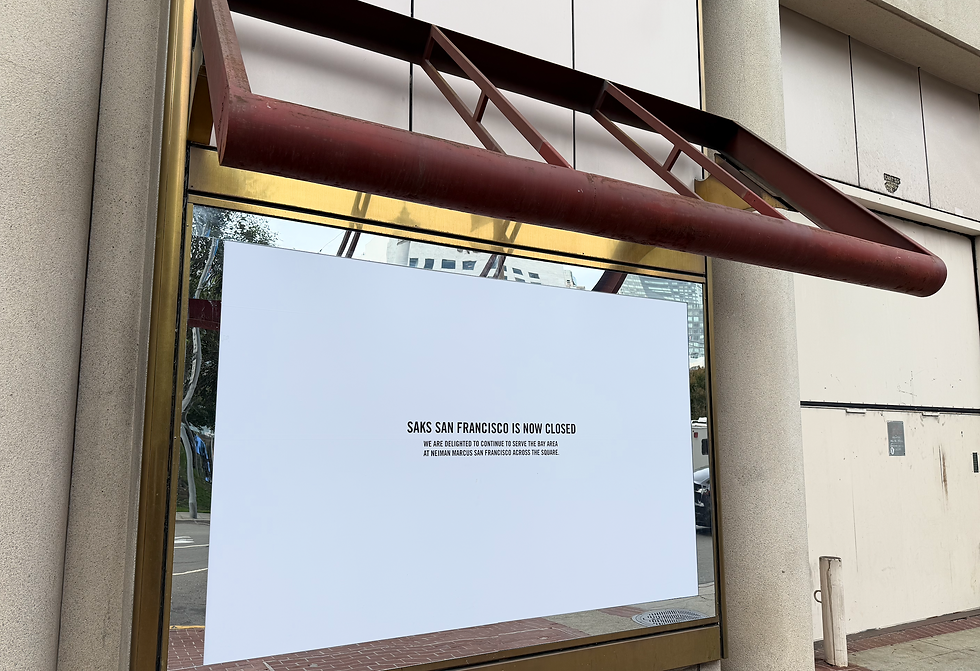
Department stores did not contribute as many units to the 2025 closure total as drugstores or specialty retail, but they produced the bankruptcy that will be written about in case law for years. Saks Global Enterprises LLC and 112 affiliated debtors filed voluntary Chapter 11 on January 13, 2026 in the Southern District of Texas (Case No. 26-90103, Judge Alfredo Perez), thirteen months after HBC closed its $2.7 billion acquisition of Neiman Marcus Group and created the combined entity (13).
The filing followed a skipped December 30 interest payment of more than $100 million on the 11 percent 2029 secured notes, an FT feature on January 11 titled "Leveraged luxury: fall of Saks Global" that noted the 2029 notes trading under 30 cents, and the resignation of CEO Marc Metrick on January 2 followed by Richard Baker's own departure on January 10. The debtor entered Chapter 11 with approximately $3.4 billion of funded Global Debtor debt, excluding the $1.25 billion Saks Fifth Avenue New York flagship CMBS loan and the $428.1 million HBS JV securitized loan. DIP financing totaled $1.75 billion: a $1.5 billion facility from the ad hoc group of senior secured bondholders including GoldenTree's $200 million commitment, $240 million of incremental ABL liquidity, and a $500 million exit facility commitment. Approximately $600 million of new funding was earmarked to pay past-due vendor bills.
The store rationalization ran in three rounds. On January 29 and 30, the off-price wind-down closed 57 of 69 Saks Off 5th stores (12 retained as inventory-clearance channels) and all five remaining Neiman Marcus Last Call stores (14). Saks Off 5th was projected to lose $139 million in FY2025. The February 10 round closed eight Saks Fifth Avenue full-line locations (Birmingham, Columbus OH, East Rutherford, New Orleans, Bala PA, Phoenix, Richmond, and Tulsa), one Neiman Marcus (Copley Place, Boston), and 14 of 17 Fifth Avenue Club personal-styling suites. The March 6 round closed twelve more Saks Fifth Avenue stores including Chicago Magnificent Mile, Chevy Chase, San Antonio, Las Vegas, Tysons Corner, and Sarasota UTC, plus three more Neiman Marcus including Topanga Plaza.
The post-closure footprint is approximately 13 Saks Fifth Avenue stores, 32 Neiman Marcus stores, and 2 Bergdorf Goodman stores. Aggregate square footage coming off market across Saks Global banners is roughly 5.6 million square feet. WARN filings document more than 1,200 store job cuts plus 155 distribution-center layoffs at Wilkes-Barre (February 10) and 435 at Pottsville (March 3), plus the Miramar, Florida support-center closure.
The mall-REIT implications merit careful attention. Simon Property Group told the Q4 2025 call that the 38 Saks Off 5th leases previously paying Simon approximately $18 million in aggregate rent had been rejected and were being re-tenanted at roughly $30 million, a +67 percent mark-to-market spread that will flow primarily into 2027 NOI (15). Simon wrote off its $100 million Saks Global equity investment at year-end 2025 but offset it with a $414.8 million pre-tax gain on the Q1 2024 sale of its Authentic Brands Group stake, a 7x multiple on invested capital. The bankruptcy therefore functioned as an accelerator of rent reset rather than a credit event for the best-positioned mall landlord.
Macy's, Kohl's, and Nordstrom each ran lower-intensity rationalizations. Macy's "Bold New Chapter" 150-store closure program has extended through 2028, per CFO Tom Edwards's March 2026 remarks, rather than the original 2026 completion target. Roughly 66 stores closed during fiscal 2025 plus 14 additional 2026 closures (the first being Pittsburgh Mills Mall on April 26, 2026) brought the cumulative total to approximately 80. Bloomingdale's and Bluemercury remain in expansion mode with approximately 45 net new locations planned through 2026. Kohl's closed 27 stores by April 2025 before the May 1 firing of CEO Ashley Buchanan for cause over a vendor conflict of interest and explicitly ruled out further 2026 closures during its Q4 FY25 results. Nordstrom was taken private for $6.25 billion by the Nordstrom family and El Puerto de Liverpool on May 21, 2025, closed only modest full-line locations, and added 22 Nordstrom Rack stores in 2025 with 23 more planned for 2026.
The Catalyst Brands merger of January 8, 2025 (JCPenney combined with SPARC Group's Aeropostale, Brooks Brothers, Eddie Bauer, Lucky Brand, Nautica, and Forever 21) produced the second-largest department-store bankruptcy of the cycle almost immediately. Forever 21's F21 OpCo LLC filed Chapter 22 on March 16, 2025 (D. Del. Case No. 25-10469) and liquidated all 354 U.S. stores by April 30, 2025. The first-day declaration cited the de minimis exemption used by Shein and Temu as the principal driver of more than $400 million in FY2022 through FY2024 losses. Authentic Brands Group retained the intellectual property. Eddie Bauer filed its own Chapter 11 on February 9, 2026 (D.N.J. Case No. 26-11422), with approximately 175 to 180 remaining U.S. and Canadian stores working through an orderly wind-down under a pre-negotiated RSA with lenders.
Dillard's and Belk avoided the wave. Dillard's closed just one store in fiscal 2025 (The Shops at Willow Bend, 240,000 square feet) and maintained the sector's healthiest balance sheet with Q3 FY25 net income of $129.8 million. Belk avoided a second bankruptcy when KKR and Hein Park replaced Sycamore Partners as controlling owners in July 2025.
Specialty retail produced the highest closure square footage
Strip-center and big-box specialty retail drove the largest share of 2025 vacated square footage. Joann's second Chapter 11 filing on January 15, 2025 in the District of Delaware (Case No. 25-10068) escalated from a planned 500-store pruning to full liquidation of all approximately 800 stores by May 30, 2025 (16). Funded debt totaled $615.7 million. Michaels acquired Joann's intellectual property and private labels (including the Big Twist line) via SVP Sewing Brands on June 5, 2025, without taking physical stores. At the chain's 22,500-square-foot strip-center format, Joann alone produced approximately 18 million square feet of second-generation inventory, concentrated in the exact type of neighborhood centers owned by Brixmor, Kimco, Regency, and Phillips Edison. That is the tenant most of this cycle's backfill cohort wanted to inherit.
Party City's Chapter 22 (December 21, 2024, S.D. Texas, Case No. 24-90621) liquidated all approximately 700 U.S. corporate stores through early 2025, eliminating roughly 8.4 million square feet at the typical 12,000-square-foot footprint. Five Below acquired designation rights on 44 Party City leases for $2 million upfront plus $70,000 per lease in February 2025 and opened eight of them in the Pacific Northwest on November 7, 2025. Dollar Tree acquired designation rights on 148 leases. The Party City rationalization is one of the clearest examples in recent retail history of bankruptcy transferring prime retail real estate from a weak tenant to a set of stronger ones at higher rents without the asset ever sitting empty for long.
Big Lots' path was more convoluted. The September 9, 2024 filing (D. Delaware, Case No. 24-11967) saw the Nexus Capital stalking-horse sale collapse, leaving Gordon Brothers to acquire the platform in January 2025 and transfer 200 to 400 stores to Variety Wholesalers, which reopened approximately 220 under the Big Lots banner. Ollie's Bargain Outlet acquired 63 former Big Lots leases. The case converted to Chapter 7 on November 10, 2025, formally ending Big Lots as a going concern. Net unrecovered closures after the Variety rescue were approximately 340 stores representing roughly 9 million square feet.
At Home (formerly Garden Ridge) filed Chapter 11 on June 16, 2025 (D. Delaware), eliminated approximately $2 billion of debt under a $600 million DIP, and emerged on October 24, 2025 with approximately 229 stores after closing 30. Hellman & Friedman's $2.8 billion 2021 equity investment was wiped out. Claire's Chapter 22 (August 6, 2025, D. Delaware, Case No. 25-11454) produced one of the cycle's rare high-survival-rate outcomes: a going-concern sale to Ames Watson in September 2025 for approximately $140 million, with the new owner retaining approximately 800 to 950 of 1,500 U.S. and Canadian stores (17). First-day declarations cited $30 million of 2025 tariff cost increases, competition from Rowan and Studs, and declining mall traffic as primary drivers. A $506 million term loan maturing December 2026 was the precipitating trigger.
The 2024 specialty-retail liquidations that continued to work through the system during 2025 included Rue21's third Chapter 11 (May 2024, 540-plus stores liquidated), Conn's HomePlus and Badcock (July 23, 2024, full liquidation of 553 stores), Express Inc. (April 22, 2024, Phoenix Retail LLC acquired 403 Express plus 49 Bonobos for approximately $174 million with Simon Property Group, Brookfield, and WHP Global as co-investors), LL Flooring (August 11, 2024, F9 Investments acquired 219 stores for $40 to $43 million), 99 Cents Only (April 2024, 371 stores liquidated with Dollar Tree acquiring 170 leases), and The Body Shop U.S. (Chapter 7, March 8, 2024).
The Container Store's prepackaged Chapter 11 on December 22, 2024 produced the cleanest outcome of the cycle: emergence in 35 days with only two stores closed and $88 million of debt eliminated. That is the template lenders want to see, and it is worth noting that the common thread across Container Store's success and every other 2025 reorganization's struggle was prepackaged consensual restructuring versus contested free-fall filings. A separate and more recent outcome is American Signature (Value City Furniture), which filed Chapter 11 on November 22, 2025 (D. Del. Case No. 25-12105) and moved into full wind-down in January 2026 after the stalking-horse Schottenstein-affiliate bid was the sole auction offer.
The common thread across nine of the ten largest retail bankruptcies of 2024 and 2025 was private-equity leverage. Joann (Leonard Green), Party City (original THL and Advent), Conn's (Wingate), Express (the WHP Global and Brookfield consortium), At Home (Hellman & Friedman), Forever 21 (Authentic Brands Group and Catalyst), Rue21 (Apax, then Blue Torch), Claire's (Elliott Management, after Apollo's legacy), and LL Flooring (F9) each demonstrated that acquisition-debt capital structures built for a low-rate environment could not service in a 4 to 5 percent Fed funds environment. The Private Equity Stakeholder Project counted 71 percent of the largest U.S. consumer discretionary bankruptcies of 2025 as involving private equity ownership at filing (18).
Casual dining is in the worst distress since 2009
Restaurants produced the largest number of distinct bankruptcy filings of any sector across 2024 and 2025, with twenty-plus notable brand and large-franchisee Chapter 11 cases in each year. Red Lobster's May 19, 2024 filing (M.D. Florida, Case No. 6:24-bk-02486) emerged under Fortress Investment Group ownership (RL Investor Holdings, with TCW and Blue Torch) in September 2024 with approximately 130 stores closed during bankruptcy (19). By year-end 2025 the chain operated approximately 544 U.S. and Canadian stores under CEO Damola Adamolekun, with roughly 15 additional 2026 closures under review. The 2014 Golden Gate Capital sale-leaseback of Red Lobster's real estate at roughly $1.5 billion created the onerous lease base that persisted post-bankruptcy under Fortress, a recurring case study in why PE-engineered sale-leasebacks can become binding constraints through a full credit cycle.
TGI Fridays (November 2, 2024, N.D. Texas Case No. 24-80069) closed 86 U.S. stores before filing, another approximately 30 during the case, and the 363 sale closed in February 2025 with approximately 85 U.S. units operating under a pure franchise model. Hooters of America (March 31, 2025, N.D. Texas Case No. 25-80078) completed its restructuring-support-agreement-backed plan on October 31, 2025, with the original founders' Hooters Inc. group (75 units) and franchisee Hoot Owl Restaurants LLC (65 units) acquiring approximately 140 of 198 U.S. stores in a rare genuine reorganization rather than a credit-bid liquidation.
The second-tier casual dining bankruptcies drew less attention but collectively reshaped the category. BurgerFi and Anthony's Coal Fired Pizza (September 11, 2024, D. Delaware Case No. 24-12017) produced a TREW Capital credit-bid acquisition at approximately $54 million across both brands ($44M Anthony's + $10M BurgerFi), with subsequent flips to Happy Asker and Florida Burger Inc. Rubio's Coastal Grill filed its second Chapter 11 on June 5, 2024 (D. Del. Case No. 24-11164) and sold to a TREW Capital affiliate for a $40 million credit bid. Buca di Beppo filed August 5, 2024 (N.D. Texas) and sold via Main Street Capital's $27 million credit bid before converting to Chapter 7 on February 5, 2025 due to administrative insolvency of the estate. Tijuana Flats filed April 19, 2024 (M.D. Fla. Case No. 3:24-bk-01128) and sold to Flatheads LLC. World of Beer filed August 2, 2024 (M.D. Fla.) and emerged December 2024. Bertucci's filed April 24, 2025 (M.D. Fla. Orlando, Case No. 6:25-bk-02401) in its third modern filing in seven years. On the Border filed March 4, 2025 (N.D. Georgia Case No. 25-52415) and sold to Pappas Restaurants for approximately $15.9 million. Shari's Cafe & Pies executed an out-of-court wind-down on October 20, 2024, closing all 42 Oregon stores without a formal Chapter 11 filing.
The Q1 2026 casual-dining pipeline added two major filings. FAT Brands and Twin Hospitality filed Chapter 11 on January 26, 2026 in the Southern District of Texas (Case No. 26-90126) with approximately $1.3 to $1.4 billion in debt affecting an 18-brand, 2,200-unit portfolio (20). The filing covers roughly a quarter of the full FAT Brands system and is working through reorganization. QVC Group filed a prepackaged Chapter 11 on April 16, 2026 (S.D. Texas Case No. 26-90447) targeting a $5.3 billion debt reduction, a bankruptcy whose scale and structure puts it on par with Saks Global as a Q1 2026 defining event. Bar Louie filed its second Chapter 11 on March 26, 2025 (D. Del. Case No. 25-10576) with a $2.625 million DIP, completing its transition to Sun Holdings ownership.
Non-bankruptcy restaurant rationalization was equally material. Starbucks announced in September 2025 approximately 520 North American closures producing roughly 1.0 million square feet of vacated space, alongside $1 billion in restructuring costs under CEO Brian Niccol's "Back to Starbucks" plan. Q1 FY26 showed only 3 North American closures under the plan, suggesting the bulk of the rationalization was executed in a single quarter rather than sustained. Wendy's announced 240 closures across 2024 waves, with the November 2025 "Project Fresh" program targeting 298 to 358 H1 2026 closures. Subway continues at roughly 600 to 1,000 net annual closures under Roark Capital ownership, reaching approximately 19,500 U.S. units down from the 2015 peak of roughly 27,000. Pizza Hut announced 250 U.S. closures for H1 2026 on February 4, 2026. Papa John's announced approximately 300 North American closures on February 26, 2026, with 200 of them in calendar 2026 and a 7 percent corporate layoff. Bloomin' Brands closed 21 Outback, Bonefish, Carrabba's, and Fleming's locations in October 2025 with 22 additional non-renewals rolling through 2029. Denny's completed most of its 150-store program ahead of its approximately $620 million take-private transaction to TriArtisan Capital and Yadav Enterprises, which closed Q1 2026.
Non-bankruptcy restaurant closures for 2025 approached 1,750 to 2,000 units eliminating roughly 5.6 to 6.0 million square feet, with the Q1 2026 announcement pipeline adding another 500 to 700 units and 1.3 to 1.5 million square feet. Black Box Intelligence has flagged 9 percent of full-service restaurant units and 4 percent of limited-service units as "at risk" of 2026 closure (21). The outlook aligns with pressures we see in our hotel and hospitality feasibility engagements, where casual dining co-tenancy in full-service hotel properties is increasingly a credit concern for SBA and USDA lenders underwriting adjacent assets.
Four Corners Property Trust, whose tenant mix includes Olive Garden at 32 percent of ABR, LongHorn Steakhouse at 9 percent, Chili's, Outback, and Red Lobster, confirmed on the Q4 2024 and Q4 2025 calls that Red Lobster rents were affirmed at pre-bankruptcy levels in Fortress's reorganization plan, preserving landlord economics. FCPT disclosed zero direct exposure to TGI Fridays, Rubio's, Joann, Conn's, Party City, or Big Lots. Portfolio occupancy held at approximately 99.4 percent, one of the most impressive net-lease outcomes of the cycle.
The largest non-bankruptcy rationalizations
Outside of Chapter 11, the 2025 closures that mattered most on a square-footage basis were not at the restaurant chains but at Advance Auto Parts and GameStop. Advance Auto Parts' November 2024 strategic retreat closed 523 corporate stores, 204 independently owned Carquest locations (727 total), and 4 distribution centers, with Hilco managing disposition of more than 200 leased and 24 owned properties (22). At an average 7,500-square-foot footprint, the Advance Auto program alone represents approximately 5.45 million square feet, the single largest specialty-retail square-footage reduction of 2025. The company exited Washington, Oregon, California, Nevada, and New Mexico entirely. Realty Income, NNN REIT, and Agree Realty carry the concentrated net-lease exposure. For asset-repositioning work on these freestanding pads, see our industrial and flex-use feasibility studies page.
GameStop's contraction accelerated from FY2024's 590 closures to 727 U.S. store closures in FY2025, with an additional 430 to 500 announced across 40-plus states in the early weeks of 2026 (23). Cumulative GameStop closures since FY2023 exceed 50 percent of the fleet. Trepp identified 25 CMBS loans with GameStop tenancy exposure. Ryan Cohen's strategy redirects capital from retail real estate toward cash and Bitcoin holdings, which makes the closure program a balance-sheet decision rather than a going-concern one.
Foot Locker's "Lace Up" program continued during the approximately $2.4 billion Dick's Sporting Goods acquisition that closed September 8, 2025, producing approximately 175 North American closures in 2025 and carrying the 400-store cumulative Lace Up target forward under Dick's ownership. Apparel mall-specialty contraction was broad but moderate in scale, with Bath & Body Works at roughly 50 closures, Victoria's Secret at 30, Torrid at up to 180 (representing 28 percent of its fleet), Vera Bradley at 15 to 20 full-line plus outlets, Signet Jewelers at approximately 50 mall closures in 2025 plus 100 in FY2026, Carter's and OshKosh at 35 to 50, Hot Topic at 15 to 25, and Chico's FAS at an estimated 30 to 40 as a private company under Sycamore.
The counter-narrative is consistent with everything else in the cycle. Urban Outfitters brands and Children's Place are net openers. The Children's Place CEO explicitly reversed prior over-closure, stating roughly 300 previously closed stores had been profitable. Barnes & Noble opened 60 new stores in 2025 under James Daunt's turnaround with another 60 planned for 2026. Dick's Sporting Goods added 16 new House of Sport locations (roughly 100,000 square feet each) plus 20 Field House locations in 2025, with a 2027 target of 75 to 100 House of Sport stores, making Dick's the single largest net-positive square-footage adder in U.S. specialty retail.
The geographic bifurcation is widening
The 2024 to 2025 retail shakeout was not a national story. It was a geographic one. Across virtually every major closure announcement of the period (Macy's 66, Kohl's 27, Big Lots approximately 300, Joann 800, Rite Aid 489, Walgreens 500, CVS 270, Party City approximately 700, Family Dollar 600, Advance Auto Parts 727), the same five states absorbed the heaviest concentrations: California, Florida, Ohio, New York, and Michigan (24). Party City's auction list alone, the one publicly disclosed complete state-by-state closure schedule of the cycle, placed 82 leases in California, 72 in Texas, 59 in Florida, 46 in New York, 37 in Illinois, and 27 in Georgia, with Pennsylvania, Illinois, Indiana, Washington, and New Jersey rounding out the top ten. The same shape repeats across Joann, Big Lots, JCPenney, GameStop, and Macy's closures.
California's exposure is structural rather than cyclical. The state hosts the country's largest retail footprint, the highest operating costs (California raised the fast-food minimum wage to $20 per hour in April 2024, triggering Rubio's 48-store abrupt closure and broader chain retreat), persistent organized-retail-crime concerns, and the heaviest concentration of exiting chains. Rite Aid operated 347 California stores before its May 2025 Chapter 11; roughly 200 closed or liquidated. Advance Auto Parts exited California entirely by shuttering 137 stores plus distribution centers in Bakersfield and San Bernardino, the largest single-state chain exit of 2025. Walgreens closed approximately 35 California locations including 12 San Francisco stores between February 24 and 27, 2025. CVS closed at least 30 California stores. Macy's closed 9 California locations. Kohl's closed 10.
Pennsylvania, New York, and the Mid-Atlantic bore Rite Aid's Northeast bankruptcy concentration. Pennsylvania led the latest round with 44 pharmacy closures, and New York filed WARN notices affecting 745 employees across 68 Western New York stores closing by June 4, 2025. Michigan absorbed heavy Walgreens and Rite Aid closures alongside Joann store losses rooted in its Hudson, Ohio home market. Joann's 1.2 million-square-foot Hudson distribution center vacated in July 2025, contributing to Greater Cleveland's negative 2.8 million-square-foot Q2 industrial absorption. Florida saw heavy Macy's closures (8 locations), Joann stores, Hurricane Helene and Milton damage, and Red Lobster concentration; Florida alone lost 22 of the chain's approximately 100 closures. Ohio's Joann (headquartered in Hudson), Big Lots (headquartered in Columbus), and Kohl's (Midwest-heavy) closures made it the fourth-hardest-hit state.
The political geography is more nuanced than headlines typically suggest. High-regulation blue states (California, New York, Illinois, Washington, Oregon) dominate closure counts in absolute terms, but so do large red and purple states (Florida, Ohio, Texas, Pennsylvania, Michigan), reflecting population scale rather than ideology. The cleaner pattern is population trajectory. Stagnant and declining-population states (Ohio, Pennsylvania, Michigan, New York, Illinois, West Virginia, Mississippi) lose net retail. High-growth Sun Belt states (Texas, Florida, North Carolina, South Carolina, Tennessee, Arizona, Nevada, Idaho, Utah) gain it. Right-to-work states in the Southeast recorded the steepest vacancy improvements in 2025: Salt Lake City at minus 70 basis points, Charleston at minus 20 basis points, Charlotte and Raleigh-Durham at minus 10 basis points. These are also the markets where our multifamily feasibility study work has concentrated most heavily over the past eighteen months.
Cushman & Wakefield's Q4 2025 MarketBeat delivers the cleanest ranking of MSA retail health (25). The five most-deteriorated markets of 2025 were New Orleans (+240 bps vacancy to 6.3 percent), Buffalo (+240 bps to 10.8 percent), Pittsburgh (+200 bps to 6.4 percent), Providence (+170 bps to 6.7 percent), and Milwaukee (+170 bps to 7.0 percent). Each shares the same underlying profile: population stagnation, aging 1980s and 1990s shopping-center inventory built for middle-class manufacturing demographics that never returned, disproportionate exposure to bankrupt Rust Belt-concentrated chains (Rite Aid, Joann, Bon-Ton legacy), and in most cases zero retail under construction. Memphis posted the worst single-metro 2025 absorption at minus 708,345 square feet, followed by Pittsburgh at minus 890,851 square feet and New Orleans at minus 546,317. Detroit's retail rents declined 0.3 percent year-over-year to $18.28 per square foot, the only major metro with rent contraction. Pittsburgh fell 1.5 percent to $15.98.
The Sun Belt growth winners ran the opposite playbook. Charlotte delivered the country's strongest rent growth at +7.6 percent year-over-year (to $27.29 per square foot) with vacancy falling 10 bps to 3.4 percent, directly tied to a population gain of approximately 61,000 residents in 2023 to 2024. Raleigh-Durham vacancy fell to 3.1 percent with +4.4 percent rent growth. Phoenix absorbed +964,553 square feet despite delivering 899,217 new square feet. Charleston held at 3.6 percent. Austin retail vacancy rose modestly to 4.1 percent but sits on 875,926 square feet of new construction. Dallas-Fort Worth, Houston, and Phoenix collectively represent nearly 25 percent of the national retail construction pipeline of 12.7 million square feet per CBRE. Eight of the twelve most-stressed markets have zero retail under construction (Cleveland, New Orleans, Milwaukee, Pittsburgh, Buffalo, Rochester), creating a negative feedback loop in which failed anchors cannot be backfilled at prior rents.
MSA (Q4 2025 vacancy) | YoY Δ bps | Avg rent $/SF | Rent growth | Net absorp 2025 | Classification |
Charlotte, NC (3.4%) | -10 | $27.29 | +7.61% | +332,327 SF | Sun Belt Winner |
Raleigh-Durham, NC (3.1%) | -10 | $27.50 | +4.36% | +264,209 SF | Sun Belt Winner |
Phoenix, AZ (5.3%) | -10 | $26.20 | +4.76% | +964,553 SF | Sun Belt Winner |
Charleston, SC (3.6%) | -20 | $23.99 | +2.22% | +155,516 SF | Sun Belt Winner |
Salt Lake City, UT (3.5%) | -70 | $28.27 | +4.01% | +293,260 SF | Sun Belt Winner |
Buffalo, NY (10.8%) | +240 | $15.03 | +3.87% | -547,330 SF | Rust Belt Stressed |
New Orleans, LA (6.3%) | +240 | $19.78 | +0.82% | -546,317 SF | Rust Belt Stressed |
Pittsburgh, PA (6.4%) | +200 | $15.98 | -1.54% | -890,851 SF | Rust Belt Stressed |
Memphis, TN (6.8%) | +160 | $17.63 | +3.65% | -708,345 SF | Rust Belt Stressed |
Milwaukee, WI (7.0%) | +170 | $17.02 | +2.90% | -475,735 SF | Rust Belt Stressed |
National benchmark (5.7%) | +40 | $25.29 | +1.93% | -9.6M SF | — |
Who is backfilling America's closed retail boxes
The backfill cohort is tighter than most observers realize. Value grocers, off-price retailers, discount variety, fitness, experiential sporting goods, and high-velocity quick-service restaurants account for nearly all significant absorption of 20,000 to 50,000 square foot anchor boxes and pad sites. Kimco's public disclosures are the cleanest proof of the rent reset: its 2023 Bed Bath & Beyond backfill book closed at a blended +43 percent spread to prior in-place rent, including a +57 percent Q4 2023 tranche and a +54 percent Q3 2023 tranche. Brixmor's Interim CEO Brian Finnegan stated on the Q4 2023 call that bankruptcy was proving to be an opportunity across the portfolio, with rent growth of 60 percent on recaptured space executed in 2023 (26). That dynamic continued through 2025.
Grocery is where the competition is most intense. Aldi opened approximately 180 new U.S. stores in 2025 toward a multi-year 800-store target that reaches roughly 3,200 stores by 2028. Typical format is 17,000 to 22,000 square feet, typical ground-lease or triple-net rent is $10 to $14 per square foot, and the chain's preferred feedstock is closed Winn-Dixie, Harveys, former drugstore anchor sites, and rationalized strip-center space. Sprouts Farmers Market added 35 new stores in 2025 with at least 40 targeted for 2026 at 23,000 to 30,000 square foot format, rent in the $22 to $28 range, targeting Kohl's, Rite Aid, Kmart, and 99 Cents Only boxes. Trader Joe's added 43 new stores in 2025 and more than 20 in 2026 at 12,500 to 15,000 square feet and premium rent of $24 to $40-plus, moving aggressively into former Bed Bath & Beyond and Whole Foods spaces.
Off-price is the second-largest backfill category. Burlington Stores added 104 net new stores in 2025 with at least 110 planned for 2026, with 73 of the cycle's Bed Bath & Beyond locations, 45 former Joann locations, and 13 former Big Lots spaces absorbed directly (27). That is more than 40 percent of Burlington's 2026 new-store class coming from bankrupt-tenant recaptures. Ross Stores and dd's Discounts added approximately 90 combined with similar rent economics. TJX (across the Marmaxx, HomeGoods, and Sierra banners) added roughly 130 U.S. net new stores against a 146-store global target, with BBBY becoming the largest single backfill source for HomeGoods in particular.
Fitness absorbed more square footage than off-price did. Planet Fitness opened 181 new clubs in 2025, its highest annual total ever, after 150 in 2024, ending the year near 2,900 clubs and 20.8 million members. Crunch Fitness opened 91 clubs in 2025, a 49 percent acceleration over 2024's 61, and leased 4.27 million square feet per CoStar, up nearly 50 percent year-over-year. Both chains are primary absorbers of 20,000 to 40,000 square foot former BBBY, Big Lots, Joann, and Kmart boxes at $8 to $18 per square foot triple-net plus $20 to $50 in tenant improvements. Leonard Green & Partners acquired a majority interest in Crunch from TPG Growth in April 2025 at a reported approximately $1.5 billion enterprise value, and TSG Consumer Partners signed a definitive agreement to acquire EoS Fitness in May 2025 at roughly $1 billion including debt. The PE capital is specifically underwriting the backfill thesis: these chains exist as portfolio companies precisely because sponsors have modeled the embedded rent economics of the 2023 to 2026 box recapture.
Discount variety and experiential formats round out the cohort. Five Below added 150 net new stores in FY2025, with the 44 Party City conversions opening in waves through Q4 2025. Ollie's Bargain Outlet acquired 63 former Big Lots leases. Dick's House of Sport added 16 new locations plus 20 Field House locations, with House of Sport's 100,000 to 200,000 square foot format requiring former department-store boxes (Sears, Lord & Taylor, JCPenney) at $8 to $15 per square foot. Sheetz opened approximately 30 new stores in 2025 with 50 to 65 planned for 2026 (14 of them in Michigan alone). Wawa opened roughly 70 stores with 80 to 100 targeted for 2026. Casey's added 270 stores in FY25 largely through acquisition, with at least 80 planned for FY26. The pad-site backfill cohort (Wawa, Sheetz, Casey's, 7 Brew, Dutch Bros, Raising Cane's) is absorbing former drugstore, bank, and QSR outparcels at ground-lease rents of $85,000 to $350,000 per year. Our gas station and C-store feasibility studies have tracked the Wawa, Sheetz, and Casey's expansion directly through SBA 7(a) and USDA B&I engagements.
Raising Cane's opened roughly 100 restaurants in 2025 and crossed 950 U.S. units, with average unit volumes above $6 million, more than double the industry norm (28). Chick-fil-A added 179 net new franchised and company stores in 2025, up sharply from 132 in 2024, reaching 2,863 traditional units plus 424 licensed locations. Dave's Hot Chicken is the cycle's breakout story: Roark Capital bought a majority stake in June 2025 at a reported $1 billion valuation, and the chain expects to end 2025 above 400 restaurants from 283 at end-2024. Dutch Bros opened 154 new stores in 2025 with at least 181 planned for 2026. 7 Brew opened approximately 280 stores in 2025 with 225-plus planned for 2026.
Auto parts split the difference between closure and expansion. AutoZone opened 304 net new stores in fiscal 2025, its most aggressive year on record, ending with 7,657 total locations. O'Reilly Automotive opened 207 net new stores in 2025 and guided to 225 to 235 net openings in 2026, the most ambitious build plan in its history. O'Reilly's new "Super Hub" format, roughly twice the size of a standard 7,000-square-foot store, is increasingly being placed in repurposed big-box shells vacated by Toys R Us, Kmart, Bed Bath & Beyond, Big Lots, and Joann. Advance Auto Parts, on the other hand, is the turnaround: after closing roughly 700 stores in 2024, the chain announced plans for 130-plus new stores by 2027 with more than half in its "Market Hub" format.
Landlords turned bankruptcy into alpha
The core finding of the cycle, and the single most counterintuitive data point for anyone who had only read the closure headlines, is that the best landlords used the bankruptcy wave to drive the largest embedded rent mark-to-market in a decade. The grocery-anchored shopping-center REITs posted the strongest leasing spreads in their public-market history. Brixmor Property Group documented the pattern most explicitly. By Q1 2025 Brixmor had resolved 75 percent of its Big Lots exposure at spreads greater than 50 percent, with backfills including Aldi, Planet Fitness, Burlington, Ross, Trader Joe's, Ulta, Crunch Fitness, and Barnes & Noble. Full-year 2025 new-lease cash spreads reached 38.7 percent, blended 21.7 percent, with Q4 2025 posting a record 100 bps sequential occupancy gain despite carrying approximately 200 bps of tenant-disruption drag through the year (29).
Kimco Realty quantified the dollar impact. Q3 2025 FFO benefited approximately $3.2 million, roughly a half-cent per share, from the accelerated amortization of two below-market Rite Aid leases. CEO Conor Flynn reported approximately 90 percent of Party City, Joann, Big Lots, and Rite Aid spaces are either re-leased or under letter of intent, with releasing spreads averaging 30 to 40 percent. Small-shop occupancy reached a company-record 92.7 percent by Q4 2025, and the leased-to-economic spread (pipeline rent contracted but not yet commenced) expanded to an all-time high 390 basis points, or $73 million future ABR. CFO Glenn Cohen told the Q4 2025 call that Q1 2026 would mark the low point as the REIT laps prior-year rental income from Joann, Party City, Rite Aid, and Big Lots, with each successive 2026 quarter benefiting from rent commencement. S&P upgraded Kimco to A- in Q3 2025 and Moody's to A3 in December 2025 on the strength of this pipeline.
Regency Centers ran the narrowest exposure (just 30 basis points of Rite Aid ABR) but captured the most aggressive rent growth, with Q4 2025 GAAP spreads hitting 25 percent, full-year FFO growth of 7.9 percent, and same-property NOI of +5.3 percent. Regency crossed $1 billion in EBITDA for the first time in 2025 at A3/A- ratings and 5.1x leverage. Phillips Edison, the only pure-play grocery-anchored neighborhood-center REIT with Kroger (5.2 percent ABR) and Publix (4.9 percent) as top tenants, reported 70 percent of Joann, Big Lots, and Party City vacancies backfilled by mid-2025, a portfolio-record 95.1 percent inline occupancy, and full-year 2025 new-lease spreads of 30.9 percent with renewals at 20.7 percent. Federal Realty posted full-year 2025 cash spreads of 15 percent, its highest in more than a decade, and GAAP spreads of 27 percent. CEO Don Wood summarized the sector reality on the Q4 2025 call with unusual directness.
We do not have a lot of exposure to tenant credit issues. We just do not.
The mall REIT tier stratified sharply. Simon Property Group sat atop the quality spectrum and used the Saks Global bankruptcy as an aggressive mark-to-market opportunity. The $18 million of Saks Off 5th rent re-tenanted at approximately $30 million, the +67 percent uplift, represents the aggressive end of the bankruptcy alpha trade. Simon ended 2025 at 96.4 percent mall and outlet occupancy, 5.0x leverage, A-rated, with $9 billion of liquidity and initial 2026 FFO guidance of $13.00 to $13.25 per share. Macerich, under CEO Jackson Hsieh's "Path Forward Plan," ran the most aggressive portfolio transformation. Forever 21's liquidation unloaded 570,000 square feet across Macerich centers. By Q4 2025 the REIT had 67 percent re-leased plus 18 percent in letter of intent with replacement rents at approximately 2x prior Forever 21 rent, backfill tenants including Dick's House of Sport (9 commitments), Zara, and Uniqlo. Tanger Inc. experienced the least disruption; CEO Stephen Yalof reported that 18 of 20 Rue21 stores continued under new leases to YM Inc. and only 1 of 30 Express stores was rejected. Tanger ended 2025 at 98.1 percent occupancy with blended +9.5 percent cash rent spreads.
The bottom tier is where the casualties lived. Washington Prime Group announced in April 2025 a wind-down of its remaining 50 properties with 139 headquarters layoffs beginning June 2. Dayton Mall sold out of receivership to Hull Property Group on October 27, 2025. Unibail-Rodamco-Westfield's U.S. portfolio continued its multi-year disposition program, culminating in the November 12, 2025 foreclosure auction of Westfield San Francisco Centre, where lenders took title with a $130.2 million credit bid against $691 million in total defaulted debt, an 81 percent haircut from the 2016 valuation of $1.2 billion. Seritage Growth Properties is effectively in wind-down with 13 properties remaining from the original 160-property Sears spin. PREIT, which emerged from its second bankruptcy in April 2024, sold Exton Square Mall for $34.25 million and put Plymouth Meeting Mall and Willow Grove Park Mall under contract in late 2025, with Willow Grove transferring via deed-in-lieu to PGIM Inc. below the $170 million matured loan balance.
Single-tenant net-lease REITs navigated with 85 to 105 percent recapture rates. Realty Income, the largest landlord in the U.S. retail stack at 15,542 properties and 98.9 percent occupancy, disclosed on the Q3 2024 call one of the most-cited recapture statistics of the cycle: 91 percent recapture on 216 Red Lobster pre-bankruptcy assets with only 9 rejected, 88 percent on 29 Rite Aid locations, 85 percent on 35 Regal assets, 100 percent renewal on 13 Walgreens leases, and 102 percent on 40 CVS renewals. The 2025 portfolio-wide recapture rate was 103.9 percent. Agree Realty realized only 28 bps of credit loss in 2025 and guided to 25 to 50 bps in 2026, with leverage at 3.8x and a Fitch upgrade to A- placing it in the top tier of global REITs.
Three structural forces drove the wave
First and foremost, private-equity leverage overhang. Red Lobster (Golden Gate and Thai Union), TGI Fridays (TriArtisan), Joann (Leonard Green), Hooters (Nord Bay and TriArtisan), Rubio's (Mill Road), Buca di Beppo (Main Street), At Home (Hellman & Friedman), Party City (THL and Advent), Express (the WHP and Brookfield consortium), and LL Flooring (F9) all demonstrated that acquisition-debt capital structures built for a low-rate environment could not service in a 4 to 5 percent Fed funds environment. The Private Equity Stakeholder Project counted 71 percent of the largest U.S. consumer discretionary bankruptcies of 2025 as involving private equity ownership at filing, and 54 percent (19 of 35) of all U.S. corporate bankruptcies with $1 billion or more in liabilities, against a PE share of roughly 7 percent of the broader U.S. economy (30). The sponsor league table is dominated by legacy LBOs from the 2007 to 2013 vintage, which is to say the 2025 wave was primarily the old PE deals finally failing rather than a new underwriting problem.
Second, tariff shock. President Trump's April 2, 2025 "Liberation Day" tariffs combined with the closure of the de minimis exemption created discrete P&L hits. Claire's first-day declaration cited $30 million in 2025 tariff costs as a principal driver of Chapter 22. Carter's disclosed $110 million in duty exposure. Forever 21's March 2025 filing cited de minimis as a primary factor in $400 million-plus of cumulative losses. At Home's Chapter 11 cited tariffs explicitly. The Washington Post's analysis concluded the tariffs were the highest in decades and drove roughly 14 percent higher corporate bankruptcy filings through November 2025 versus 2024.
Third, the Shein and Temu channel shift. Forever 21's bankruptcy explicitly cited the Chinese direct-to-consumer platforms' use of the de minimis exemption as the single largest driver of $400 million-plus in three-year losses. Coresight Research CEO Deborah Weinswig attributed 2024 to 2025 market-share erosion at discretionary retailers to consumer willingness to accept longer delivery timeframes in exchange for substantially lower prices (31). The channel shift is particularly acute for the mall-specialty apparel segment, which had already been losing share to off-price throughout the 2015 to 2023 period; the addition of a second low-price channel compressed economics below what the post-LBO capital structures could support.
The Q1 2026 pipeline and the 2026 to 2027 outlook
Three categories will define the 2026 trajectory. Pharmacy is stabilizing. CVS's decision to reverse its four-year contraction with roughly 60 new 2026 openings and Walgreens's decision to scale 2026 closures to fewer than 100 stores signal the drugstore closure wave has peaked, absent a further deterioration at Walgreens under Sycamore. Rite Aid's exit is definitively complete. Restaurant closures will accelerate before they decelerate. Pizza Hut's 250-store H1 2026 program, Papa John's 300-store program, Wendy's Project Fresh, and ongoing Bloomin' Brands, Dine Brands, and Starbucks rationalization will push 2026 full-service and limited-service closures above 2025 levels. The PE maturity wall tightens. Claire's, Party City, At Home, and TGI Fridays all filed after debt maturity triggers. PwC's 2026 bankruptcy outlook projects another modest increase in Chapter 11 filings driven by the K-shaped economy and sticky elevated input costs.
The 2026 watchlist is concentrated. Petco is on S&P negative watch at B from B+, with Moody's affirming B3 at negative outlook. Qurate Retail (QVC Group) was cut to CCC in August 2025 and filed a prepackaged Chapter 11 on April 16, 2026 targeting a $5.3 billion debt reduction. Saks Global is in Chapter 11 as of January 14, 2026 and running through its store rationalization. Claire's sold to Ames Watson for $140 million in September 2025. Eddie Bauer filed February 9, 2026. American Signature and Value City Furniture moved into full wind-down after its November 22, 2025 filing. The next tier of watchlist names includes several mid-market apparel and restaurant brands with 2026 to 2027 maturity walls.
Coresight's early-2026 tracking showed store openings down 47 percent year-over-year through Week 13, a warning signal that new-store pipelines have not yet recovered from 2025 caution. Coresight projects approximately 7,900 closures and 5,500 openings in calendar 2026, which would be the lowest closure tally in three years and the first step toward normalization. The UBS April 2023 forecast of 50,000 cumulative U.S. store closures over five years, widely dismissed at the time, is now tracking on pace: the five-year cumulative to 2028 is likely to exceed 45,000 without any further acceleration.
Moody's Ratings' 2026 corporate outlook forecasts the U.S. speculative-grade default rate declining from 5.3 percent in October 2025 to 3.0 percent by October 2026 with a stress range of 1.7 to 8.3 percent, with retail, apparel, and autos bearing disproportionate risk under tariff pass-through scenarios. The right framing for 2026 is a distribution rather than a point estimate. The low end implies a quiet year with a clean landing. The high end implies a repeat of 2025's concentration dynamic, potentially worse given the Q1 2026 pipeline already includes Saks Global, QVC, FAT Brands, Eddie Bauer, and American Signature as defined events.
What this means for underwriters
The institutional implications of the 2025 cycle are more optimistic than the closure headlines suggest and more nuanced than the best-landlord-wins summary allows.
First, open-air and grocery-anchored formats remain the strongest absorbers of second-generation inventory. Leasing spreads are running double-digit positive at Kimco, Brixmor, Simon, Regency, Phillips Edison, and Federal Realty. The concentration of closures into strip-center anchor boxes between 20,000 and 50,000 square feet is a structural gift to landlords who own the right locations, because the backfill cohort wants precisely that format and is willing to pay current-market rent to get it. Our retail feasibility studyengagements increasingly underwrite recaptured-box conversion economics as a distinct line item.
Second, B-mall and C-mall risk is concentrated but manageable at the platform level. Simon and Macerich continue to post mid-single-digit NOI growth, though individual asset outcomes will bifurcate sharply based on anchor composition and trade-area demographics. The Westfield San Francisco Centre foreclosure is the cautionary tale. The Macerich Forever 21 backfill at 2x prior rent is the optimistic case. Most B and C mall assets will land somewhere in between, with outcomes driven by trade-area household formation rather than national-level retail conditions.
Third, the single-tenant net-lease category carries the most differentiated underwriting risk. Pure-pharmacy net-lease vehicles (Alpine Income, NETSTREIT, ExchangeRight Essential Income) are most exposed to Walgreens program execution risk, and casual-dining net-lease (Four Corners) is insulated primarily by Darden's 41 percent portfolio weighting and the demonstrated Red Lobster lease-affirmation outcomes. Investors evaluating these vehicles should underwrite specifically to the tenant credit watchlist rather than to platform-level averages.
Fourth, the geographic bifurcation is widening, not narrowing. Any deal in a Rust Belt or Northeast central business district that relies on a weak pharmacy, apparel, or casual-dining anchor is underwriting a 2026 to 2028 credit migration risk that the 2025 data makes explicit. Any deal in Charleston, Raleigh, Charlotte, Phoenix, DFW, Tampa, or Nashville is underwriting a supply-demand dynamic that even the 2025 bankruptcy wave failed to disrupt. This geographic divide shows up most clearly in our multifamily feasibility study and assisted living feasibility study work in Sun Belt MSAs, where population growth is creating demand that cannot be supplied through retail recapture alone.
Fifth, the private-equity signal dominates everything else. A retail or restaurant operator owned by a 2007 to 2013 vintage PE sponsor and carrying that era's capital structure should be treated as a 2026 to 2027 maturity-wall risk until proven otherwise. The 71 percent PESP figure is not a peak; it is a running rate until the maturity wall clears in late 2027. Underwriters who treat it otherwise are mispricing credit.
For underwriters and feasibility consumers who want to pressure-test a specific asset against the 2025 to 2026 closure pipeline, MMCG's suite of interactive CRE tools offers the seismic, FEMA flood and wetlands, multi-hazard wind, USDA Rural Development eligibility, and SBA/USDA loan comparison calculators used in our own feasibility workflow.
Conclusion: rotation, not collapse
The 2025 closure wave was best read as compressed rotation rather than structural collapse. Five bankrupt brands drove more than half of closure square footage. Three categories drove two-thirds of unit closures. Private-equity leverage, tariffs, and direct-to-consumer Chinese imports (not brick-and-mortar obsolescence) account for most of the distress. The winners (Aldi, Five Below, Dick's House of Sport, TJX, Ross, Burlington, Planet Fitness, Crunch, Wawa, Sheetz, Casey's, Sprouts, Raising Cane's, Chick-fil-A, Dave's Hot Chicken) are quietly building the next generation of U.S. physical retail on the bones of the previous one.
Coresight's 8,270 closures in 2025, below the revised 8,825 of 2024 and well under the original 15,000 forecast, is the quiet data point that reframes the year correctly. The closure count did not match the bankruptcy count. The bankruptcy count did not match the square footage count. And the square footage count did not match the vacancy data, because the backfill pipeline was already running at a pace that mostly kept up.
What the tracker captures is a singular moment: the unwinding of a decade of PE-financed retail overleverage, colliding with a tariff cost shock and a structural channel shift, in the tightest retail real estate supply environment since the 1990s. That combination produced the bankruptcies. It did not produce a collapse. It produced a reshuffle.
The forward question for 2026 is whether Chapter 22 refilings continue at the Saks and Joann pace, which would extend the concentration dynamic into a second consecutive year, or whether the pharmacy stabilization, the off-price and fitness expansion pipeline, and the grocery-anchored REIT leasing spreads point toward normalization. The base case, supported by Coresight's 7,900-closure 2026 projection and Walgreens' pivot under Sycamore, is normalization. The tail risk is Chapter 22 contagion combined with tariff escalation. A serious underwriting process needs to model both. For engagement inquiries, see MMCG Invest or review our published market reports and blog coverage of adjacent asset classes.
April 19, 2026 by Michal Mohelsky, J.D.
MMCG Invest, LLC provides independent, third-party feasibility studies for SBA and USDA guaranteed loan programs across all commercial real estate asset classes, including multifamily, hotel, industrial, retail, self-storage, senior living, and mixed-use properties. Our studies incorporate absorption rate analysis, lease-up modeling, pre-stabilization cash flow bridging, and scenario-based stress testing to meet the analytical rigor required by leading government-guaranteed lenders, CDCs, and institutional investors. For more information, contact our team directly.
Evaluating a development or acquisition that requires defensible absorption assumptions? Reach out to discuss how our methodology supports your lending decision.

Michal Mohelsky, J.D. | Principal | mmcginvest.com
Contact: michal@mmcginvest.com
Phone: (628) 225-1125
Disclaimer: This report is provided for informational purposes only and does not constitute investment advice. Data presented herein is derived from proprietary MMCG databases and third-party sources believed to be reliable; however, MMCG Invest makes no representation as to the accuracy or completeness of such information. Figures from third-party industry databases have been independently verified and, where appropriate, adjusted to reflect MMCG's proprietary analytical methodology. Past performance is not indicative of future results.
Sources:
(1) Coresight Research, US Store Tracker Extra: Store Openings and Closures 2025 Review and 2026 Outlook, January 27, 2026. Analyst: Aaron Mark Dsouza; sector lead: John Mercer.
(2) CNBC, "Retail closures came in far below projections," February 2, 2026, citing John Mercer, Coresight Research.
(3) Cushman & Wakefield, U.S. Shopping Center MarketBeat Q4 2025, February 2026.
(4) Simon Property Group, Q4 2025 earnings call transcript, February 4, 2026.
(5) Coresight Research, revised historical time series, January 2026 publication.
(6) S&P Global Market Intelligence, "US corporate bankruptcies soar to 15-year high in 2025," December 14, 2025.
(7) Epiq AACER, Commercial Chapter 11 filings report, March 2026.
(8) Coresight Research, US Store Tracker Extra Midyear 2025 Review, July 21, 2025.
(9) Coresight Research, 2025 top closers and top openers lists, year-end 2025 tracker.
(10) Kroll Restructuring Administration, Rite Aid Corporation Chapter 11 docket, Case No. 25-14861, U.S. Bankruptcy Court for the District of New Jersey.
(11) Bloomberg, "Sycamore Partners closes $23.7 billion Walgreens take-private," August 29, 2025.
(12) Bloomberg, "CVS Health to open stores in 2026 after four years of closures," March 30, 2026.
(13) Stretto, Saks Global Enterprises LLC Chapter 11 docket, Case No. 26-90103, U.S. Bankruptcy Court for the Southern District of Texas.
(14) Wall Street Journal, Saks Global first-day hearing coverage, January 15, 2026.
(15) Simon Property Group Q4 2025 earnings call, David Simon remarks on Saks Off 5th mark-to-market, February 4, 2026.
(16) Kroll Restructuring Administration, Joann Inc. Chapter 11 docket, Case No. 25-10068, U.S. Bankruptcy Court for the District of Delaware.
(17) Reuters, "Claire's sold to Ames Watson for $140 million," September 2025; Omni Agent Solutions, Case No. 25-11454, D. Del.
(18) Private Equity Stakeholder Project, Private Equity Bankruptcy Tracker 2025 year-end report, November 12, 2025 and January 2026 update.
(19) U.S. Bankruptcy Court, Middle District of Florida, Red Lobster Management LLC Chapter 11, Case No. 6:24-bk-02486-GER.
(20) Omni Agent Solutions, FAT Brands Inc. and Twin Hospitality Group Chapter 11 docket, Case No. 26-90126, S.D. Texas, January 26, 2026.
(21) Black Box Intelligence, full-service and limited-service restaurant at-risk analysis, Q4 2025 report.
(22) Advance Auto Parts Inc., Q3 FY2024 8-K, November 14, 2024, SEC EDGAR.
(23) GameStop Corp., Q4 FY2024 and Q1 FY2025 filings, SEC EDGAR; Reuters store closure tracking, 2025 to 2026.
(24) Newsweek, "State-by-state retail closure map," 2025 edition, based on Coresight Research data; CoStar and A&G Real Estate Partners Party City auction list, Q1 2025.
(25) Cushman & Wakefield, U.S. Shopping Center MarketBeat Q4 2025, MSA vacancy and rent growth tables.
(26) Brixmor Property Group Q4 2023 earnings call transcript, Brian Finnegan interim CEO remarks, February 2024.
(27) Burlington Stores Inc. Q4 FY2025 earnings presentation and new-store pipeline disclosures, March 2026.
(28) QSR Magazine, Raising Cane's AUV and new-store opening data, 2025 annual review.
(29) Brixmor Property Group Q4 2025 earnings call transcript, February 2026.
(30) Private Equity Stakeholder Project, full-year 2025 retail bankruptcy analysis, January 2026.
(31) Coresight Research, Deborah Weinswig remarks on Shein and Temu channel impact, various 2025 publications.


Comments