Summary
Lenders underwrite the rent a property can sustain, not the rent it currently collects, and the gap between the two sets the loan. One tenant paying $50,000 above market annually is enough to move debt service coverage from 1.25× to 1.0× and, at an 8% cap, $625,000 of value. Rating agency practice makes the same adjustment in a milder form, since DBRS Morningstar will generally mark above-market rents down to about 110% of market rent.
Below-market leases run the other way and are credited more slowly. In a 200-unit example with 150 units occupied at $100 under market, loss to lease runs $180,000 per year, worth about $3.27 million at a 5.5% cap rate, but lenders commonly size the loan on current rents and release the rest only as the increases are realized.
Written for Loan underwriters sizing commercial credits, Appraisers reconciling leased fee and fee simple, Owners preparing a rent roll for financing. 46 minute read.
Key figures
- Rating agency mark-down applied to above-market rents
- about 110% of market rent
- DBRS Morningstarcurrent rating agency cash flow criteria
- Value swing from a change in stabilized NOI, multifamily
- $30,000 of NOI moves value by $600,000 at a 5% cap rate
- a published multifamily example cited in the articleillustrative, no date stated
- Rent used in a DSCR loan calculation, actual versus market
- $1,800 market rent used instead of $2,000 actual
- the OfferMarket DSCR loan examplecurrent DSCR loan practice
- Value impact of normalizing one above-market lease
- $625,000 at an 8% cap on $50k of NOI
- the article's simplified normalization scenarioillustrative, no date stated
- Annual loss to lease in the 200-unit multifamily example
- $180,000 per year
- the article's multifamily loss to lease exampleannual, at the time of the example
Updated: Mar 28
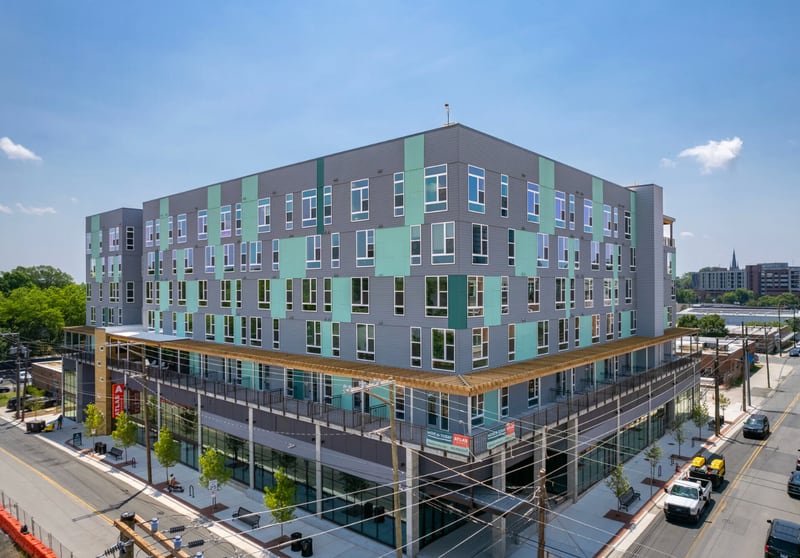
4 Star Mid-Rise Apartments
Introduction
Underwriting professionals at U.S. lending institutions must keenly understand the difference between market rent and contract rent , especially when evaluating income properties. A property’s rental income may include leases that are either above or below prevailing market rates, which can distort the true risk and value profile. Lenders need to "normalize" these leases – in other words, adjust or account for them – to ensure underwriting reflects sustainable cash flows. In this educational overview, we define market vs. contract rent, discuss why normalization is strategically important in underwriting, outline methods to normalize out-of-market leases, address legal/structural lease considerations, and examine how these adjustments impact Net Operating Income (NOI) , Debt Service Coverage Ratio (DSCR) , and valuation metrics. We also present case-based examples (retail, multifamily, medical office) with numerical illustrations to solidify these concepts. The tone throughout is professional and analytical, focusing on practical techniques that lenders use to minimize risk and accurately assess collateral value.
Defining Market Rent and Contract Rent
Market Rent is generally defined as the rent a property would command in the open market at a given time, for a similar space under current conditions. In other words, it’s the prevailing fair market rental rate that comparable units or properties could achieve right now if newly leased. Market rent is determined by supply and demand in the local area, and is typically supported by rental comparables and market surveys.
Contract Rent (also called in-place rent or actual rent) is the rent actually being paid by tenants under existing lease contracts. This is the income the property currently produces from its tenants. Contract rent can deviate from market rent for various reasons – for example, a long-term lease signed years ago may now be below market due to rent growth, or a tenant might be paying above-market rent due to unique lease negotiations or limited supply when they signed.
It’s important to note that these terms often arise in property valuation and underwriting contexts. Appraisers sometimes distinguish between the leased fee interest (value based on contract rents in place) and the fee simple interest (value as if at market rents). Underwriters similarly must distinguish between what the property earns today versus what it could earn at market. The difference between contract and market rent underpins concepts like “loss to lease” (when contract rent is below market) and “above-market lease gain” (when contract rent exceeds market). In multifamily analysis, for instance, Loss to Lease is defined as the gap between actual rents and market rents – essentially the rental income “lost” relative to market potential. If market rent exceeds in-place rent, there is positive loss-to-lease indicating upside; if in-place rent is above market (perhaps in a declining market), there is effectively a negative loss-to-lease or a lease gain situation.
Why It Matters for Lenders in Underwriting
Why do lenders care about market vs. contract rents? A comprehensive feasibility study addresses these valuation dynamics within a structured analytical framework. The core reason is to gauge the sustainability and risk of the property’s income stream. Loan underwriters are tasked with ensuring that a property’s future cash flow will be sufficient to cover debt service and maintain collateral value. If the current rent roll is filled with above-market leases, the property’s income may be artificially inflated and could drop when those leases expire (increasing default risk). Conversely, if leases are far below market, the property might have hidden upside (or conversely, might indicate restrictions like rent control) – important for understanding long-term value but also noting that current cash flow is lower in the short term.
From a strategic lending perspective , normalizing rents is critical for several reasons:
Avoiding Overstated Cash Flow : Using in-place income at above-market rates can lead to an overstated NOI and property value. Lenders adopting a conservative stance will often limit underwritten rent to market levels. In fact, some lenders or DSCR-based loan programs explicitly use the lower of actual or market rent when calculating debt service coverage. This means if a property is rented for more than the appraiser’s market rent estimate, the excess won’t be fully credited in underwriting. This protects the lender from assuming an income level that might not be achievable if the tenant vacates or renegotiates. For example, a DSCR lender will take a house rented at $2,600/month vs. market $2,500 and underwrite only $2,500 for income. By using the market figure, the DSCR is calculated more conservatively at the sustainable rent level. If a property’s rent is well above comps, it may signal risk: as one source notes, asking rents set above comparable market rates tend to result in higher vacancy and lower cash flow realized (tenants simply won’t lease at that inflated rate, or will leave, causing downtime). Thus, lenders normalize downward to avoid this pitfall.
Recognizing Under-Market Leases and Upside : On the flip side, below-market rents mean the property is not earning what it potentially could. Lenders are cautious here as well – while below-market leases suggest future upside (rents could be raised to market), they also mean current income (and DSCR) is lower. A common requirement is that current cash flow must cover debt adequately; lenders may not give full credit for hypothetical future rent increases until they are closer to realization. That said, understanding below-market leases is strategically important because it indicates value-add potential or the need for reserves. If a major lease is 30% under market but expiring next year, a lender might underwrite an increase upon rollover (perhaps with some vacancy period and costs), or they may require the borrower to have a plan (and perhaps capital for tenant improvements) to achieve those higher rents. It’s a delicate balance: ignoring the upside could undervalue the property, but over-relying on it could be risky if market conditions or tenant decisions don’t pan out. Experienced underwriters will often model both scenarios – “in-place” income vs. “stabilized market” income – to see how reliant a deal is on future rent growth. This informs credit decisions like loan-to-value (LTV) and debt service coverage requirements.
DSCR and Loan Sizing : The Debt Service Coverage Ratio is directly impacted by rental income. When normalizing rents, underwriters ensure the DSCR is calculated on a prudent income figure. For instance, if a property is only fully covering debt service because one tenant pays above-market rent, the lender will recognize that upon that lease’s expiry, coverage could drop. Many lenders require a minimum DSCR (often around 1.20 to 1.30x for commercial loans). If normalizing rents causes NOI to drop, the DSCR falls as well, which could necessitate a lower loan amount to meet minimum coverage. Conversely, if a property has many below-market leases that will roll to higher rates, the underwriter might calculate a stabilized DSCR in addition to the current DSCR to understand future buffer. Notably, in DSCR-focused loans for rental properties, leasing the property at or near market rent is advantageous – if you lease it significantly under market, the lender will likely use that lower contract rent in the DSCR calculation, which can jeopardize loan approval or reduce proceeds. For example, one lender illustrates that a unit leased below market (e.g. $2,000 vs $2,500 market) can drop the DSCR to 1.0× (barely break-even), whereas leasing at market would have maintained a stronger 1.25× coverage. This underscores why getting rents to market (or close) is important before refinancing or obtaining a DSCR-based loan.
Valuation and Loan-to-Value (LTV) : Normalizing rents also impacts appraised value. Appraisers often value income properties on a stabilized NOI (net operating income) that reflects market rental levels and normal occupancy, rather than simply capitalizing the current contract NOI if it’s considered unsustainable. If an appraisal uses market rents for valuation and the lender based their LTV on higher contract rents, there could be a shortfall. Typically, lenders will align with appraisers in using market-based analysis for value. To illustrate, consider a property with in-place NOI of $200,000 that includes above-market rents in a 7% cap rate market. If one naively capitalized that, value would appear $2.86 million. But an appraiser might adjust those rents down to market, yielding a normalized NOI of $175,000; at a 7% cap that is $2.5 million. The $360k gap represents potential overvaluation if the above-market lease wasn’t normalized. Lenders want the lower, more realistic value because it affects the maximum loan (they don’t want to lend against income that may vanish). Another example: in a multifamily context, a mere $30,000 difference in stabilized NOI can swing the property’s value by $600,000 at a 5% cap rate. Therefore, normalizing to the true sustainable NOI is critical to avoid over-leveraging . It can also reveal hidden value: if NOI will rise after re-leasing, the stabilized value might be higher – but a lender might only count that once it’s nearer or achievable, possibly holding back some proceeds until those rent increases occur.
In summary, lenders normalize rents to ensure prudent underwriting . Overestimating market rent or relying on above-market contracts is a known underwriting mistake that can lead to financial “nightmares”. Normalization guards against optimistic projections by recasting the income to market reality . It also allows lenders to assess covenants like DSCR and LTV on a conservative basis, thereby minimizing default risk and unexpected shortfalls in income.
Methods for Normalizing Above- and Below-Market Leases
Once differences between contract and market rent are identified, underwriters employ several methods to normalize and adjust the financial analysis. Key techniques include:
Mark-to-Market of Rents : This approach involves adjusting rents to current market levels either immediately or at a defined analysis point. In appraisal or loan underwriting models, one might replace the in-place rent with market rent (especially for valuation purposes) to see the stabilized income. For example, an office tenant paying $40 per square foot when the market is $30 might be underwritten at $30 going forward, effectively marking the rent to market . Rating agency criteria often do this in a nuanced way. As one example, DBRS Morningstar (a credit rating agency) will generally mark down above-market rents to about 110% of market rent in their cash flow analysis. The slight 10% premium acknowledges some uncertainty in pinpointing exact market rent and the fact the lease isn’t expiring immediately, but it largely removes the excess above market. In practice, lenders might simply cap the underwritten rent at the market level (100%) for conservatism. For below-market leases, a pure mark-to-market would imply marking up the rent to market, but lenders usually don’t give full credit immediately unless that increase is imminent. Instead, they may project an increase at lease expiry (see next point) or, if doing a present value analysis, calculate the NPV of the difference for reference. In acquisitions under GAAP accounting, the concept of above/below-market lease intangibles is exactly this: determining the present value of the rent difference over the lease term. For instance, if a lease is $5/SF below market for 5 more years, an intangible asset (for the landlord it’s unfavorable, so a liability) can be quantified for that gap. While lenders don’t record intangibles on the balance sheet, the exercise of quantifying the rent gap via NPV or direct adjustment is a way to normalize the financials. In sum, marking to market ensures the analysis uses market-based rent assumptions rather than simply whatever was contractually agreed historically.
Reversion to Market at Lease Expiration : A common method in underwriting is to assume that when each lease expires, it will revert to market rent (often abbreviated as “RTM”). Underwriters will model the lease roll with the expectation that above-market rents will drop to market and below-market rents can be increased to market (subject to downtime and costs). Tools like Argus (widely used in commercial real estate underwriting) facilitate this by using Market Leasing profiles for each tenant: you input the current lease terms, and upon expiration the software inserts a new lease at the market rent (and can factor vacancy periods, lease commissions, tenant improvements, etc.). For example, Blue West Capital describes that after collecting lease and rent roll data, they enter it into an Argus model and “determine market rental rates in the asset’s trade area… The market rent is then applied in our Market Leasing Profiles of each tenancy when each lease term expires.” . If a strip mall lease is expiring in two years, they explicitly model the potential vacancy downtime and then apply achievable market rent for that space going forward. This approach is essentially a cash flow projection where year-by-year income reflects a transition from contract to market levels. For an above-market lease, the projection will show a step-down at expiration; for a below-market lease, a step-up increase is modeled. Lenders often examine the stabilized year (post-rollover) to see what the NOI looks like once all leases are at market. They might use that stabilized NOI (with some appropriate vacancy factor) to value the property or to gauge longer-term DSCR. Reversion to market is a prudent way to normalize over the holding period rather than immediately – acknowledging that as leases roll, the property will eventually converge to market income. It’s particularly useful when there are numerous tenants on different expiration schedules, as a gradual normalization can be modeled.
Lease-Up and Vacancy Adjustments : Normalizing rent isn’t just about the rate per square foot; it’s also about occupancy and downtime. When bringing leases to market, one must consider that changing tenants or raising rents can introduce vacancies. Underwriting therefore often includes lease-up adjustments . If a tenant is paying above-market and is unlikely to renew at that high rate, an underwriter might assume the space goes dark for a period (say 6 months of vacancy) while a new tenant is found at the lower market rent. Similarly, if a space is currently vacant or on a month-to-month below-market lease, the underwriter will factor in lease-up time and costs to achieve market rent. These adjustments effectively normalize the occupancy and rent concurrently to an expected stabilized level. For example, a property might be 100% occupied only because one tenant is at a bargain rent. Normalizing might entail assuming occupancy will settle at a market norm (say 95%) once rents are raised to market – capturing that some tenants might leave and space might take time to refill. In the Blue West Capital example, they explicitly consider “potential vacancy cost” when modeling a lease expiration and re-leasing at market. This means they acknowledge a period of no rent (and incurring re-leasing costs) as part of normalizing the income. Lease-up reserves or rent concessions may also be accounted for. In practical underwriting, one might deduct a stabilization reserve or use a higher vacancy allowance if current occupancy is above sustainable market levels. Likewise, if a property is in initial lease-up (like a new multifamily property with many vacant units), the underwritten income will reflect only stabilized occupancy and perhaps a lease-up discount until that occupancy is reached. All these adjustments ensure the pro forma isn’t assuming an unrealistic full rent collection without the frictions of turnover.
Phased Rent Adjustments : In some cases, normalization is done not as an immediate drop or jump to market, but as a phased approach. This is especially relevant for multifamily properties or other short-term leases . For instance, if apartments are on 1-year leases and currently 10% below market, an underwriter might assume it will take one or two leasing cycles to raise all units to market (to avoid excessive tenant turnover). So they might model, say, a 5% annual increase for two years to gradually reach market levels, instead of one immediate 10% hike. This approach recognizes practical limitations: you typically can’t raise all existing tenants’ rents to market overnight without potentially losing many of them. Phased normalization is less applicable to very long commercial leases (those you just treat as fixed until expiration), but it’s a useful technique for shorter lease assets and for portfolio underwriting where leases expire at different times. Ultimately, whether immediate or phased, the goal is to bridge the gap between current contract rents and market rents within the analysis horizon.
Use of Averages or Blends : Another technique sometimes seen is using blended rent rates to account for above/below-market situations. For example, if a lease has several years remaining at $20/SF (contract) vs. $15/SF market, an analyst might use a weighted average effective rent over the lease term in the projection (somewhere between $20 and $15, depending on how soon it expires). This is akin to partially recognizing the above-market rent for a time, then market thereafter. The DBRS method of 110% of market for above-market leases is conceptually a type of blend – it doesn’t fully credit the contract rent, but allows a slight premium since the lease is in place for a while longer. In other cases, underwriters might present two NOIs: “In-place NOI” (with current rents) and “Stabilized NOI” (with market rents), and perhaps even underwrite the loan somewhere between the two if appropriate. The blend could also appear in metrics like an effective gross income adjustment or through amortizing the difference over the lease term (similar to how accountants amortize leases). The key is that the underwriting acknowledges the divergence from market rather than blindly using the contract figures.
Each of these methods serves to normalize the financials to a “true” or maintainable income level . Normalization can be strict (only market rents used) or nuanced (partial credit to above-market rents for a time, gradual increases for below-market). Lenders tend to err on the side of caution: for example, using market or even slightly below market rent assumptions if uncertain, and incorporating worst-case vacancy. It’s worth noting that long-term, credit-rated leases (like a 20-year lease to a AAA tenant) might be an exception where underwriters accept the contract rent even if above market, because the tenant’s strength and commitment make that income secure for the long haul. In such cases, one might not “normalize down” a long-term bondable net lease to Amazon or a government agency, since they will likely pay as agreed for decades. However, generally, whenever leases are not reflective of current market, some adjustment or plan for adjustment will be made.
Legal and Lease Structure Considerations
When normalizing rents, underwriters must also consider the legal and structural parameters of each lease , as these factors constrain if, when, and how rents can change:
Remaining Lease Term : The length of time until lease expiration is crucial. A lease far above or below market with only a few months left can essentially be treated as if it were at market soon (because the opportunity to adjust is near). Conversely, if that lease has 10 years remaining, the contract rate will govern income for a long time. Underwriters cannot assume a change to market until the contract allows – which might be a decade away. Thus, for long remaining terms, lenders might lock in the contract rent in their cash flow projection for those years and only normalize afterward (or not at all if it goes beyond their loan term). The term length also interacts with market uncertainty: market rents could change by the time of expiry. For above-market long leases, some underwriters will still discount them (as per the DBRS approach of capping at 110% of market) because who knows if market rents might soften further before expiry. But others might say “we’ll take the contract for now since it’s locked in by a strong tenant.” In all cases, the timing of reversion to market is tied to lease term remaining.
Renewal Options : Many commercial leases give the tenant options to extend the lease, often at preset rents or at some discount to market. These can prolong a below-market situation or keep an above-market rent in place, depending on how they’re set. For example, a tenant might have an option to renew for 5 years at the same rent (which, if current rent is below market, effectively locks in that below-market rate for an additional term – unfavorable to the landlord). Underwriters will carefully review options: if they are at fixed rates below today’s market , then any normalization must extend through the option period (assuming the tenant is likely to exercise it). A lender cannot assume rent will go to market at the initial expiration if a savvy tenant has the right to stay five more years cheaply. Similarly, if an above-market lease has a renewal option at that same high rent, a landlord might hope the tenant doesn’t exercise (because it’s above market), but if it’s favorable to the tenant they likely won’t renew at above market unless no better alternatives – more commonly, above-market situations see tenants negotiate down or leave. In any case, lease options essentially become part of the contract for underwriting purposes. The underwriter might model the option being exercised if it benefits the tenant. If an option is set to “fair market rent” at the time, that is easier – one can assume it will normalize to market upon renewal (though even then, some options cap how much rent can increase). In summary, options are a legal factor that can delay or accelerate normalization and must be built into the cash flow analysis.
Contracted Escalations : Leases often have built-in escalation clauses – e.g. 3% annual increases or CPI-based adjustments. These affect the gap between contract and market over time. A lease that is below market today but has 5% annual bumps may “catch up” partially to market by expiration. Conversely, an above-market lease with no escalations might become closer to market as inflation raises market rents while it stays flat. Underwriters consider these dynamics. They might project the contract rent moving in line with its escalations and compare it to an assumed growth rate for market rent. If market rent growth is modest, a high fixed escalation could actually turn a below-market lease into an above-market lease in a few years (or vice versa). For normalization, this means one can’t just look at today’s snapshot; you evaluate whether the lease will still be above/below at various future points. Lenders will sometimes perform a sensitivity or scenario : for instance, if a current rent is $20 with 3% bumps and market is $22 with 2% projected growth, by year 5 the contract might exceed the market forecast. In such a case, the underwriter might find that the lease goes from below to above market over its term, and adjust the analysis accordingly (perhaps it’s close enough that they treat it as market-neutral over the whole term, depending on the situation).
Expense Structure and Lease Type : Gross vs. net leases can complicate market rent comparisons. Market rents are often quoted on a particular basis (e.g., NNN rent where tenant pays expenses, or gross rent where landlord pays). If a contract rent is $30/SF gross but market comps of $25/SF are NNN (with $5/SF in expenses), the true comparison might be $30 vs $30 (if $25 + $5 expenses = $30 effective gross). Underwriters must normalize for lease structure to make an apples-to-apples comparison. If an above-market rent includes expenses that the landlord is covering, perhaps it’s not really above market once expenses are netted out. Conversely, a below-market NNN rent might actually be even more below when considering that the tenant also pays all expenses (meaning the landlord’s net is low). Lenders often convert everything to an effective net rent for analysis. They will also ensure operating expenses are modeled appropriately according to lease type (for instance, if a lease is below market but is triple-net, the landlord at least isn’t bearing extra expenses, whereas a below-market gross lease hurts twice: low income and landlord pays expenses). Expense recoveries, percentage rent clauses, and other lease economics are part of the “normalization” in a broader sense – not only adjusting the rent, but also normalizing how expenses and reimbursements are handled to reflect a typical market lease structure. A cautionary note from one source highlights that missing nuances in lease expense reimbursements can skew NOI and create liability for investors, so underwriters thoroughly review each lease clause.
Tenant Credit and Termination Rights : If a tenant paying above-market rent has early termination options or is financially shaky, a lender will be very careful in underwriting that rent. Sometimes retail leases have co-tenancy clauses (if key tenants leave, others can demand rent reductions or even terminate) – an above-market rent might effectively get voided if a co-tenancy trigger happens. Underwriters factor these possibilities by either excluding such income in worst-case scenarios or requiring reserves. For below-market rents, the concern is usually less about termination (the tenant is unlikely to leave a cheap lease) and more about the landlord’s ability to eventually push rent higher (which might depend on tenant health – a weak tenant might vacate, allowing re-lease at market, which is good for upside but introduces vacancy risk in interim). In properties like medical offices, a tenant might have a kick-out clause if their practice doesn’t hit targets, etc., which could end a below-market lease early (allowing re-leasing at market sooner). All these legal nuances dictate the timeline and likelihood of achieving market rent.
Rent Control and Regulations : In multifamily especially, rent control laws can keep rents below market legally, and normalization may be constrained or impossible in the near term. If a building is in a rent-controlled city, the “market rent” might be abstract because you cannot actually charge market to existing tenants beyond small annual increments. Lenders absolutely take this into account. For instance, a New York City rent-stabilized apartment might be 40% under market and can only increase by a few percent per year by law – the underwriter will not assume it reaches market on turnover if laws prevent deregulation, or will assume only a very long-term gradual catch-up. This is a critical legal consideration: failing to account for rent control could grossly misstate an underwriting. On the other hand, if local law allows a reset to market upon vacancy ( vacancy decontrol ), then some upside can be underwritten but it depends on tenant turnover rates, etc. Similarly, in medical or affordable housing sectors, there might be government leases or subsidized rents that are contractually below market with no ability to raise (or sometimes above market in certain government tenancy cases but very secure). In such scenarios, “market” is less relevant than the contract and regulatory framework.
Tenant Improvements (TI) and Concessions : The presence of significant tenant improvement costs or free rent periods in a lease can also indicate whether a rent is truly above or below market. For example, if a tenant is paying above-market rent, it might be because the landlord gave them a large TI allowance upfront (effectively financing their buildout, recovered via higher rent). In such a case, an underwriter might treat a portion of that above-market rent as recovering costs rather than pure profit – meaning when that lease ends, a new tenant likely won’t pay that high without another large TI. So the normalized view would be to maybe reserve for future TI or to be aware that the next lease could be at market (lower) unless similar concessions are given. Likewise, if a lease is below market but the tenant received no TI and is as-is, maybe the landlord can bump it to market on renewal with minimal expense (depending on competition). Some appraisers consider TI and lease commissions “below the line,” but lenders know these costs are part of achieving market rents and will include them in cash flow projections when normalizing (reducing NOI in the turnover year). Mark-to-market techniques thus go hand-in-hand with adequate leasing cost allowances – you don’t assume a rent jumps to market without possibly spending on improvements or free rent as an incentive. One must normalize the net effect on owner cash flow, not just the headline rent.
In essence, lease provisions and legal contexts set the boundaries of normalization . Underwriters meticulously review each lease document during due diligence for things like renewal options, termination clauses, escalations, and pass-throughs. This legal review informs the assumptions in the cash flow model. A fully informed normalization means the underwritten income timeline aligns with what the leases legally permit and what market evidence suggests tenants will do.
Impacts of Normalization on NOI, DSCR, and Valuation
Adjusting rents to market levels will ripple through all the key financial metrics that lenders and investors watch. Let’s break down the impacts on Net Operating Income (NOI) , Debt Service Coverage Ratio (DSCR) , and valuation measures like cap rates and values :
Net Operating Income (NOI) : NOI is essentially income minus operating expenses, and rental income is its biggest component. Normalizing rents directly changes the projected NOI. If we normalize an above-market lease downward, the property’s NOI (on a pro forma basis) decreases relative to using the contract rent. For example, dropping a rent from $100,000/year to $80,000/year to reflect market would cut $20k from NOI immediately. On the other hand, normalizing a below-market rent upward would increase NOI (though often not realized until lease rollover). Lenders often speak in terms of stabilized NOI – the NOI once the property is at a stable market occupancy and rent level. This stabilized NOI is the basis for many underwriting decisions. A higher stabilized NOI (due to bringing rents up) could support a higher valuation in theory, but lenders may not lend on that until it’s achieved or very likely. Meanwhile, they will be very attentive to current NOI vs. normalized NOI . If current actual NOI is much higher than stabilized (due to temporary above-market conditions), the lender might use the lower stabilized NOI to size the loan (for safety). Conversely, if current NOI is lower than stabilized (due to temporary lease-up or below-market leases), the lender might still base DSCR on current cash flow, but they will recognize future NOI growth could improve metrics (they just might not give that benefit upfront in loan proceeds). In any case, normalization ensures NOI is not taken at face value without adjustment . This helps avoid misrepresenting the property's earnings power. It’s worth noting too that changes in NOI disproportionately affect value – a concept we touched on earlier. A small change in NOI, when capitalized, has a large effect on value (e.g., $1 of NOI at a 5% cap is $20 of value). Thus, normalization can significantly alter the perceived value of the asset by altering NOI. A published example highlighted that a $30k swing in stabilized NOI led to a $600k change in value. So, getting NOI right (through proper rent normalization) is paramount for accurate valuations.
Debt Service Coverage Ratio (DSCR) : DSCR = NOI / Debt Service. By modifying NOI, normalization influences DSCR calculations directly. Lenders require a certain DSCR to approve the loan, often around 1.20 to 1.30× for many commercial deals (higher for riskier assets, potentially slightly lower for very stable ones). If above-market rents are normalized down, the NOI used in the DSCR ratio falls , potentially reducing DSCR. This can turn what looked like a safe deal into a marginal one. For instance, if actual NOI gave DSCR of 1.30× but after normalizing rents it’s only 1.15×, the loan might have to be reduced or the borrower must bring more equity. Many lenders explicitly take the more conservative of current vs. market income when computing DSCR. The OfferMarket DSCR loan example demonstrates this: a property with $2,000 actual rent vs. $1,800 market rent will have DSCR calculated on $1,800, not $2,000. If the debt service (PITIA) was $1,440, using the market rent yields a DSCR of 1.25×; had they used the higher actual rent, one might have thought it’s 1.39×, which the lender intentionally avoids because that extra .14 coverage may be illusory. On the flip side, if leases are well below market, current DSCR might look weak, but a lender might get comfortable if they see it will improve post-renewal – though typically they will still underwrite to current or require guarantees/reserves for interim. The worst-case DSCR is often evaluated: if a big tenant at above-market rent leaves and rent drops, what happens to DSCR? Lenders may perform a stress test DSCR in that scenario to ensure it stays above 1.0× or some threshold. If not, they might structure the loan with a cash reserve or a lower LTV to mitigate that risk. Essentially, normalization aligns the DSCR with true risk – preventing the ratio from being propped up by unsustainable rent levels. It’s also important in loans that will be securitized (CMBS loans), where rating agencies will recalc the DSCR using their own normalized income. A borrower might claim a 1.50× DSCR using current rents, but the rating agency could recalculate it to 1.20× using market rents and higher vacancy, etc. Thus, for consistency, sophisticated lenders do that upfront themselves.
Valuation and Cap Rates : A property’s valuation in income approaches (like direct capitalization or DCF) is sensitive to normalized rent assumptions. Two primary metrics affected are the capitalized value (NOI divided by cap rate) and the investment yield metrics (like internal rate of return, IRR, which would incorporate cash flow growth from below-market leases or declines from above-market). When above-market rents are normalized, the immediate capitalized value tends to drop , because we use a lower NOI. For example, capitalizing an above-market rent at an 8% cap might give a certain value, but if we cap the market rent (which is lower), value goes down. In retail or office acquisitions, buyers often capitalize the stabilized NOI (with market rents) and may price the deal closer to that than to in-place NOI if they expect reversion. If a property is priced and appraised based on in-place income and that income is above market, a lender will lend less than the face LTV might suggest, effectively using a lower valuation internally. On the other hand, below-market leases can create a valuation uplift potential – this is often reflected in a discounted cash flow (DCF) analysis: the NOI grows as leases roll to market, which can increase the IRR or yield to an investor. However, a single-period cap rate valuation might understate value if you only use current NOI that’s depressed by below-market rents. Appraisers sometimes do both a leased fee value (based on actual income for the term of existing leases) and a fee simple value (as if at market today). Lenders focus on the leased fee value for near-term loan safety, but they also acknowledge if fee simple (market) value is higher, meaning there’s equity potential (though unrealized). In underwriting, one might see valuation metrics like debt yield or DSCR at stabilization to complement the current metrics. Debt yield , for instance, is NOI/Loan amount – a lender might compute this on normalized NOI to ensure it’s healthy (e.g., wanting a 10%+ yield on stabilized NOI). If a property has a lot of upside (below-market leases), the lender might still size the loan on in-place numbers but note that the value could grow. They may include covenants that capture some of that (like future funding once rents are marked to market, or simply letting the borrower benefit later). For above-market heavy deals, lenders might tighten LTV (since true value is lower) or require amortization to build equity cushion knowing the NOI will fall later. In summary, normalization ensures that valuation metrics (like cap rate application and DSCR) are grounded in realistic economics . It prevents lending on inflated values and ensures ratios like LTV are calculated on a credible base. A practical note: investors who “overestimate market rent” in their models often overpay and face issues; lenders counteract that by pulling rents back to reality in their underwriting, often saving themselves from funding overvalued deals.
To highlight the interplay of these metrics, consider a simplified scenario: A property has one tenant paying $50,000 above market annually. NOI impact : normalized NOI is $50k lower. DSCR impact : if annual debt service is $200k, and NOI was $250k with the above-market rent, DSCR was 1.25×; after normalization NOI is $200k, DSCR falls to 1.0× – a red flag. Valuation impact : at an 8% cap, that $50k difference in NOI translates to $625,000 difference in value. Clearly, normalization drastically changes the analysis: what looked like a decent 1.25 DSCR, 75% LTV loan (if valued at $3.125M) turns into a precarious 1.0 DSCR, 93% LTV situation (if value is $2.5M). Lenders want to know this picture before lending, not the rosy one. By normalizing, they catch these issues and adjust the loan terms accordingly (either by reducing the loan amount, requiring more equity, or mitigating risk through structure).
Case Examples by Asset Class
To see normalization in action, let’s explore three brief case examples in different asset classes – retail, multifamily, and medical office. Each example illustrates how above- or below-market leases are treated during underwriting, with numerical snapshots.
Retail Example: Normalizing an Above-Market Anchor Lease
Consider a neighborhood retail center whose anchor tenant (say a supermarket) is paying above-market rent . Perhaps during better times, the 20,000 sq. ft. anchor signed a lease at $25 per sq. ft. Now, new comparable leases for similar spaces are only $18 to $20 per sq. ft. due to market softening. The anchor has 3 years remaining on the lease at $25/SF, which is ~25% above today’s market rate of $20. An underwriter approaches this situation as follows:
In-Place Income (Contract Rent) : The anchor’s current contract rent yields $500,000 per year (20,000 SF × $25). This contributes significantly to the center’s NOI. If one looked at the rent roll without context, it appears strong.
Normalized Market Rent : At $20/SF market rate, the same space would generate $400,000 per year. For underwriting, the lender caps the income at $400k for valuation and risk analysis purposes, recognizing that once the lease expires, a renewal or new lease will likely be around this level (or worse if market declines further). They might still count the $500k for the next 3 years in a cash flow model, but they will project a drop to $400k afterward. In a stabilized NOI estimate, they use $400k.
Vacancy & Costs on Rollover : Additionally, the underwriter models a vacancy period at lease expiry. For example, assume 6 months downtime to re-lease the space. That’s 6 months of no rent (a $200k hit, since $400k/year market rent equates to ~$33k/month) plus, say, $50k in tenant improvement and leasing commission costs to sign a new market-rate tenant. These costs are factored into the cash flow in year 4. This means the effective income over the lease transition will be even lower in that year (nearly a 50% drop for that space in the turnover year).
Impact on NOI/Value : Using contract rent, one might have valued the center’s income stream higher. But with normalization, the underwritten stabilized NOI is $100,000 less per year (a $500k original minus $400k market for the anchor). If the overall cap rate for such centers is, say, 8%, that difference equates to $1.25 million in value (0.1 million / 0.08 = 1.25M). The lender will base the LTV on the lower value. For instance, if using the contract rent NOI the property was appraised at $10M, using normalized rent it might be $8.75M. A 70% LTV loan would thus be $6.125M instead of $7M – a very material reduction stemming from that one lease normalization.
DSCR and Loan Structuring : Suppose the loan’s annual debt service is $600,000. With the above-market rent, current NOI might be $650,000, implying a DSCR of ~1.08× – which is already low in this hypothetical (indicating risk even before normalization). After normalization to market, stabilized NOI might be only $550,000, which is below the debt service (DSCR ~0.92×). This clearly wouldn’t meet underwriting standards. The lender might respond by requiring the sponsor to pay down the loan or establish an interest reserve to cover the anticipated shortfall when the anchor’s rent resets. Alternatively, they might underwrite as if the anchor space is vacant (since at market it effectively contributes much less coverage). In extreme cases, if a huge portion of income is above-market and likely to drop, a lender may cap the loan as if that tenant weren’t contributing (or might even decline the loan until the lease situation is resolved). In our example, the lender sizes the loan to ensure that even at $400k from the anchor, the DSCR will be acceptable (perhaps they target a 1.3× DSCR on the $550k stabilized NOI, meaning debt service must be <=$423k, which implies a much smaller loan than the borrower desired).
This retail example demonstrates how aggressively underwriters normalize above-market rents: by reducing the assumed rent to market and accounting for downtime, they protect against rent cliffs. It also shows that sometimes an owner’s current cash flow (enjoying that above-market lease) is not fully “counted” by the lender – in essence, the lender might lend as if the property already were at the lower market rent. The owner might feel this is harsh, but it is a prudent approach to ensure the loan can be repaid even after the lease reverts to market. In negotiations, the lender might highlight industry guidance that tenants with above-market rents are typically marked down in underwriting, because precise market rent is hard to know and conditions can change by lease expiry. The outcome for our anchor: unless the tenant’s corporate credit is extremely strong (and perhaps the tenant is unlikely to ever vacate), the conservative path prevails – normalize now, avoid surprises later .
Multifamily Example: Normalizing Below-Market Rents (“Loss to Lease”)
Imagine a 200-unit apartment complex where the average in-place apartment rent is $1,000 per month, while the current market rent for similar units is $1,100. This is a common scenario in growing markets or in properties that haven’t kept up with market increases – the property has below-market rents . In multifamily terms, this $100 gap is called loss to lease (the property is “losing” $100 per unit per month compared to market potential). Let’s quantify and normalize:
Current Income vs. Market Potential : Out of 200 units, say 150 are occupied (the others might be in turnover or being leased – 75% occupancy for the sake of example). Those 150 occupied units each are $100 under market. Monthly loss to lease = 150 units × $100 = $15,000 per month not realized. On an annual basis, that’s $180,000 per year below potential market rent. If all units were at $1,100, the property would collect that much more in rent annually. So, the stabilized NOI (assuming full market rent on occupied units) could be higher by $180k (ignoring any additional costs). However, the lender will not assume you can magically get $180k more starting tomorrow.
Normalization Approach : Multifamily leases roll over frequently (typically yearly). The underwriter will examine lease expiration schedules and market dynamics. Perhaps they assume that over the next 12-24 months, rents can be brought up to market as leases renew. A possible normalization might be to model an aggressive scenario: e.g., implement rent increases for renewing tenants and push new leases to $1,100 immediately. If, say, half the tenants’ leases roll in a year, you might capture roughly half of that $180k in the first year and the rest in the second. The underwriter could thus project NOI rising over two years until the stabilized NOI is achieved. Importantly, they may also consider occupancy impact – raising rents could cause some tenants to leave, increasing vacancy. If the current occupancy of 75% is low, they might be in lease-up mode, so perhaps they plan to fill units at market rent (thus capturing loss-to-lease on new leases without displacing anyone). If occupancy is high (say 95% with low turnover), pushing rents might risk some vacancy, so the effective captured may be a bit less. For underwriting, a lender might not give full credit to the future $180k immediately , but they’ll note it. They could, for example, take 50% of that upside in the first year’s pro forma, meaning they add $90k to the year-1 NOI estimate, and maybe the full $180k by year 2 or 3.
NOI/Value Implication : At stabilization (all units at $1,100), the property’s annual NOI increases by $180,000 (minus any higher turnover costs). If we use a market cap rate of, say, 5.5% for apartments, that additional income corresponds to about $3.27 million in value (180,000 / 0.055). This is substantial – it shows why investors love finding below-market rents (value-add opportunity). However, lenders will treat that carefully. They might structure the loan with holdbacks or earn-outs: for instance, they’ll fund a portion of the loan now and only release additional proceeds when the NOI improvements are actually realized (to ensure the plan is executed). If the borrower’s business plan is to renovate and increase rents, the lender could escrow some funds and make future draws as rents hit targets. Alternatively, the lender simply underwrites based on current rents (so a lower NOI, maybe valuing property on current $1,000 rents plus maybe a slight upward trend). This often results in a more conservative initial loan amount. The positive side is that as the borrower increases NOI, they could refinance or have more equity later. From a DSCR lens, currently the DSCR might be tight, but the lender takes comfort that it will improve. Some lenders might allow a slightly lower initial DSCR if there’s a clear path to, say, 1.3× DSCR after repositioning and they structure accordingly. But others will just require you meet 1.20 to 1.25× on current income alone, effectively ignoring upside in terms of their underwriting metrics.
Example Numbers : Let’s say at $1,000 rents, the property’s NOI is $1.8 million (just to use round numbers, and assume $180k of that is the loss to lease piece). With the current NOI, a 1.25× DSCR on a 5% interest loan might only support about $1.44M in debt service, which at 5% interest suggests a loan around $28.8M (just rough math, if interest-only for simplicity). If NOI rose to $1.98M after capturing half the loss to lease, DSCR would improve and support more debt. But lenders won’t lend that upfront. They might give a loan based on the $1.8M NOI, perhaps 70% LTV on current value. If current value (cap at 5.5%) is $32.7M (1.8M/0.055), 70% LTV is $22.9M loan. Yet the stabilized value after raising rents could be $36M (because NOI 2.0M/0.055), meaning 70% of that would be $25.2M. The delta $2 to $3M might be left on the table initially. The borrower’s job is to realize the rent increases, then possibly refinance into that higher valuation later. The lender’s job is to ensure the initial loan of $22.9M is secure even if the plan fails (meaning if rents stayed at $1,000, the loan is still fine). By not immediately lending as if NOI is higher, the lender creates a margin of safety .
Gradual Rent Uptick vs. Tenant Retention : A subtle aspect underwriters think about: if you try to jump rents by $100 at once, will the property experience backlash in vacancy? The property manager might opt for, say, $50 increases on renewal (to keep good tenants) and then use turnovers to reset units fully to $1,100. This means it could take a couple of years to get everyone up to market. Underwriters sometimes ask about the lease renewal strategy . For instance, the Home & Condo Rentals blog example we saw actually argued keeping contract rents slightly below market to retain tenants, because chasing every last dollar could lead to vacancy losses that outweigh the gain. This is a reminder that the optimal economic occupancy might involve not always being at absolute top market rent if it increases turnover. Lenders know this too – a very high loss-to-lease (big gap) might indicate either big upside or possibly an operational choice to keep units filled. They’ll ask: “Is this loss-to-lease because the owner hasn’t pushed rents, or because of rent control or because they prioritize occupancy?” Depending on the answer, the underwriting might assume only partial capture of that gap. In our scenario, if the $100 gap is purely due to market growth and the owner was asleep at the wheel, it’s likely recoverable. If it’s because half the tenants are long-term and will only accept moderate increases, maybe not all of it will be realized without some turnover pain.
In conclusion for the multifamily case, normalizing below-market rents means acknowledging the $180k/year upside but integrating it carefully: modeling rent bumps over time, possibly with higher vacancy/turn costs. The underwriter might end up using a blended NOI that is between current and fully stabilized for loan sizing, or simply stick to current NOI for safety. They will definitely incorporate the increased NOI in a longer-term DCF or in qualitative assessment of the deal (“strong upside potential”), but from a credit standpoint, they often want to see a deal that isn’t dependent on that upside to meet minimum debt service. The case also shows how loss to lease , when eliminated, can significantly boost value – however, as one lesson noted, the property value’s sensitivity to those changes means an underwriter must get these assumptions right. A misjudgment (like overestimating ability to raise rents) could mean the projected NOI (and thus value) doesn’t materialize, which would leave the lender over-exposed. Thus, they err conservatively: maybe assume only a $80 gap instead of full $100, or a slower absorption of it.
Medical Office Example: Evaluating a Specialty Above-Market Lease
Now consider a medical office building (MOB) scenario. Suppose a specialty healthcare tenant – for instance, a radiology clinic with expensive imaging equipment – signed a 15-year lease in a building, and because the landlord built out a costly imaging center for them, the agreed rent was above prevailing market for normal medical office space. They pay $40 per sq. ft. while a typical medical office in that area goes for $30. There are 5 years left on this lease at $40, with no early termination. This creates an above-market situation, but it’s backed by a strong tenant and a build-out. How does an underwriter handle this?
In-Place vs. Market Rent : The tenant occupies 10,000 sq. ft. At $40/SF they contribute $400,000/year in rent. Market rent for that kind of space, if it were not a specialized build-out, would be $30, yielding $300,000/year. Right now, the property’s NOI benefits from an extra $100k annually thanks to this lease. The underwriter notes this 33% premium relative to market.
Tenant & Lease Considerations : Because this is a medical user with heavy build-out, some considerations come into play. Firstly, the tenant has sunk costs (or the landlord did on their behalf) in installing equipment and renovations, making them more likely to renew or stay long-term (since moving would be costly). That could be positive for continuity, but at the same time, when renewal comes, they may negotiate the rent down closer to market since their initial TI costs (perhaps amortized in that $40 rate) have been paid off. If the lease had an option to renew at, say, $42 (fixed increase) or fair market value, we need to check that. Let’s assume they have an option for 5 more years at $42 (above current market as well). If that’s the case, the lease could remain above market for 10 more years in total – favorable for now, but what about re-leasing risk after 10 years? The underwriter will weigh the credit quality of the clinic or if it’s part of a hospital system (which might imply reliability of payments). They will also consider the relocation risk : is there any chance the tenant leaves in 5 years? If not, maybe counting on that above-market rent for 5 (or 10 with option) years is okay, but prudent analysis would still consider end-of-lease.
Normalization and Value : One way the underwriter might normalize is to capitalize the income at market rent level and treat the above-market portion separately. For example, value the space at $300k/year at the market cap rate (say 7% for MOBs in that area), which gives about $4.29M value attributable to a market rent stream. The extra $100k/year for 5 years, they might treat as a finite benefit – perhaps valuing it as an annuity: $100k for 5 years at a discount rate of 8-10%. That might be worth roughly $400k present value (if 5 years, no growth, discounted). So they might say the property’s value = $4.29M (stabilized) + $0.4M (excess for 5 years) = $4.69M for that space. This is essentially how purchase price allocation would treat an above-market lease: an intangible asset worth $0.4M that amortizes over 5 years. The lender in underwriting might not explicitly do this math, but conceptually, they avoid capitalizing the above-market rent in perpetuity . If a less sophisticated analysis simply did $400k/0.07 = $5.71M for that space, it would overstate value by ignoring the finite term of that premium. The lender ensures they’re closer to $4.7M in their internal valuation for that portion, recognizing the contract rent advantage is temporary.
DSCR and Loan Treatment : If this lease constitutes a major portion of the income, the lender will also stress DSCR for when it reverts to market. Suppose the building’s total NOI now is $1.2M including this lease. Without the extra $100k, stabilized NOI might be $1.1M. If debt service is $900k, current DSCR is 1.33×, but normalized it’s 1.22×. Both are above 1.2, but the drop is noticeable. The lender might be okay with that level, but if the drop made DSCR go below requirement, they could do what we described earlier: structure some amortization or shorter loan term to ensure by year 5 the loan balance is lower (so debt service is lower or refinance is easier). They might also create a reserve : sometimes for big single-tenant expirations, lenders require a cash reserve to be built up from cash flow to cover re-leasing costs or potential downtime. In this case, since the tenant is expected to stay through the term, they may not require a reserve now, but around year 3 they might start asking for a plan (especially if the option is at above-market $42 – the tenant might want to renegotiate instead of exercise).
Qualitative Factors : Medical office leases often have specifics – e.g., some are NNN, some are gross with expense stops. Let’s assume this one is NNN (typical for MOBs: tenant might pay pro-rata share of operating expenses). If the market comparables at $30 were also NNN, then we’re apples-to-apples on rent. If not, we’d adjust accordingly. Another factor: given the special build-out, if the current tenant left, could another medical tenant easily take that space at $30? Or would it require retrofitting? Possibly, if the imaging center is highly specialized, a generic office user might not value it and we’d have to spend significant TI to convert the space. Underwriters will consider a re-tenanting cost and maybe a prolonged downtime if that tenant ever leaves (for instance, might assume 12 months to find another healthcare group that can use the imaging infrastructure, or else you rip it out). These factors effectively reduce the effective value of that above-market lease to the lender. They might internally say: “Yes, we’re getting $40 now, but realistically, if we had to re-lease, we’d get $30 after maybe 12 months and $500k of landlord work.” That risk might lead them to increase the cap rate or apply a higher discount rate for that segment of cash flow. In some cases, lenders might limit credit for such unique income streams – either by using the market rent in DSCR calculations (like the DSCR loans using lower of actual/market) or by requiring a guarantor if the tenant is a small practice.
Outcome : In underwriting, the lender likely treats the $100k above-market portion conservatively. They may still count it in near-term cash flow (which helps pay debt), but when sizing the loan and judging long-term metrics, they lean towards the $300k market rent scenario. If the borrower is refinancing, they might be disappointed that the lender isn’t giving full value credit for that hefty rent – but the lender will point out, in five years, either that rent is coming down or you’ll incur costs to maintain it. By making an allowance for that now (either in lower LTV or simply in their risk rating of the loan), the lender protects themselves. This example also showcases how lease structure and tenant specifics in medical office matter: a hospital-backed clinic on a long lease might be viewed differently (perhaps a bit more like a bond, with less chance of default). If, say, this $40 was being paid by a large hospital system as part of their outpatient network, a lender might be slightly more lenient because the tenant is very creditworthy – they might think the tenant could even absorb above-market costs for strategic reasons indefinitely. Even then, at ultimate lease expiration, unless they renew, the re-leasing goes to market.
To sum up, the medical office case underscores the nuanced thinking needed: The lease is above-market, but it’s tied to a big investment (imaging equipment) and presumably a strong tenant, making it a bit stickier than a typical retail above-market lease. The underwriter in this case uses normalization (valuing at market rent) combined with lease-specific analysis (tenant intentions, specialty use, renewal likelihood) to arrive at a prudent evaluation. They won’t blindly lend as if $40/SF will continue forever, but they might not discount it 100% immediately either if the tenant is locked in for 5 more years. This balanced approach ensures the lender isn’t caught off guard if in year 6 the rent drops by 25%. They have already accounted for that in their underwriting by perhaps using a conservative terminal cap rate or by ensuring the borrower has skin in the game such that if values recalibrate, the loan is still secure.
Conclusion
For real estate lenders, normalizing contract rents to market levels is a fundamental step in underwriting that ensures a clear-eyed view of a property’s income . Market rent represents the durable, replaceable cash flow the property should generate in an open market, while contract rent may be higher or lower due to legacy deals, incentives, or restrictions. By identifying above- and below-market leases, underwriters can adjust the financial model so that metrics like NOI, DSCR, and LTV reflect realistic conditions. This process involves analytical techniques (mark-to-market rent adjustments, pro forma lease rollover modeling, vacancy and cost allowances) and must account for legal lease terms and market practices. Ultimately, normalization protects lenders from credit risk: it prevents lending on unsustainable income (in the case of above-market rents that could disappear) and properly gauges upside (in the case of below-market rents that may or may not be realized).
In practice, a lender’s underwriting might differ from a seller’s pro forma – often being more conservative by using typical market rents and expenses. This conservative normalization often results in a lower property valuation or loan size than the face numbers suggest, but it is done “to minimize risk and maximize value” in the long run. For underwriting professionals, the takeaways are clear: always verify how contract rents compare to market; apply appropriate normalization methods; consider the specific lease structures and legal rights; and understand the implications on cash flow coverage and value. By doing so, one can produce a thorough, sustainable underwriting that stands resilient against the fluctuations of tenant turnover and market cycles – a result that benefits both lender and borrower by ensuring loans are made on stable ground.
In summary, the dance between market rent and contract rent is a critical aspect of real estate underwriting. Mastering this normalization process enables lenders to see through temporary distortions, focus on the core earning power of the asset, and make informed decisions that align loan terms with the property’s true economic reality. This disciplined approach underpins sound lending practices and contributes to the long-term health of real estate portfolios. For applied illustrations of these principles across specialized sectors, explore our gas station feasibility considerations , the gas station development outlook driven by fuel price dynamics, and emerging hospitality development trends shaping new construction pipelines.
October 14, 2025, by a collective of authors at MMCG Invest, real estate study consultants.
Sources:
Normalization concepts and definitions drawn from industry discussions, underwriting guidelines, and valuation literature have been applied throughout.
These illustrate how adjusting rents to market rates yields more accurate NOI and valuation (e.g., adjusting above-market leases down to ~110% of market, or quantifying loss to lease as the gap between market and actual rents).
Real-world examples show the importance of conservative assumptions – for instance, investors often err by overestimating rents, leading to vacancy and lower cash flow, whereas lenders mitigate this by using supported market comps or the lower of actual/market rent for DSCR calculations.
The case studies provided reflect these principles in practice, demonstrating normalization’s effect on NOI, DSCR, and property value in various asset contexts.
Valuation Fundamentals

Michal Mohelsky, J.D., FMVA, Practicing Affiliate of the Appraisal Institute
Principal, MMCG Invest, LLC
Published October 14, 2025. Last updated March 28, 2026. How this analysis was prepared.
Cite this
Michal Mohelsky, J.D., FMVA (2025). Market Rent vs. Contract Rent: Normalizing Leases in Real Estate Underwriting. MMCG Invest, LLC. https://www.mmcginvest.com/post/market-rent-vs-contract-rent-normalizing-leases-in-real-estate-underwriting
Where this goes next
- Feasibility Study Company for Commercial Real Estate LendingMMCG's feasibility study page for this subject.