
AWS at Scale: Inside the Largest Private Infrastructure Buildout the World Has Ever Seen
Updated: May 19
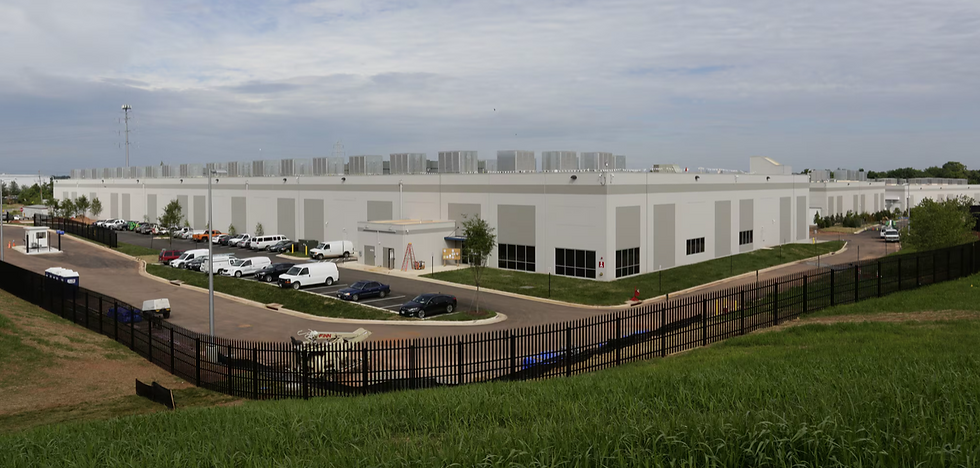
Amazon Web Services operates the largest cloud computing infrastructure on Earth — a sprawling, largely secret network of more than 900 facilities across 50 countries that consumes as much electricity as a mid-sized nation. With $96.5 billion spent on data center capital expenditure in 2025 alone and $200 billion budgeted for 2026, AWS is engaged in what may be the most aggressive private infrastructure buildout in history. The scale is staggering, the costs escalating, and the consequences for American energy systems, farmland, and communities increasingly difficult to ignore.
This expansion is not merely about cloud computing. It is about artificial intelligence. The race to train and deploy frontier AI models has transformed AWS from a profitable utility into a capital-hungry industrial giant, one whose power demands now rival those of entire states and whose construction footprint stretches from the cornfields of Indiana to the nuclear plants of Pennsylvania.

A Footprint Larger Than Anyone Knew
For years, industry trackers estimated AWS operated somewhere between 350 and 450 data center facilities globally. That picture shattered in November 2025, when a Bloomberg and SourceMaterial investigation of leaked internal documents revealed the true number: more than 900 facilities, including 440-plus colocation sites and 220-plus rented "edge" locations. The disclosure roughly doubled previous estimates and confirmed AWS's scale dwarfs that of any competitor.
AWS now spans 39 geographic regions and 120-plus availability zones, with each region containing a minimum of three physically separate data centers for redundancy. The company maintains 700-plus CloudFront points of presence and 43 local zones. Nearly 20 million kilometers of fiber optic cabling stitch this network together. In the United States alone, ABI Research counts 105 hyperscale data center sites supporting 2.3 gigawatts of active IT capacity — a figure that roughly doubles when accounting for cooling, power distribution, and overhead at a global power usage effectiveness (PUE) of 1.15.
The competitive gap remains significant. Microsoft Azure operates roughly 400 data centers across 70-plus regions but holds only 1.2 GW of active U.S. IT capacity — about half of AWS. Google Cloud, despite its industry-leading PUE of 1.09, runs just 508 MW of U.S. IT capacity across 42 regions, roughly one-quarter of AWS's American footprint. In market share terms, AWS commands approximately 29–31% of global cloud infrastructure spending, ahead of Azure at 20% and Google Cloud at 13%, according to Synergy Research Group data from late 2025.
The financial trajectory tells the story most vividly. Amazon's total capital expenditure hit $134.7 billion in 2025, up 61% year-over-year. AWS-specific spending accounted for $96.5 billion of that — an 81% increase that pushed AWS's capital intensity to an unprecedented 75% of its own revenue. On the February 2026 earnings call, CEO Andy Jassy guided to $200 billion in total CapEx for 2026, the vast majority destined for AWS. Combined with Microsoft ($118 billion), Google ($91.5 billion), and Meta ($72.2 billion), the four major hyperscalers spent $416 billion on infrastructure in 2025 — a figure projected to approach $645 billion in 2026.

Northern Virginia: The Epicenter of the Global Internet
The largest concentration of data center infrastructure on Earth sits not in Silicon Valley but in the suburbs of Washington, D.C. AWS's US-East-1 region — anchored in Loudoun County, Virginia, and sprawling across Prince William, Fairfax, and Fauquier counties — represents 163 facilities drawing approximately 2,754 MW of power. Since 2006, Amazon has invested $91.5 billion in this single cluster, making it the costliest private infrastructure project in American history outside of oil and gas.
The region houses six availability zones — more than any other AWS region globally — across an estimated 17.9 million square feet of data center space. COPT Defense Properties, one of AWS's primary landlords, delivers a new facility roughly every three months. Dominion Energy provides grid power supplemented by massive renewable energy purchases, though the underlying generation mix remains heavily dependent on natural gas and nuclear. AWS paid $542.9 million in Virginia property taxes in 2024 alone.
AWS's second-largest operational cluster occupies the high desert of eastern Oregon, where the Columbia River's hydroelectric dams provide some of the cheapest and cleanest electricity in North America. The US-West-2 region encompasses 46 data centers across Boardman, Umatilla, Hermiston, and Arlington, with an estimated 1,000 to 1,500 MW of operational capacity. Amazon has invested $39.2 billion since 2011. The Bonneville Power Administration supplies hydroelectric power, and AWS claims 95% renewable energy sourcing for the region. Yet the environmental record is complicated: a Rolling Stone investigation in November 2025 linked AWS's groundwater withdrawals to worsening nitrate contamination and a cluster of rare cancers in nearby communities.
The third major operational cluster surrounds Columbus, Ohio, where 53 data centers in New Albany, Dublin, and Hilliard form the US-East-2 region. Amazon has invested $19.7 billion since 2015, with plans to reach $23.8 billion by 2030, making it the second-largest private-sector investment in Ohio history after Intel's semiconductor fabrication complex. Ohio's three availability zones serve Midwest enterprise workloads and provide geographic redundancy for East Coast deployments. The region is expanding aggressively, with filings indicating 29 planned data centers across central Ohio.

Project Rainier and the New Megacampuses
The most ambitious AWS construction projects now underway reflect a paradigm shift: these are not general-purpose cloud facilities but purpose-built AI supercomputing campuses designed around custom silicon and unprecedented power densities.
Indiana's Project Rainier stands as the single largest. Announced in April 2024 with an $11 billion price tag, the campus occupies 1,200 acres of former farmland near New Carlisle in St. Joseph County, approximately 15 miles west of South Bend. The site is designed for 2.2 gigawatts of power capacity across 30 buildings — each exceeding 200,000 square feet. Construction began in September 2024. Seven buildings were operational within seven months, and a second $15 billion expansion across northern Indiana, adding 2.4 GW of additional capacity through NIPSCO utility territory, brings the state's total AWS commitment to approximately $26 billion and 4.6 GW. This would make Indiana's AWS footprint alone larger than the entire current U.S. capacity of Google Cloud.
Project Rainier exists for one purpose: training Anthropic's frontier AI models. The campus currently hosts roughly 500,000 Trainium2 chips — Amazon's custom AI accelerators designed by subsidiary Annapurna Labs — with plans to double that figure. AWS has described it as "the world's largest cluster of non-Nvidia AI chips." Amazon's $8 billion investment in Anthropic, combined with the dedicated infrastructure, represents a vertically integrated bet that custom silicon can break Nvidia's dominance in AI training compute.
Pennsylvania's dual-campus project, totaling $20 billion, represents the largest private-sector investment in the state's history. The centerpiece is a 1,200-acre campus in Salem Township, Luzerne County, adjacent to Talen Energy's Susquehanna nuclear power station. AWS acquired the existing Cumulus data center from Talen for $650 million in March 2024 and subsequently negotiated a restructured 17-year, $18 billion power purchase agreement for up to 1,920 MW of carbon-free nuclear electricity through 2042. After the Federal Energy Regulatory Commission rejected the original behind-the-meter colocation arrangement in November 2024, Talen and Amazon pivoted to a front-of-the-meter retail structure. A second campus at Falls Township in Bucks County, on the site of a former U.S. Steel mill, will draw power from the PJM grid. Full nuclear power delivery is expected to ramp to 1,920 MW by 2032.
Mississippi's emerging complex, spanning Madison and Warren counties, reflects AWS's push into lower-cost southern states. The Madison County campus, announced in January 2024 at $10 billion — with some reports suggesting the figure has since climbed to $16 billion — covers approximately 1,700 acres across two sites. Five data centers were operational by early 2026, with seven more under construction. Entergy Mississippi provides grid power through a new 300 MW substation, while a separate $1.2 billion, 754 MW natural gas plant is being constructed in Warren County, where AWS has committed an additional $3 billion. The combined Mississippi investment exceeds $13 billion, with over 700 diesel backup generators permitted at the Madison County site alone.
The Regulatory Reckoning Accelerates
AWS's expansion is colliding with an increasingly hostile regulatory and political environment. According to Data Center Watch, $18 billion in U.S. data center projects have been outright blocked and a further $46 billion delayed by community resistance, with 142 activist groups across 24 states organizing opposition.
The flashpoints are multiplying. In Warrenton, Virginia, more than 500 residents — including actor Robert Duvall — packed a town council meeting to oppose a proposed AWS campus, spawning multiple lawsuits. In Louisa County, Virginia, sustained grassroots opposition forced AWS to withdraw a 7.2-million-square-foot proposal in July 2025. In Indiana, Amazon was cited by the state Department of Environmental Management for unauthorized destruction of wetlands at the Project Rainier site, and a separate $13 billion data center proposal in the same county was denied after a 10-hour public hearing where not a single attendee spoke in support.
Tax incentives have become especially contentious. Virginia lost $1.6 billion in forgone data center sales tax revenue in fiscal year 2025, a 118% increase over the prior year. Over the past decade, the state's data center tax exemption has cost $2.7 billion, while the industry added just 1,610 jobs in the most recent year — a cost of approximately $1.2 million per job. Texas faces estimated losses of $9 billion between 2025 and 2030. Georgia expected to lose $2.5 billion in a single year. Good Jobs First, a public subsidy watchdog, has recommended all states cancel data center tax exemptions immediately.
Water consumption is emerging as a parallel concern. AWS has pledged to become water-positive by 2030 and reported reaching 53% of that goal in 2024, with a water usage effectiveness of 0.15 liters per kilowatt-hour. But in Oregon, investigations have documented tens of millions of gallons of annual groundwater extraction from aquifers already facing contamination concerns. Mississippi's Madison County campus required a $215 million state loan for wastewater treatment infrastructure upgrades to supply cooling water.
Power: The Existential Constraint
Electricity supply has become the binding constraint on AWS's growth — and a source of systemic risk for the American power grid. The numbers are sobering. PJM Interconnection, the regional grid operator covering 13 states from Virginia to Illinois, projects 32 GW of peak load growth between 2024 and 2030, with data centers responsible for 94% of the increase. In December 2025, PJM's capacity auction fell 6,625 MW short of reliability targets for the first time in its history — a deficit equivalent to the entire electricity demand of Philadelphia.
The consequences are already reaching consumers. PJM capacity prices surged from $28.92 per megawatt-day to $333.44 — a tenfold increase that translates to an additional $14.7 billion in charges passed through to ratepayers. The Natural Resources Defense Council estimates consumers could pay $163 billion through 2033 under current trajectories. In Virginia, Dominion Energy reported 40 GW of contracted data center power as of December 2024, up 88% in just six months. The state's power demand could double within a decade, with data centers consuming up to 46% of Virginia's electricity by 2030, up from 25% today. Interconnection queues now stretch eight years, meaning facilities planned today may not receive grid power until 2033 or 2034.
AWS's response is a multi-pronged energy acquisition strategy. The company has become the world's largest corporate buyer of renewable energy for five consecutive years, with 700-plus projects across 28 countries generating over 40 GW of capacity. But renewables alone cannot satisfy the baseload demands of AI training clusters. Nuclear energy has become central to the strategy. Beyond the $18 billion Talen Susquehanna PPA, Amazon anchored X-energy's $500 million Series C funding round in October 2024, taking two board seats and targeting 5 GW of new nuclear capacity by 2039. A partnership with Energy Northwest in Washington State plans to deploy 12 small modular reactors totaling 960 MW near the Columbia Generating Station. A memorandum of understanding with Dominion Energy explores at least 300 MW of SMR capacity near Virginia's North Anna nuclear station.
Natural gas is filling the gap in the interim. Large gas turbine orders hit a 20-year high of 14 GW in 2024, rising to 18 GW of U.S.-bound orders in the first half of 2025. Virginia alone has permitted more than 9,000 diesel backup generators for data centers. The Mississippi campus's 700-plus diesel generators could produce combined nitrogen oxide emissions roughly nine times higher than the nearby Nissan manufacturing plant.
What It Costs to Build the AI Age
The economics of data center construction have transformed under AI demand pressure. Standard hyperscale facilities cost approximately $10–12 million per megawatt in 2025 — already up substantially from the $6 million per MW that best-in-class operators achieved in 2017–2019. AI-optimized facilities, with their extreme power densities and liquid cooling requirements, push costs to $20 million or more per megawatt. A 100 MW facility now runs between $900 million and $1.5 billion.
The typical cost structure allocates roughly 60% to technology and hardware — servers, GPUs, custom accelerators, and networking equipment — with the remainder split between power infrastructure and cooling systems (25%) and land and building shell (15%). AI racks now demand 80 to 120 kilowatts per rack, compared to 5–10 kilowatts a decade ago, requiring fundamental redesigns of electrical distribution, cooling, and structural engineering. Facilities not designed for AI density from inception face $10–50 million in mechanical retrofit costs.
Supply chain bottlenecks are compounding cost pressures. Power transformers — the critical link between grid supply and data center electrical systems — face a 30% supply shortfall in 2025, according to Wood Mackenzie, with lead times averaging 128 weeks (roughly 2.5 years). Costs for power transformers have surged 77% since 2019, with distribution unit prices up 95%. Only 20% of large power transformers are manufactured domestically; new tariffs on imported units from Mexico, China, and Thailand are expected to add another 20–30% to costs. A single hyperscale campus can require dozens of these units, each costing up to $250,000 and weighing over 100,000 pounds.
Land costs tell a similar story. Hyperscaler-grade powered parcels rose from $2.89 per square foot in 2022 to $5.38 in 2024, and the average transaction size ballooned to 224 acres — up 144% in two years — as operators pursue multi-building campus strategies. AWS's land banking approach, acquiring sites years ahead of construction, has become standard industry practice. Total U.S. data center construction spending through July 2025 reached $26.9 billion year-to-date, nearly triple the comparable 2024 figure.
Who Fills These Buildings — and Why It Matters
AWS's customer base spans from Netflix's streaming infrastructure to the CIA's most classified intelligence operations, and this breadth is itself a competitive moat. The company serves over 90% of Fortune 100 companies and roughly 7,500 U.S. government agencies. Named enterprise customers include Apple (reportedly spending $360 million-plus annually), Disney, Capital One, Pfizer, McDonald's, and Shell.
The government portfolio carries particular strategic significance. AWS operates the only commercial cloud infrastructure certified across all U.S. classification levels — Unclassified, Sensitive, Secret, and Top Secret. The Top Secret Region, launched around 2014 as an air-gapped environment hosted within CIA facilities, was the first of its kind. The Secret Region followed in 2017, with additional Secret-West and Top Secret-West regions added by 2025. Current government contracts include the NSA's "WildandStormy" program (valued at up to $10 billion), a $1 billion sole-source contract with the National Geospatial-Intelligence Agency, and participation in the $9 billion Joint Warfighting Cloud Capability contract alongside Microsoft, Google, and Oracle. In November 2025, AWS announced $50 billion in investment for government and national security cloud infrastructure, including over 1 GW of AI and supercomputing capacity.
Internationally, sovereign cloud contracts are proliferating. Australia committed AU$2 billion for a Top Secret AWS cloud for defense agencies, part of a broader AU$20 billion infrastructure investment through 2029. The AWS European Sovereign Cloud, backed by EUR 7.8 billion through 2040, launched its first region in Brandenburg, Germany in early 2026, operated exclusively by EU residents under German law and designed for NIS2 Directive and GDPR compliance. Saudi Arabia's $5.3 billion region and India's $35 billion investment through 2030 extend the sovereign infrastructure model to the Middle East and South Asia.
But the customer reshaping AWS's infrastructure most profoundly is Anthropic. Amazon has invested $8 billion for a minority stake in the AI company, designated AWS as Anthropic's "primary training partner and cloud provider," and built the $11 billion Project Rainier campus specifically for Anthropic's Claude model training. Claude is now available to enterprise customers through Amazon Bedrock and, through a partnership with Palantir, has become the only AI model deployed in classified U.S. intelligence missions. Anthropic's revenue reached approximately $7 billion by end of 2025, validating the infrastructure investment — though the company's February 2026 Series G round at a $380 billion valuation also included a $15 billion partnership with Nvidia and Microsoft for Azure capacity, hedging Anthropic's own infrastructure bets.
The Question No One Can Answer Yet
The central tension in AWS's strategy is whether demand will justify the investment. At $200 billion in 2026 CapEx guidance against approximately $142 billion in annualized AWS revenue, the math requires continued rapid revenue acceleration just to maintain current capital intensity ratios. Free cash flow compressed to $7.7 billion in 2025 from $32.9 billion in 2024, leaving little margin for error.
Jassy has maintained that "we don't procure capacity unless we see significant signals of demand," and AWS's Q4 2025 revenue growth of 24% — the fastest in 13 quarters — suggests those signals remain strong. AI-related cloud services grew 140–180% year-over-year in mid-2025, with GPU-as-a-Service revenues up over 200%. Yet warning signs exist. Both AWS and Microsoft paused some data center leasing discussions in early 2025. The emergence of DeepSeek demonstrated that frontier AI models could be trained far more efficiently, potentially reducing raw compute requirements. China's experience — where 500-plus data center projects announced in 2023–2024 now face underutilization — offers a cautionary parallel.
The more fundamental question may be about externalities. AWS's expansion is straining power grids to their breaking points, consuming water in drought-prone regions, converting productive farmland into industrial campuses, and generating pollution from thousands of diesel generators — all while receiving billions in public tax subsidies. The infrastructure being built today will define the physical substrate of artificial intelligence for decades. Whether the returns justify the costs — not just to Amazon's shareholders, but to the communities and ecosystems absorbing the impact — remains the unanswered question at the heart of the largest private construction program the world has ever seen.
March 15, 2026, by a collective of authors at MMCG Invest, LLC, Data center feasibility study consultants, serving USDA feasibility studies.
Sources:
TT News, "Amazon Data Center Count Surges Past 900 Sites" (2025) — https://www.ttnews.com/articles/amazon-900-data-centers
Platformonomics, "Follow the CapEx: 2025 Retrospective" (February 2026) — https://platformonomics.com/2026/02/follow-the-capex-2025-retrospective/
CNBC, "Amazon Opens $11 Billion AI Data Center Project Rainier in Indiana" (October 2025) — https://www.cnbc.com/2025/10/29/amazon-opens-11-billion-ai-data-center-project-rainier-in-indiana.html
Data Center Dynamics, "Amazon to Invest $20bn in Data Centers in Pennsylvania" (2025) — https://www.datacenterdynamics.com/en/news/amazon-to-invest-20bn-in-data-centers-in-pennsylvania/
POWER Magazine, "Talen, Amazon Launch $18B Nuclear PPA" (2025) — https://www.powermag.com/talen-amazon-launch-18b-nuclear-ppa-a-grid-connected-ipp-model-for-the-data-center-era/
Data Center Watch, "$64 Billion of Data Center Projects Have Been Blocked or Delayed" (2025) — https://www.datacenterwatch.org/report
Yahoo Finance, "Amazon's $200 Billion AI Spending Shocker Has Wall Street Asking One Question" (February 2026) — https://finance.yahoo.com/news/amazon-200-billion-ai-spending-153341517.html
Belfer Center, Harvard Kennedy School, "AI, Data Centers, and the U.S. Electric Grid: A Watershed Moment" (2025) — https://www.belfercenter.org/research-analysis/ai-data-centers-us-electric-grid
Cushman & Wakefield, "Data Center Development Cost Guide 2025" — https://cushwake.cld.bz/Data-Center-Development-Cost-Guide-2025
ABI Research, "Top 25 Largest Data Center Companies in the U.S. by Active IT Capacity" (2025) — https://www.abiresearch.com/blog/top-25-largest-data-center-companies-united-states
Synergy Research Group, "Cloud Market Share Trends" (Q3 2025) — https://www.srgresearch.com/articles/cloud-market-share-trends-big-three-together-hold-63-while-oracle-and-the-neoclouds-inch-higher
AWS Global Infrastructure (official) — https://aws.amazon.com/about-aws/global-infrastructure/


Comments